
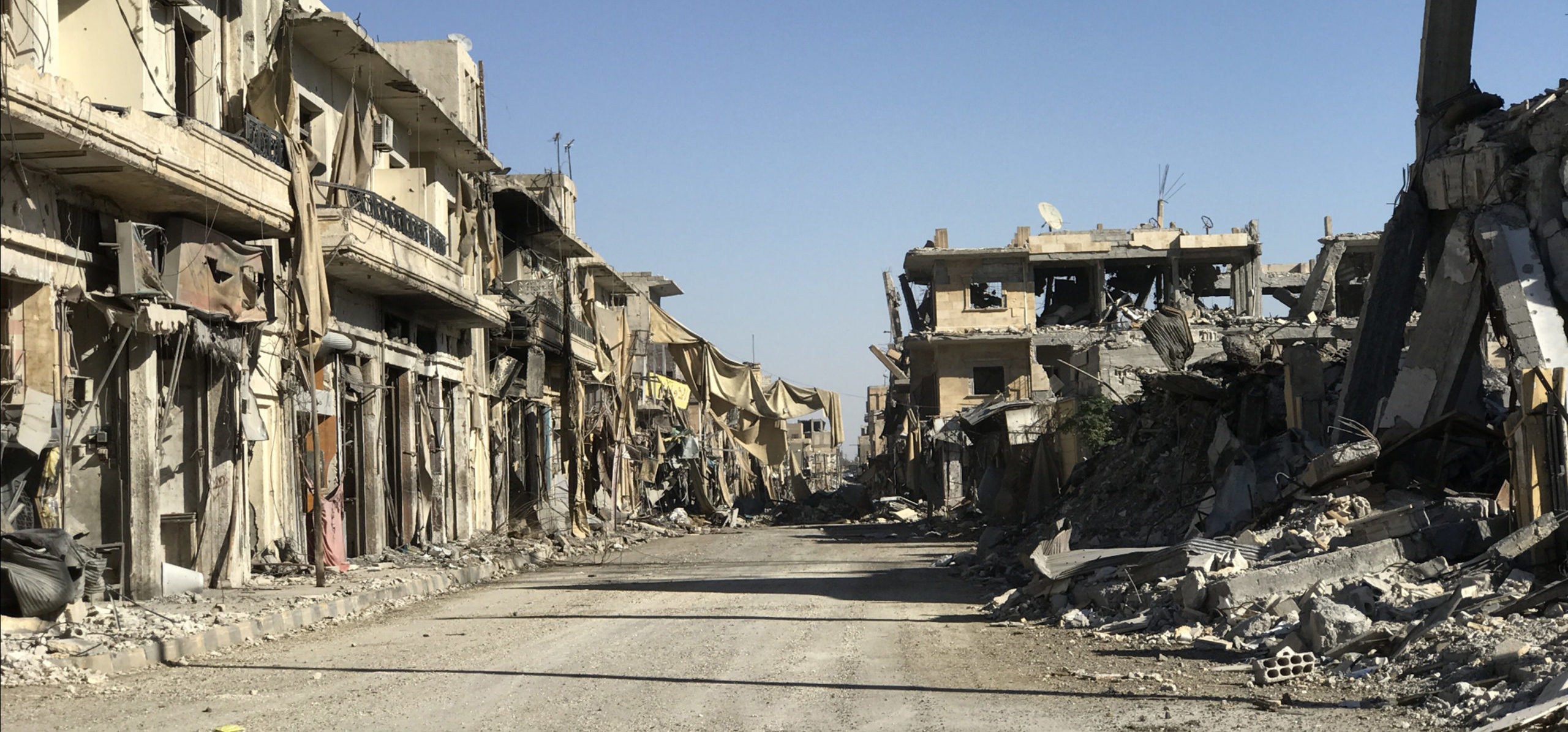
In 2014, ISIS rapidly and brutally seized control of parts of northeast Syria, establishing a well-structured proto-state in the wake of these advances. Among ISIS’ 23 governing authorities, its education ministry, or Diwan al-Taalim,[1] was responsible for overseeing education in ISIS-controlled areas.
Relying on existing research, official databases, the voices of individuals directly affected by ISIS, insights from Syrian and Syrian-Kurdish educational experts, local officials and educators, and ISIS educational materials, including textbooks, the following chapter examines the significant impact that ISIS had on the local education sector in northeast Syria. It explores the impacts on the curriculum as well as teachers and students in areas under ISIS control from January 2014 until the group’s territorial collapse at Baghouz in 2019. The chapter also analyses the enduring consequences for education in the region.
Background
The protracted post-2011 conflict in northeast Syria has had a profound, far-reaching impact on the local education system, particularly because of the period of ISIS rule between early 2014 and 2019.[2] During its rule, ISIS held significant territory in northeast Syria and imposed an extreme interpretation of Islamic law that also manifested itself within ISIS’ education policies.
ISIS used education as a tool for indoctrination to shape a new generation of supporters, commonly referred to as the “Cubs of the Caliphate.” The group established the Diwan al-Taalim, which was run by the group’s hisba units. The department implemented a highly ideological educational policy that drastically changed the educational curriculum, the lives of students, and the role of teachers.[3]
Those who did not conform to the rules were punished, leading in many cases to the abduction and killing of educators, students, and their families. Under ISIS, schools, universities, and educational institutions were destroyed, contributing to the displacement of millions of students and educators. Although ISIS retreated from northeast Syria in 2019 following its territorial defeat at Baghouz in Deir Ezzor,[4] widespread repercussions of its rule are still felt today. According to UNICEF, as of 2022, over two million children between the ages of five and 17 in Syria were still out of school, with a significant number concentrated in the country’s northeast.[5] Furthermore, an additional 1.3 million children were at risk of dropping out of school in 2019 while approximately one in three schools were closed nationwide.[6]
Methodology
To illustrate the story of how ISIS rule affected education in northeast Syria, this chapter relies on a combination of data sources. First, the research team conducted a thorough examination of open-source databases, research papers, reports, and newspaper articles. Copies of textbook materials and public memoranda shared with students and teachers by the Diwan al-Taalim were also examined. While this information is valuable, much of this literature does not consider the perspective of affected individuals and communities.
In the second stage of research, the voices of affected individuals in Syria were collected through KIIs; they comprised a range of community members, including thirteen current and former teachers, three education officials, a civil council member, a former student, the wife of a former teacher, a pensioner, a freelancer, a grocer, and an international expert.[7] It also included a series of eleven focus group sessions comprising a total of 87 participants. This qualitative data was collected by RDI, with one local research partner from RDI conducting and translating all 23 interviews. Interviews and focus group sessions covered four governorates in northeast Syria (and at least eight cities within those governorates): 1) Aleppo (Kobane and Manbij); 2) Hasakeh (al-Qahtaniyah,[8] Qamishli, al-Shaddadah, Tal Brak); 3) Raqqa (Tabqa and other undisclosed locations); and 4) Deir Ezzor (Hajin and other undisclosed locations).[9] Interviews of affected persons were primarily retrospective accounts of their experiences during ISIS rule but also included their more recent experiences. The language used for these conversations was predominantly Arabic, with some conducted in English. Eight of the 23 KIIs were conducted with female participants.
Due to safety restrictions related to accessing certain regions in northeast Syria, interviews were conducted through a combined written and oral approach. In most interviews, the local RDI researcher first shared the interview questions with the interviewees. Then, interviewees responded in writing, before the local researcher conducted a follow-up phone call or WhatsApp chat to consolidate the information, ensure proper interpretation, and delve into specific questions if needed. In addition to safety issues, some affected persons who were contacted for interviews refrained from further involvement in the research for various reasons including fear of being named, while others were unable to connect with the local researcher due to local internet connectivity issues.
Finally, some topics were included in the interview protocol but did not receive a lot of coverage in this chapter. According to local researchers, this was possibly because they were too sensitive for affected people to discuss. One such topic is the destruction of schools and educational institutions. For example, an article from the North Press Agency reported that anti-ISIS battles by the SDF and US-led Coalition in Raqqa led to the destruction of a staggering 80% of the city’s infrastructure, citing UN figures indicating that 11,000 buildings were either destroyed or damaged between February and October 2017.[10] However, since damage was at times caused by the SDF and the US-led Coalition themselves, and not just ISIS, few residents were willing to discuss the topic for fear of being seen to criticise the SDF in post-ISIS northeast Syria.[11]
ISIS’ impacts on northeast Syria’s education sector
Based on analysis of existing literature, interviews and focus group sessions, this chapter is grouped into four main areas: 1) teachers and teaching; 2) curriculum and textbooks; 3) students and learning spaces; and 4) lasting impacts.
Following repeated threats and financial incentives, I found myself with a beard [in order] to become a model teacher under the radical group.[12]
Teachers and teaching
The teaching profession changed drastically under ISIS’ rule in northeast Syria, with many teachers fleeing to neighbouring countries or regions to escape.
The role of teachers
[The role of the teacher] was to deliver what was dictated to them without any personal diligence or information outside the curriculum.[13]
ISIS’ takeover of the education system in northeast Syria drastically changed the role of teachers. Teachers became, or were forced to become, implementers of Salafi-jihadi doctrine as promoted by the new ISIS curriculum.[14]
As one male teacher from Kobane described, “Teachers were employed as an instrument through which ISIS’ ideology was implemented to change the minds of students.”[15] This was reiterated by a formal announcement made bytheDiwan al-Taalim in May 2015:
Indeed, the ummah excels through its teachers when they direct what they have assumed responsibility for with truthfulness and trustworthiness…So the importance of the teacher is to polish minds, refine souls, implant virtues and tear out vices, and to educate [future] generations with an established, correct education for that is among the qualities of the prophets.[16]
In ISIS-controlled territories, teachers were forced to make a choice: either leave their homes or pledge allegiance to ISIS. Over 140,000 educational personnel residing in ISIS-controlled territories in both Iraq and northeast Syria therefore left their posts once ISIS arrived, either to join ISIS as fighters or to flee their regime.[17] Many teachers fled to other areas of control within Syria (including Latakia, Hasakeh and Qamishli[18]) fearing ISIS brutality or repression on the one hand, or military conscription or other forms of maltreatment that may be at the hands of the Syrian government in government-controlled areas.[19] In a focus group session in Kobane, a teacher described how he and other teachers fled to Turkey for several months following a massacre on 25 June 2015.[20] He added that when students returned to school, there was a shortage of teaching staff across northeast Syria as many teachers stayed in Turkey, creating longer-term repercussions for the local education sector.[21]
Teachers who stayed on after the arrival of ISIS in the area were often forced to remain due to financial reasons. With the takeover of parts of northeast Syria by ISIS, teachers’ wages were cut by the Syrian government, leaving most of those who did not make the move immediately with little to no financial resources to migrate. One male former teacher from Tal Brak in Hasakeh described how he “stopped receiving wages in 2015 and then stopped teaching altogether in 2016.”[22] He explained how the teachers who did stay on became little more than conformists:
Since ISIS could not create a new cadre of educational personnel and teachers for its “caliphate,” it had to rely largely on existing personnel and teachers. Teacher innovation and autonomy was no longer allowed. Previously, in universities, students studying to become teachers were told that the teacher was given a kind of freedom to move away from the textbook and teach according to the culture of the [local] area. This was no longer the case under ISIS. There was no space for innovation from the teachers. Teachers were required to follow the textbook exactly as it was written.[23]
Additionally, all teaching was required to be in Classical Arabic, the language of the Quran. All other languages of instruction were forbidden since they were the “language of the enemy.”[24] One exception was English, which was only taught to foreign students living in ISIS-held areas.
A male teacher from Hajin in Deir Ezzor described the changed realities of being a teacher under ISIS:
The main role assigned to the teacher under ISIS was to instil jihad and extremist religious bigotry into the brains of [students] to prepare them for the path of God, whatever the circumstances. Before ISIS, teaching and education was different in the sense that teachers felt safer; they were not exposed to any pressures from anyone.[25]
Another male teacher from Hajin described teachers under ISIS as changing from an esteemed role model in society to instead becoming mamlouk (servants or subordinates) who could not disobey their masters. He added that teachers of Islamic subjects were not accepted as qualified teachers by ISIS since they “graduated at the hands of scholars who did not apply the approach of the [Prophet, Peace Be Upon Him].” [26]
A former student from al-Shaddadah reported that all male teachers were required to wear a long robe and full beard,[27] further moulding educators into this new role and to visually represent their commitment to ISIS’ interpretation of Islam.
Teacher re-education and repentance
Under ISIS, teachers’ professional development only involved religious re-education. In December 2014, the Diwan al-Taalim announced that schools would be required to undergo mass ideological and religious re-education and “repentance” to ensure that all teachers were in compliance with the caliphate (see Box 1).[28] This included instructing teachers to ‘arm students with memorizing Quranic verses and hadith [teachings of the Prophet Mohammed, Peace Be Upon Him] reports to support what they believe’ and stressing the ‘strengthening of creed in their hearts and their responsibility to proselytize to others.’[29] Under ISIS, one focus group participant said, “the teacher was considered an infidel. No one dared to say they were teachers originally.”[30] Therefore, they were forced to repent completely and re-educate themselves on how to serve ISIS as teachers of the Quran.[31]
Repentance was completed by attending a formal session at a mosque where teachers proclaimed their repentance to God by signing an official document. Those who did not attend were ‘considered as insisting on [their] apostasy, and in this regard, the relevant Shari’a judicial proceedings [were] applied.’[32] Teachers who did not comply were fired and shamed through public announcements where their names were listed and disseminated as having rejected Salafi-jihadithought.[33] A former female teacher from Deir Ezzor described the religious repentance courses in her region:
Teachers were invited to have a religious discourse. This lasted for a month. In my area, we spent a whole month undergoing a course in the mosque. On the ground floor were male teachers, and on the first one, there were females. Every day after al-Asr [afternoon prayers] until sunset, we attended the course. Friday and Saturday were off. At the end of the course, there was a test. Even university graduates had to pass it. If one failed, he/she would not be entitled to teach.[34]
Occasionally, repentance was required if ISIS suspected that a teacher had some form of affiliation with the Syrian government. One focus group participant in Raqqa recalled a situation he witnessed when a professor was accused of being a regime collaborator, and that employees were forced to undergo a 20-day repentance that included memorizing “certain verses and religious matters taught by the extremists to the people.”[35]
A male teacher from Hajin described the repentance oath-taking for teachers:
All teaching cadres were gathered inside a mosque for three hours daily over a period of 15 days. They had lectures as if they [the teachers] had been infidels and reneged on Islam. It was an attempt by the group to instil ignorance in teachers and exploit their need to know more about Islam…They were asked to memorise one of the 30 parts of the Quran. Then, ISIS publicly declared that these teachers had repented, and they were no longer misguided. These courses were not intended to raise the level of teachers educationally or culturally, but [were intended to save] the misguided.[36]
Box 1. Call for Repentance of Teachers (Nineveh Province: December 2014)[37] [translation] 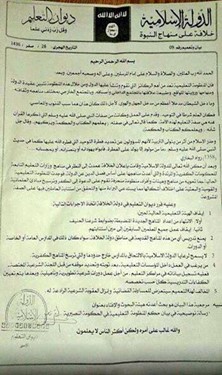 “Indeed, the educational system is considered among the most important centres that states establish and cultivate, and through this system is made clear the ideology/creed of the state, its program, its consideration of the situation, as well as the nature of its relations with internal society and its classes, and external society in its varying directions and cultures. And Satan has not found a greater entrance than the entrance of ignorance and arbitrary whim, and this has been among the most important causes of misdeeds and rebellion. For knowledge has been a condition of tawheed and among the qualities of the Prophet (PBUH) that the Quran mentioned about him was the quality of teaching this Ummah, as the Almighty said in describing him: “Who may teach them the Book and wisdom to purify them” [Quran 2:129]. And the One whose affairs are exalted said: “Who may teach you the Book and Wisdom.” And Islam has warned about the influence of those who take charge of education for themselves because they are the ones responsible for tampering with the inborn-nature of tawheed that God has endowed as related in a hadith of the Prophet [PBUH]: “Every child is born with true faith. It is the parents who make him/her Jewish, Christian or Magian”—Bukhari 1358. After God Almighty enabled the Islamic State and it announced the Caliphate, it has directed attention towards the programs of the ministries of education affiliated with the kafir and apostate governments that have been reckoned to be programs attempting to separate religion from state, so the current educational system has been found to be…a decadent program establishing the call to kufr and establishing the principles of secularism, nationalism and Ba’athism in its various forms—something that calls for disavowal of it and the realization of the call for repentance from those working in it on the legal level. Thus, the Diwan al-Taalim has decided to adopt the following measures: 1. Putting a stop to the current educational committee for now: a) Ceasing the preparation of the new educational programs bound by the restrictions of our Hanif [renunciate] law. b) Stopping the work of all prior teachers until the fulfilment of the call for their repentance. 2. None of the old educational programs are to be taught in the areas of the Caliphate, whether public/private schools or lessons. 3. Citizens of the Islamic State are not allowed to attend schools outside its borders and which establish principles of disbelief. 4. Whoever wishes to work in the educational foundations: after his repentance, and definition of his stance before the special Shari’a Committee, he must record his affirmations in the education centres, to undertake developmental and qualifying Shari’a sessions. After that the educational qualifications of each according to his speciality will be completed. 5. The one who contravenes this statement for distribution will be subject to judicial inquiry, with the coming down of deterrent consequences according to Shari’a for him. Note: The authority of this statement is the result of an investigation prepared by the al-Eftaa [offer Islamic guidance/ruling to Muslims] and Buhuth [research] Committee,[38] under the title: “Clarification Message on the Statement of Judgment on the Education System in the Nusayri government.”[39] And God is Predominant over His affair but most people do not know it.” Note: Although this document was published in Iraq’s Nineveh province, the same conditions applied to ISIS-controlled area of northeast Syria. |
We ask you to attend a qualification session for teachers in aqida [creed] and fiqh [jurisprudence], and the teacher will be granted at the end of it a qualification document to teach in public schools. Whosoever refrains from the session will be barred from undertaking any teaching activity or work in the lands of the Islamic State.[41]
Additionally, those in university studying to become teachers had to undergo a ‘Shari’a session lasting 15 days’ and ‘pass a test with a score over 70%’ before completing a 10-month course with ISIS’ Institute for the Preparing of Teachers.[42] Teacher training sessions involved lectures on subjects from the previous Syrian national education curriculum that were now forbidden, including supposedly “blasphemous” lies in science books accused of questioning Islamic beliefs about the origins of humankind, such as Darwin‘s theory of evolution.[43] Lectures were reportedly delivered firmly, and often with shouting, a way of inciting fear among teachers.[44] Most re-education campaigns were led by armed brigades and those who did not abide by the strict regulations faced threats of public execution. Some were executed.[45]
Box 2. Educational Plans in Raqqa Province (indirect testimony: via local pro-ISIS Raqqa Islamic News Network [RNN])[46] 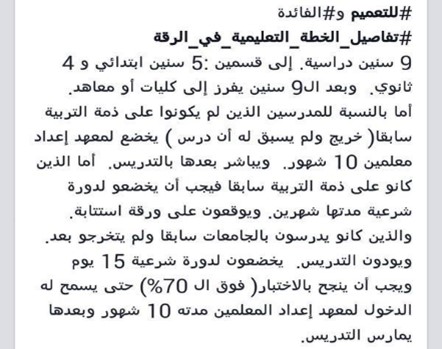 “For general distribution and benefit: Details of the educational plan in Raqqa: Nine years of study: in two divisions. five primary, four secondary. After the nine years, selection for colleges or institutes. As for teachers who have not previously had an education qualification (graduate with no prior teaching experience), there is subjection for 10 months to the Institute for the Preparing of Teachers. And after that there is direct entry to teaching. As for those who have previously had a teaching qualification, they must undergo a Shari’a session lasting two months, and they sign a document calling for repentance. As for those who have been previously studying in the universities but have not yet graduated and would like to teach, they are subjected to a Shari’a session lasting 15 days and they must pass a test with a score over 70% that the person may be allowed to enter the Institute for the Preparing of Teachers for a period of 10 months, after which the person may teach.” |
Inciting fear among teachers
ISIS’ main strategy for controlling what was taught was the ‘infusion of terror by means of extreme violence and fear throughout all educational components.’[47] There are numerous accounts of ISIS officials inciting fear among teachers in northeast Syria, but a common thread throughout was the gruesome nature of punishments given to those who did not abide by ISIS’ strict rules. In one focus group session, the father of a teacher explained:
We suffered academically. My daughter, who was a teacher, left the school; my son, who was an employee, also quit his job out of fear of ISIS.[48]
Grass-roots educator Lamiaa Suleiman received a great deal of attention in the media for establishing the Khotowat Foundation for Social Development to secretly keep teaching under ISIS rule.[49] In an interview with SceneArabia, she described their work:
We started working underground, in homes, in mosques, in cellars […] it didn’t matter where we were, but just that education continued in some way or another, outside their indoctrination camps.
Suleiman’s network started in Deir Ezzor and expanded to include more than 80 educators throughout the region, secretly teaching students reading, mathematics and English while also offering psychosocial support. Aware that the teachers could be abducted or tortured for educating students outside of the ISIS curriculum, Suleiman and her teachers coordinated remotely using encrypted messages without revealing any information about the members of the network to each other.[50] However, ISIS did learn about the Khotowat Foundation and threatened the lives of those involved.[51]
A similar account was reported by a former female teacher in Deir Ezzor who had her own story of defying religious law:
Once, the hisba members entered the classroom. At the time, my face was not fully covered. They protested and wanted to take me forcibly out of the school to their offices. I refused to obey saying if I put on a face veil then the pupils would not hear me well; this impinges upon sound articulation. Then they protested why I had my gloves off, I replied that it is impossible to have chalk and write on the board with a glove. At the end, they made me [swear on the Quran] not to repeat such an action.[52]
In addition to the fear ISIS incited among those in civil society networks like Suleiman’s in Deir Ezzor, there were multiple reports from across northeast Syria of teachers and educators who were publicly executed. These executions were often for actions deemed to be in defiance of ISIS’ rule, such as refusal to teach the new curriculum. Executions sometimes took place in front of students.[53] In another account, a teacher reported that ISIS also forcibly took possession of the homes of teachers who defied ISIS policies.[54]
Teachers who had connections to the Syrian government could be fatally punished. One interviewee from Deir Ezzor described how teachers who were still receiving public sector salaries from the government in the early days of ISIS rule were brutally executed. He stated: “A number of people were killed—including my friend from Hawayej Ziban, who was a teaching assistant at al-Furat University. He was killed and crucified.”[55]
Another teacher from Kobane remembered how one of the teachers from his village was also killed:
In 2015, [a teacher] was killed in Sarrin under the pretext of teaching related to infidels with the Syrian regime. He was from the village of al-Ayouj [Sarrin, Kobane]. He had just returned to Aleppo, where he received his monthly salary. He was taken from his home.[56]
The journey to Aleppo to receive salaries was dangerous for teachers still working under the Syrian government. A mother of boys recounted how her husband, a former teacher in Kobane, went missing and was never found. In May 2016, her husband and 13 other teachers were headed to Aleppo to receive their monthly salaries to avoid forced dismissal—a requirement from the government that served to assert its continued presence in the region. However, ISIS spotted the teachers:
[The teachers and my husband] were arrested on Qara Qozaq Bridge on the Euphrates River. After two months in captivity, [my husband’s nephew] was released. He told us that they were held in the former cultural centre in Manbij, which ISIS had turned into a prison.
One day in the afternoon, we were told that the abducted teachers would be freed. We gathered. We heard they had reached the security checkpoint at the village of Qomji where the Autonomous Administration would ask them a set of questions. But [the teachers who were abducted] never came.[57]
This type of punishment and abduction was not limited to schoolteachers. It also applied to school principals as well as other educators, scholars, and anyone else that ISIS deemed had the potential to influence young minds. A participant from a focus group session in Deir Ezzor described how ISIS raided and stole furniture in schools where principals were seen to have links or direct contact with the Syrian government. In some cases, these principals were forced to join ISIS.[58]
Scholars were also punished for protecting history that was deemed anti-Muslim. In 2015, Khaled al-Asaad, a Syrian scholar, was beheaded in Palmyra for refusing to lead ISIS to valuable, historical artifacts that the group viewed as un-Islamic “idols” that should be destroyed.[59] Two years later, in 2017, a group of 12 Syrians, many of them teachers, were also publicly executed in Palmyra, although the reasons for this execution were not clear.[60]
Physical acts of torture and murder contributed to the building of feelings of constant fear among teachers. The main message from ISIS was to obey or be punished; there would be no middle-ground.[61]
A teacher from Tal Brak in Hasakeh summarised the shared experience of fear and torture among teachers:
Teaching has [historically] been [an honourable] mission. Knowledge has been the key to progress and success. However, such an experiment [under ISIS] served as a turning-point, not for me personally, but for all teachers and students who experienced [life under ISIS]. We were engulfed by fear and horror. [ISIS] sought unsparingly to instil radical ideas and ideology into our brains. Partly, they were successful in moulding minds, sowing sedition, and creating rifts among people through sectarianism and jihad, which they advocated relentlessly to install their so-called state.[62]
Curriculum and textbooks
[ISIS] did not keep any former book or subject.[63]
The curriculum played a pivotal role in ISIS’ strategic agenda, serving as an instrument for indoctrination and the dissemination of the group’s extremist ideology. Prior to ISIS’ presence in the region, the Syrian government’s curriculum was widespread throughout northeast Syria.
A Christian male civil council member shared how, in his area of al-Qahtaniyah:
The Syrian education system was very good. All Syrians [from different backgrounds] agree on this issue. Kurdish, Arab and Syrian students attended these schools and got a wonderful education.[64]
Another male teacher from Hasakeh agreed, stating:
All Syrians, regardless of their [religious or ethnic] backgrounds were in the same classes. No preference was given to one over the other. Words like Kurds or Arab [in the context of school curricula] were not used.[65]
Contrary to these views, Kurdish journalist Sardar Mlla Darwish, in an article on the state of education for Kurds in northeast Syria, noted that for decades prior to ISIS, ‘Syrian Kurds have endured a ban on speaking and studying in their mother tongue as a result of political pressure and repression from the Syrian regime.’[66] The Kurdish Project similarly reported that under the Syrian government, ‘Syrian Kurds were not allowed to use the Kurdish language, were not allowed to register babies with Kurdish names, were not allowed to attend private Kurdish schools, and were banned from publishing books or other written materials in Kurdish,’[67] leaving Kurds with limited access to an education if they were unwilling or unable to learn in Arabic.
However, with the arrival of ISIS, the government’s curriculum in general was abolished.[68] ISIS textbooks and instructional materials were systematically infused with propaganda and ideological messaging, reflecting the group’s radical interpretation of Islam. Notably, the curriculum was heavily militarised, with a primary focus on training young individuals to become active fighters in the group’s ranks.[69]
Through the analysis of collected data, two prominent sub-themes related to the curriculum and textbooks emerged: a) ideology and the militarisation of pedagogy; and b) textbook reforms and curriculum developers. These sub-themes shed light on the fundamental aspects of the curriculum reforms under ISIS rule, which in turn provide valuable insights into the group’s systematic manipulation of education for ideological purposes.
Ideology and the militarisation of pedagogy
In introducing its own highly ideological curriculum, ISIS overhauled the diverse range of subjects that once formed the basis of the Syrian curriculum. Music, physical education, nationalism, law and philosophy were among the subjects banned by ISIS in their efforts to reshape educational curricula within schools and universities.[70] This process of overhauling the curriculum was carried out in stages, as described by a male education official from Deir Ezzor:
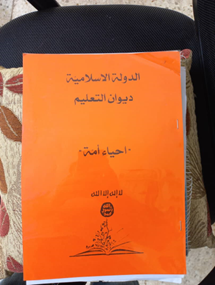
When ISIS ordered schools to be reopened, it initially eliminated core subjects with the exception of mathematics and reading. This transitional phase lasted for approximately four months, during which time the existing curriculum was annulled. Subsequently, a new curriculum was introduced, accompanied by newly printed textbooks that were distributed to schools. The [new] ISIS curriculum included subjects such as reading, [mathematics], Islamic education and Quranic studies, which were taught in the initial stages. Later, subjects such as jurisprudence, creed, Quranic interpretation [tafsir] and traditions were introduced for higher stages.[71]
Furthermore, the curriculum focused on religious studies, including memorisation of the Quran, hadith and other Islamic texts, while also promoting extremist views about violence, jihad and the establishment of an Islamic state. One focus group session participant explained:
[ISIS] tried to manipulate children using all means possible, and they succeeded. If you wanted to work in the field of education, it had to be done secretly out of fear of them. The goal was to brainwash children.[72]
The impact of ISIS’ curriculum extended beyond the restructuring of subjects. Education became a domain for exclusively promoting the group’s interests, revolving around concepts of jihadand paradise.[73]The curriculum was also a recruiting tool that targeted unemployed youth with promises of material possessions, power, and leadership positions.[74] The indoctrination process was pervasive, aiming to mould the minds of individuals and instil a distorted understanding of Islam. ISIS’ curriculum actively propagated violence, advocating for armed conflict and endorsing acts of terror.[75] A male teacher from Tabqa explained this by stating: “They changed the textbooks to be able to insert their ideology into the minds of children. The aim was to recruit the kids as the ‘Cubs of the Caliphate’.”[76]
As such, ISIS placed a particular strategic emphasis on primary schooling as an entry point for disseminating their interpretation of Islam.[77] Educational standards were notably low, with mathematics stripped down and subjects such as physics and chemistry later banned.[78] Figure 1 and Figure 2 demonstrate the kind of Islamic textbooks introduced by ISIS in these early stages.[79] The titles of the books alone show that the focus of education was largely on the significance of the ”caliphate” and Islam.
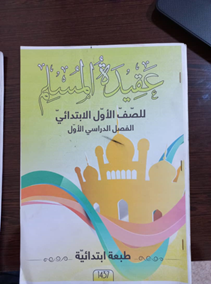
ISIS used the militarisation of pedagogy, which can be defined as incorporating military themes and practices into the education system, to instil its values among youth in northeast Syria.[80] This included the use of military-style uniforms and disciplinary systems.[81] ISIS even offered classes and programmes that were designed to prepare students for combat, with recruiters invited to speak with students and promote careers in their battalions. Violence and aggression were regularly hailed as a means of problem-solving within ISIS pedagogy, as was the marginalisation of alternative views and value systems. Elaborating on this, a former school owner explained how:
They did not allow us to open private schools. I remember when I used to smoke, one of the children told me that he would report me to “the brothers” [ISIS] because I smoked. Another child tried to persuade him with knowledge [not to], but he said he would register a complaint and commit a suicide bombing. An 11-year-old child was imagining himself as a soldier and a fighter.[82]
Echoing this, a male civil council member who was abducted and tortured by ISIS for 12 days stated:
[ISIS] abhorred all different ideas that did not fit their ideology. They persistently targeted education and intentionally sought to destroy the curriculum to control the new generation. They fought education, the Christian religion, even Islam. They hated everything that did not correspond to their cruel and dark ideas.[83]
This push to adopt ISIS’ ideological agenda was a driving force for those who created the ISIS curriculum.
Textbook reforms and curriculum developers
ISIS utilized various forms of propaganda and psychological manipulation within its curriculum to cement its ideology in the minds of its followers. Textbooks, teaching materials and multimedia resources were carefully crafted to evoke strong emotions, create a sense of superiority, and demonize those falling outside their worldview.[84]
The textbooks and learning materials developed by ISIS eradicated elements of traditional culture and history deemed un-Islamic by the group.[85] Through vivid imagery, symbols and language, ISIS sought to shape the perceptions and attitudes of students. Figures 3, 4 and 5 (below) depict the use of weaponry and military objects in the English for Islamic State textbook taught to foreign students.[86] A former kindergarten teacher from Hajin in Deir Ezzor shared an emotional testimony on the drastic textbook changes:
For example, in mathematics, instead of “1+1=2,” we had “one warplane + another warplane = two warplanes.” Their textbooks [went] against human nature.
There were other examples that advocated killing and murder. These textbooks ran contrary to the age-group of the kids. I found myself [in a difficult place]. I [could] either endanger myself or sacrifice my work.
So, I devised a scheme: I told teachers that on the surface we could pretend we were teaching their textbooks, but in reality, we would [avoid] the textbooks. Had we taught their textbooks, we would have produced monsters.[87]
For some non-religious subjects that existed in the pre-ISIS curriculum, teachers reported that they were promised textbooks that never materialised. A female teacher from Deir Ezzor recounted how after she had repeatedly asked about certain subjects: “They replied they were being printed and they would be delivered when they were ready. Actually, there were none.”[88]
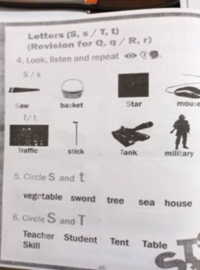
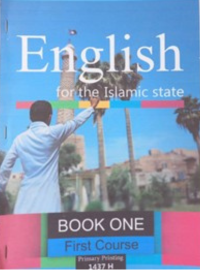
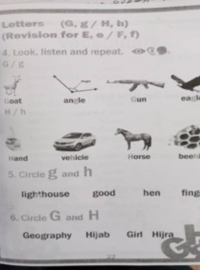
Those who developed ISIS’ curriculum came from a range of countries, further adding to the complexity of ISIS’ overhauled education system.[90] To illustrate this, a male education official said that in Deir Ezzor, “the vast majority of ISIS members [were] from Iraq” alongside “Tunisians, Moroccans, Saudis and other Asian nationalities.” He also estimated that as many as 75% of ISIS members in Hajin were Iraqi, 10% were from Deir Ezzor province itself while the remainder came from Arab countries, Europe or Asia.[91]
Together, these individuals from various parts of the world created an ISIS curriculum that reflected the systematic and calculated nature of the group’s strategy. This was especially reflected in the new textbooks created by committees composed of foreigners. A male former teacher from Deir Ezzor described how: “We believe that there had been figures and leaders from other countries that ordered such changes [to the curriculum] to take place.”[92] Meanwhile, a current teacher, also from Deir Ezzor, specified that the curriculum developers were “mostly from Gulf countries—Saudi Arabia and Kuwait in particular.”[93]
The mechanism and the speed by which these textbooks were developed, printed, and published (often within a year or less) suggested that an efficient and generously funded system was already in place.[94] At the same time, the inclusion of elements of Wahhabismadvocating global jihad and support for the radicalization of foreign Muslims strongly indicated the influence of systems of Wahhabi mudaris (schools) in shaping these educational materials.[95]
Historically, Wahhabi ideology recruited Muslims worldwide through educational channels, financing the constructions of mosques, schools and funding publications.[96] While the origin of Wahhabism is rooted in Saudi Arabia,[97] the extent of its influence in shaping ISIS’ new textbooks is debated and hard to prove.[98] This is in part due to how the export of Wahhabism abroad usually involves complex financial trails, making it difficult to trace its origins.[99]
The curriculum imposed by ISIS promoted intolerance, hatred and violence, and was designed to brainwash and radicalise those moving through the group’s education system. A female teacher from Manbij reflected on the ISIS curriculum and its connection to Islamic ideology, stating that:
The curriculum employed by [ISIS] was a dominating, despotic one, that sought only to serve its ends and inculcate its ideology in the kid’s brains for two main goals: to keep them ignorant and to easily [motivate] them to serve its agenda.
She further suggested that the new curriculum, while upheld by ISIS as being oriented around the Quran, was “in direct contradiction with the basic tenets of Islam”:
This could be juxtaposed with the words of the Muslim scholar and reformer Abdul Rahman al-Kawakbi who says, “The despotic state not only denies people the right to live in divinity; rather, it strives to keep them ignorant. The worst kind of tyranny is that of ignorance. Tyrants seek to emasculate basic knowledge, the [one thing] that [could] contribute to the development or advancement of society.”[100]
Another male teacher agreed with the long-term plan of this agenda stating, that “ISIS targeted young people to instil its ideology into their minds,” reflecting a “systematic policy adopted by the group.”[101] Such extremist teachings had long-lasting effects on society—but especially on students.
Students and learning spaces
Learning while young is like carving in stone” (Rhyming saying in Arabic).[102]
ISIS drastically changed the educational landscape for students in northeast Syria. While ISIS was in power, students were denied their right to quality education and exposed to violence and fear. This section presents the voices of teachers, education officials and other affected individuals who have worked in education in northeast Syria. Three key themes related to students emerged from the desk review, interviews and focus group sessions: 1) school attendance disruptions; 2) gender; and 3) learning spaces.
School attendance disruptions
Under ISIS, the curriculum underwent extensive changes, negatively impacting student learning, but its impact on school attendance was also significant. One teacher interviewed estimated that under ISIS, 90% of students in Deir Ezzor governorate dropped out of school.[103] Various factors contributed to the disruption of school attendance, including the displacement of families, the loss of children’s lives, the physical destruction of schools, and the recruitment of children as fighters.
While ISIS’ rule over northeast Syria reduced school attendance rates in the region, schools under ISIS did not provide the quality, safe learning spaces to which children are entitled through international humanitarian law and conventions such as the UN Convention on the Rights of the Child.[104] As such, schools themselves were danger zones for students, explaining why many parents chose to keep their children at home. The lack of safety at schools represents one of many reasons why students did not attend school during ISIS’ rule, in addition to those considered in the table below:
Range of factors preventing children from attending school under ISIS rule
| Family displacement | ISIS’ invasion forced many to flee their homes, with many seeking shelter in overcrowded camps.[105] Interviewees noted how families with the financial means and education often left to find peace and economic stability elsewhere.[106] Internal displacements resulted in significant disruptions to schooling, with many children unable to attend school due to the lack of facilities or the distance from their new homes. |
| School closures | ISIS was responsible for directly closing schools. For example, in 2015, an estimated 670,000 children in Aleppo, Deir Ezzor and Raqqa provinces were impacted when schools were closed while the ISIS curriculum was under development.[107] |
| Attendance issues | Under ISIS, many parents were afraid to send their children to school and would, as such, keep them home, although at times they were forced to send them.[108] One focus group participant in Raqqa shared that they kept their children “at home to ensure their safety.”[109] A teacher from Deir Ezzor governorate meanwhile described in an interview how there was also fear of sending children to school as “ISIS used to ask about family issues” and that this “incited fear among people as innocent children could reveal what was said about ISIS [at home]” and put their parents at risk of arrest or execution in the process.[110] |
| Death and injury | While ISIS was in power, there were cases of students being killed while at school. In 2014 alone, UNICEF reported that at least 160 children were killed and 343 wounded in attacks on schools in Syria, although this was probably under-estimated due to difficulties documenting and accessing data.[111] The use of schools for military purposes was highlighted during focus group sessions; one participant stated, “I was shot in my hands while going to my job in the bakery by an ISIS sniper positioned above a school.”[112] |
| Damage to school infrastructure | The conflict with ISIS resulted in damage to school infrastructure, with many schools damaged or destroyed in the fighting. [113] When school infrastructure was destroyed, students could not attend school. In some cases, ISIS targeted schools and universities, using them as weapons storage facilities and making them targets for airstrikes. In Kobane, which was never under full ISIS control, schools were closed for at least two years due to a variety of factors, including destruction and damage to school buildings.[114] |
| Child soldiers | Under ISIS, children were also recruited to serve as soldiers and fighters, depriving them of their right to education and exposing them to violence, trauma and, in some instances, death.[115] In 2016 alone, the UN recorded 274 cases of child soldier recruitment attributed to ISIS.[116] One researcher found that ISIS trained hundreds, if not thousands of children, for military engagement between 2014 and 2018.[117] |
| Gender | ISIS prohibited mixing of sexes among students, separating boys from girls starting from Grade 1.[118] Due to a shortage of schools, with many damaged from the conflict, classes were often on a limited schedule and alternative days were assigned for each gender.[119] As students got older, female students left school more often than boys in higher grades.[120] |
Often, these factors intersected with others to disrupt education altogether for students in northeast Syria. For example, one focus group participant from Kobane stated: “Our houses were destroyed, many children were orphaned, and many children dropped out of schools. During the war for Kobane, schools were closed in 2014. Schools were suspended, and our children were out of school for a long time.”[121]
A fear of miseducation, bombings and arrests further prevented students from attending schools and universities and left them confined to their homes.[122] A mother of six from Raqqa shared why she stopped sending her children to school:
[Beforehand,] my six children were excelling in school, and the level of education was good. However, when [ISIS] came, they turned schools into their headquarters, and I immediately stopped [sending] my children. They became an uneducated and completely ignorant generation. I didn’t send them to mosques out of fear that they would be influenced by [ISIS’ ideas].[123]
A participant in Raqqa, meanwhile, shared the story of their brother, who had to leave his university in Deir Ezzor due to the risk of being arrested by ISIS because he was studying in a government-controlled area.[124]
The box below details how life changed for students under ISIS from the perspective of a teacher from Manbij.
| Through the eyes of a teacher: Violations against children under ISIS During an interview, a female teacher in northeast Syria described the situation for students under ISIS in her region, Manbij, which was once considered a hub for scientific knowledge and education before the conflict. As a teacher since 2007, she witnessed the drastic changes that came with the ISIS rule: “In Manbij, hundreds of schools remained closed over a period of two years. Nearly 78,000 students were deprived of their right to education. Schools were renamed after Islamic symbols. Black banners were hoisted over the schools.” Students who attended these revamped institutions often witnessed or experienced lashings, beatings and other distressing acts of violence committed in public squares. Reflecting on her students, she remorsefully noted how “their childhood has been scarred. There are cases where children witnessed the beheading of their own fathers.” While some students could be accompanied by mothers to protect them inside the schools, they were still afraid and risked ISIS retaliating with violence or threats of death. This teacher also explained that of the children that were still in school, ISIS forced nearly half of all 12-year-old students, who were supposed to be in Grade 6, to move back to Grade 1 to re-educate them. Alongside this, school-aged children in Manbij were used and trained for combat missions, in violation of international humanitarian law. Sharing a specific example of hardship, the teacher described how on 27 July 2016, ISIS committed a massacre, killing IDPs Deir Hafir in Aleppo who had been living in one of the schools in Buhayr village in Manbij. Several of those who were killed in this massacre had relatives who were university students in other cities like Damascus, Homs and Latakia. The students were not allowed back home, separating them from their families and thus resulting in additional psychological trauma. [125] |
The loss of safe and quality education and the transformation of schools into ISIS headquarters had a profound impact on the lives of students. One focus group participant from Manbij expressed their frustration:
We were students at a school. The first step was the cessation of education, and everything we planned for was destroyed. We lost our childhood. Schools became their headquarters.
The first frustration was the loss of school. Our games, like football and simple things, turned into games involving firearms and weapon-like objects. We lived in a period of constant horror. Our schools remained closed, and the curriculum taught by ISIS included lessons on jihad. Their schools became mandatory, and they educated school children about mines and slaughter.[126]
While students encountered many challenges in accessing safe and quality education during ISIS rule, some of these were determined by the students’ gender.
Gender
On the surface, ISIS purported to offer the same education to boys and girls. A female former teacher from Deir Ezzor believed that “by teaching girls, ISIS sought to avert criticism [about] why it only focused on boys.”[127] In reality, though, ISIS assigned strict gender roles and restrictions through education, often treating boys and girls distinctly.
Many of the interviewees and focus group participants shared how boys and girls encountered these gender-assigned roles under ISIS. One male teacher from Deir Ezzor stated: “According to ISIS, men should be in the service of religion and present in all battles,[128] while women are supposed to stay at home and not work unless that serves religion.”[129] A female former teacher also from Deir Ezzor described that “girls had strict rules regarding dress, which was all black.”[130]
A man who used to be a student in Tal Brak in Hasakeh shared that girls who wanted an education often had to rely on volunteer teachers who provided instruction at home.[131] This gender inequality was also expressed by a male teacher from Tal Brak:
There was no equality between the two sexes […] as men were given precedence over women, who suffered abuse and injustice during the two years of ISIS rule we endured. This was obvious to everyone.[132]
These gender roles conflicted with the belief systems of many within local communities, with one male former teacher from Sarrin describing it as “terrorism” while highlighting that ISIS ignored the rights and roles of women in contradiction to the actual teachings of Islam.[133] As noted earlier, ISIS did not allow for gender mixing starting from Grade 1 onwards: that is, the first year of primary education around the age of six and seven.[134] According to a male teacher from Tal Brak, the segregation of classes for older children harmed students psychologically and prevented them from learning from one another.[135] Both men and women were not allowed to attend higher education institutions in government-controlled areas.[136]
While in theory ISIS allowed for equal access to its schools,[137] dropout rates among female students increased as students progressed to higher grades and were higher than dropout rates among male students. These higher dropout rates were partly attributed to Sadda Sayyam, ISIS’ top education official, who encouraged female students to marry ISIS foreign fighters.[138] One parent from Raqqa shared their daughter’s story of being a student under ISIS and how their sister had abandoned education for marriage:
My daughter, during the time of ISIS, was in first grade and was not allowed to receive an education. Now she is older and illiterate; she can neither read nor write because ISIS used to teach children to carry weapons and practice [“sexual jihad”]. They would forcibly marry girls they liked, disregarding their families’ wishes. My sister abandoned her education because [a family member] who was an emir in ISIS, forced her to quit her studies and married her off to several foreign men.[139]
As a result, parents would withdraw their daughters from school to prevent early marriages.[140]However, other parents would still encourage their children’s education, including daughters, to receive higher education in parts of the country not under ISIS control.
A participant shared that “ISIS used to harass female education exclusively, and we used to send them with difficulty to [Syrian] regime-controlled areas where universities were located.”[141] Another shared the burden of women and girls requiring a guardian (mahram) to travel. The father stated:
My daughter was studying in 12th grade […] in Homs. She couldn’t go alone to continue her studies because they required a guardian who was a first-degree relative to accompany her. I had to send her mother with her, which increased the costs.[142]
Learning spaces
ISIS’ rule over northeast Syria contributed to the destruction and closure of learning spaces and schools. While data on the exact number of schools destroyed and closed is unavailable, the Assistance Coordination Unit (ACU), a Syrian relief organisation, estimated in November 2016 that 1,378 out of 3,373 (41%) public schools surveyed in Syria ‘were not functioning.’ Similarly, a World Bank report published in July 2017 found that 53% of schools and universities were partially destroyed, while 10% were completely destroyed. Many of these learning spaces (40%) were in ISIS-controlled regions such as Raqqa.
More recent data, shown in the table below, gives a detailed picture of the extent of destruction of educational infrastructure in northeast Syria. In addition, it shows the regional variations of impact across different areas, with 50 out of 386 (13%) schools completely destroyed in Raqqa compared with four out of 346 (1%) in Manbij.
During the course of ISIS rule and the anti-ISIS conflict to oust the group, schools were often used as ‘detention centres, military bases, and sniper posts’ by ISIS, the Syrian government and non-state actors, further adding to the cost to the education sector.[143] Given their placement in conflict zones, attacks on schools also led to the killing and injury of hundreds of teachers and students, putting them at risk at school or en route to and from school each day.
The operational and physical state of schools in northeast Syria as of April 2023
| Area in northeast Syria | Operating | Completely destroyed | Partially destroyed | Repaired |
| Raqqa | 386 | 50 | 61 | 10 (still under repair) |
| Euphrates Region, including Kobane | 571 | 22 | 3 | 28 |
| Deir Ezzor | 739 | 86 | 165 | 0 |
| al-Jazeera Region | 1,773 | 30 | 18 | 6 |
| Manbij | 346 | 4 | 1 | 0 |
| Tabqa | 240 | 12 | 24 | 24 |
Source: Anonymous official in northeast Syria.[144]
Reflecting on these atrocities, a male former teacher from Deir Ezzor said:
During ISIS rule, schools were not safe. Anything could happen at any moment. ISIS turned most schools into training barracks or residences for its members. This made locals refrain from sending their children to school. How could people send their kids to be taught by an enemy? What do you expect ISIS to teach them?[145]
He further added that while there were local initiatives to rebuild schools to reopen them, future educational prospects are still unclear in areas that witnessed elevated levels of damage and destruction.[146]
According to a female teacher from Deir Ezzor, schools under ISIS “never felt safe” because “every day, you could see hisba members enter the classrooms fully armed. This caused fears among the kids. Hisba members were very arrogant, repressive, and imposing.”[147]
Another former teacher from Tal Brak added that while it is well-known that schools were used by different state and non-state actors as military barracks, ISIS went further and converted some schools into “slaughterhouses.”[148]
Curriculum and textbooks
[ISIS] did not keep any former book or subject.[63]
The curriculum played a pivotal role in ISIS’ strategic agenda, serving as an instrument for indoctrination and the dissemination of the group’s extremist ideology. Prior to ISIS’ presence in the region, the Syrian government’s curriculum was widespread throughout northeast Syria.
A Christian male civil council member shared how, in his area of al-Qahtaniyah:
The Syrian education system was very good. All Syrians [from different backgrounds] agree on this issue. Kurdish, Arab and Syrian students attended these schools and got a wonderful education.[64]
Another male teacher from Hasakeh agreed, stating:
All Syrians, regardless of their [religious or ethnic] backgrounds were in the same classes. No preference was given to one over the other. Words like Kurds or Arab [in the context of school curricula] were not used.[65]
Contrary to these views, Kurdish journalist Sardar Mlla Darwish, in an article on the state of education for Kurds in northeast Syria, noted that for decades prior to ISIS, ‘Syrian Kurds have endured a ban on speaking and studying in their mother tongue as a result of political pressure and repression from the Syrian regime.’[66] The Kurdish Project similarly reported that under the Syrian government, ‘Syrian Kurds were not allowed to use the Kurdish language, were not allowed to register babies with Kurdish names, were not allowed to attend private Kurdish schools, and were banned from publishing books or other written materials in Kurdish,’[67] leaving Kurds with limited access to an education if they were unwilling or unable to learn in Arabic.
However, with the arrival of ISIS, the government’s curriculum in general was abolished.[68] ISIS textbooks and instructional materials were systematically infused with propaganda and ideological messaging, reflecting the group’s radical interpretation of Islam. Notably, the curriculum was heavily militarised, with a primary focus on training young individuals to become active fighters in the group’s ranks.[69]
Through the analysis of collected data, two prominent sub-themes related to the curriculum and textbooks emerged: a) ideology and the militarisation of pedagogy; and b) textbook reforms and curriculum developers. These sub-themes shed light on the fundamental aspects of the curriculum reforms under ISIS rule, which in turn provide valuable insights into the group’s systematic manipulation of education for ideological purposes.
Ideology and the militarisation of pedagogy
In introducing its own highly ideological curriculum, ISIS overhauled the diverse range of subjects that once formed the basis of the Syrian curriculum. Music, physical education, nationalism, law and philosophy were among the subjects banned by ISIS in their efforts to reshape educational curricula within schools and universities.[70] This process of overhauling the curriculum was carried out in stages, as described by a male education official from Deir Ezzor:
When ISIS ordered schools to be reopened, it initially eliminated core subjects with the exception of mathematics and reading. This transitional phase lasted for approximately four months, during which time the existing curriculum was annulled. Subsequently, a new curriculum was introduced, accompanied by newly printed textbooks that were distributed to schools. The [new] ISIS curriculum included subjects such as reading, [mathematics], Islamic education and Quranic studies, which were taught in the initial stages. Later, subjects such as jurisprudence, creed, Quranic interpretation [tafsir] and traditions were introduced for higher stages.[71]
Furthermore, the curriculum focused on religious studies, including memorisation of the Quran, hadith and other Islamic texts, while also promoting extremist views about violence, jihad and the establishment of an Islamic state. One focus group session participant explained:
[ISIS] tried to manipulate children using all means possible, and they succeeded. If you wanted to work in the field of education, it had to be done secretly out of fear of them. The goal was to brainwash children.[72]
The impact of ISIS’ curriculum extended beyond the restructuring of subjects. Education became a domain for exclusively promoting the group’s interests, revolving around concepts of jihadand paradise.[73]The curriculum was also a recruiting tool that targeted unemployed youth with promises of material possessions, power, and leadership positions.[74] The indoctrination process was pervasive, aiming to mould the minds of individuals and instil a distorted understanding of Islam. ISIS’ curriculum actively propagated violence, advocating for armed conflict and endorsing acts of terror.[75] A male teacher from Tabqa explained this by stating: “They changed the textbooks to be able to insert their ideology into the minds of children. The aim was to recruit the kids as the ‘Cubs of the Caliphate’.”[76]
As such, ISIS placed a particular strategic emphasis on primary schooling as an entry point for disseminating their interpretation of Islam.[77] Educational standards were notably low, with mathematics stripped down and subjects such as physics and chemistry later banned.[78] Figure 1 and Figure 2 demonstrate the kind of Islamic textbooks introduced by ISIS in these early stages.[79] The titles of the books alone show that the focus of education was largely on the significance of the ”caliphate” and Islam.
ISIS used the militarisation of pedagogy, which can be defined as incorporating military themes and practices into the education system, to instil its values among youth in northeast Syria.[80] This included the use of military-style uniforms and disciplinary systems.[81] ISIS even offered classes and programmes that were designed to prepare students for combat, with recruiters invited to speak with students and promote careers in their battalions. Violence and aggression were regularly hailed as a means of problem-solving within ISIS pedagogy, as was the marginalisation of alternative views and value systems. Elaborating on this, a former school owner explained how:
They did not allow us to open private schools. I remember when I used to smoke, one of the children told me that he would report me to “the brothers” [ISIS] because I smoked. Another child tried to persuade him with knowledge [not to], but he said he would register a complaint and commit a suicide bombing. An 11-year-old child was imagining himself as a soldier and a fighter.[82]
Echoing this, a male civil council member who was abducted and tortured by ISIS for 12 days stated:
[ISIS] abhorred all different ideas that did not fit their ideology. They persistently targeted education and intentionally sought to destroy the curriculum to control the new generation. They fought education, the Christian religion, even Islam. They hated everything that did not correspond to their cruel and dark ideas.[83]
This push to adopt ISIS’ ideological agenda was a driving force for those who created the ISIS curriculum.
Textbook reforms and curriculum developers
ISIS utilized various forms of propaganda and psychological manipulation within its curriculum to cement its ideology in the minds of its followers. Textbooks, teaching materials and multimedia resources were carefully crafted to evoke strong emotions, create a sense of superiority, and demonize those falling outside their worldview.[84]
The textbooks and learning materials developed by ISIS eradicated elements of traditional culture and history deemed un-Islamic by the group.[85] Through vivid imagery, symbols and language, ISIS sought to shape the perceptions and attitudes of students. Figures 3, 4 and 5 (below) depict the use of weaponry and military objects in the English for Islamic State textbook taught to foreign students.[86] A former kindergarten teacher from Hajin in Deir Ezzor shared an emotional testimony on the drastic textbook changes:
For example, in mathematics, instead of “1+1=2,” we had “one warplane + another warplane = two warplanes.” Their textbooks [went] against human nature.
There were other examples that advocated killing and murder. These textbooks ran contrary to the age-group of the kids. I found myself [in a difficult place]. I [could] either endanger myself or sacrifice my work.
So, I devised a scheme: I told teachers that on the surface we could pretend we were teaching their textbooks, but in reality, we would [avoid] the textbooks. Had we taught their textbooks, we would have produced monsters.[87]
For some non-religious subjects that existed in the pre-ISIS curriculum, teachers reported that they were promised textbooks that never materialised. A female teacher from Deir Ezzor recounted how after she had repeatedly asked about certain subjects: “They replied they were being printed and they would be delivered when they were ready. Actually, there were none.”[88]
Those who developed ISIS’ curriculum came from a range of countries, further adding to the complexity of ISIS’ overhauled education system.[90] To illustrate this, a male education official said that in Deir Ezzor, “the vast majority of ISIS members [were] from Iraq” alongside “Tunisians, Moroccans, Saudis and other Asian nationalities.” He also estimated that as many as 75% of ISIS members in Hajin were Iraqi, 10% were from Deir Ezzor province itself while the remainder came from Arab countries, Europe or Asia.[91]
Together, these individuals from various parts of the world created an ISIS curriculum that reflected the systematic and calculated nature of the group’s strategy. This was especially reflected in the new textbooks created by committees composed of foreigners. A male former teacher from Deir Ezzor described how: “We believe that there had been figures and leaders from other countries that ordered such changes [to the curriculum] to take place.”[92] Meanwhile, a current teacher, also from Deir Ezzor, specified that the curriculum developers were “mostly from Gulf countries—Saudi Arabia and Kuwait in particular.”[93]
The mechanism and the speed by which these textbooks were developed, printed, and published (often within a year or less) suggested that an efficient and generously funded system was already in place.[94] At the same time, the inclusion of elements of Wahhabismadvocating global jihad and support for the radicalization of foreign Muslims strongly indicated the influence of systems of Wahhabi mudaris (schools) in shaping these educational materials.[95]
Historically, Wahhabi ideology recruited Muslims worldwide through educational channels, financing the constructions of mosques, schools and funding publications.[96] While the origin of Wahhabism is rooted in Saudi Arabia,[97] the extent of its influence in shaping ISIS’ new textbooks is debated and hard to prove.[98] This is in part due to how the export of Wahhabism abroad usually involves complex financial trails, making it difficult to trace its origins.[99]
The curriculum imposed by ISIS promoted intolerance, hatred and violence, and was designed to brainwash and radicalise those moving through the group’s education system. A female teacher from Manbij reflected on the ISIS curriculum and its connection to Islamic ideology, stating that:
The curriculum employed by [ISIS] was a dominating, despotic one, that sought only to serve its ends and inculcate its ideology in the kid’s brains for two main goals: to keep them ignorant and to easily [motivate] them to serve its agenda.
She further suggested that the new curriculum, while upheld by ISIS as being oriented around the Quran, was “in direct contradiction with the basic tenets of Islam”:
This could be juxtaposed with the words of the Muslim scholar and reformer Abdul Rahman al-Kawakbi who says, “The despotic state not only denies people the right to live in divinity; rather, it strives to keep them ignorant. The worst kind of tyranny is that of ignorance. Tyrants seek to emasculate basic knowledge, the [one thing] that [could] contribute to the development or advancement of society.”[100]
Another male teacher agreed with the long-term plan of this agenda stating, that “ISIS targeted young people to instil its ideology into their minds,” reflecting a “systematic policy adopted by the group.”[101] Such extremist teachings had long-lasting effects on society—but especially on students.
Students and learning spaces
Learning while young is like carving in stone” (Rhyming saying in Arabic).[102]
ISIS drastically changed the educational landscape for students in northeast Syria. While ISIS was in power, students were denied their right to quality education and exposed to violence and fear. This section presents the voices of teachers, education officials and other affected individuals who have worked in education in northeast Syria. Three key themes related to students emerged from the desk review, interviews and focus group sessions: 1) school attendance disruptions; 2) gender; and 3) learning spaces.
School attendance disruptions
Under ISIS, the curriculum underwent extensive changes, negatively impacting student learning, but its impact on school attendance was also significant. One teacher interviewed estimated that under ISIS, 90% of students in Deir Ezzor governorate dropped out of school.[103] Various factors contributed to the disruption of school attendance, including the displacement of families, the loss of children’s lives, the physical destruction of schools, and the recruitment of children as fighters.
While ISIS’ rule over northeast Syria reduced school attendance rates in the region, schools under ISIS did not provide the quality, safe learning spaces to which children are entitled through international humanitarian law and conventions such as the UN Convention on the Rights of the Child.[104] As such, schools themselves were danger zones for students, explaining why many parents chose to keep their children at home. The lack of safety at schools represents one of many reasons why students did not attend school during ISIS’ rule, in addition to those considered in the table below:
Range of factors preventing children from attending school under ISIS rule
| Family displacement | ISIS’ invasion forced many to flee their homes, with many seeking shelter in overcrowded camps.[105] Interviewees noted how families with the financial means and education often left to find peace and economic stability elsewhere.[106] Internal displacements resulted in significant disruptions to schooling, with many children unable to attend school due to the lack of facilities or the distance from their new homes. |
| School closures | ISIS was responsible for directly closing schools. For example, in 2015, an estimated 670,000 children in Aleppo, Deir Ezzor and Raqqa provinces were impacted when schools were closed while the ISIS curriculum was under development.[107] |
| Attendance issues | Under ISIS, many parents were afraid to send their children to school and would, as such, keep them home, although at times they were forced to send them.[108] One focus group participant in Raqqa shared that they kept their children “at home to ensure their safety.”[109] A teacher from Deir Ezzor governorate meanwhile described in an interview how there was also fear of sending children to school as “ISIS used to ask about family issues” and that this “incited fear among people as innocent children could reveal what was said about ISIS [at home]” and put their parents at risk of arrest or execution in the process.[110] |
| Death and injury | While ISIS was in power, there were cases of students being killed while at school. In 2014 alone, UNICEF reported that at least 160 children were killed and 343 wounded in attacks on schools in Syria, although this was probably under-estimated due to difficulties documenting and accessing data.[111] The use of schools for military purposes was highlighted during focus group sessions; one participant stated, “I was shot in my hands while going to my job in the bakery by an ISIS sniper positioned above a school.”[112] |
| Damage to school infrastructure | The conflict with ISIS resulted in damage to school infrastructure, with many schools damaged or destroyed in the fighting. [113] When school infrastructure was destroyed, students could not attend school. In some cases, ISIS targeted schools and universities, using them as weapons storage facilities and making them targets for airstrikes. In Kobane, which was never under full ISIS control, schools were closed for at least two years due to a variety of factors, including destruction and damage to school buildings.[114] |
| Child soldiers | Under ISIS, children were also recruited to serve as soldiers and fighters, depriving them of their right to education and exposing them to violence, trauma and, in some instances, death.[115] In 2016 alone, the UN recorded 274 cases of child soldier recruitment attributed to ISIS.[116] One researcher found that ISIS trained hundreds, if not thousands of children, for military engagement between 2014 and 2018.[117] |
| Gender | ISIS prohibited mixing of sexes among students, separating boys from girls starting from Grade 1.[118] Due to a shortage of schools, with many damaged from the conflict, classes were often on a limited schedule and alternative days were assigned for each gender.[119] As students got older, female students left school more often than boys in higher grades.[120] |
Often, these factors intersected with others to disrupt education altogether for students in northeast Syria. For example, one focus group participant from Kobane stated: “Our houses were destroyed, many children were orphaned, and many children dropped out of schools. During the war for Kobane, schools were closed in 2014. Schools were suspended, and our children were out of school for a long time.”[121]
A fear of miseducation, bombings and arrests further prevented students from attending schools and universities and left them confined to their homes.[122] A mother of six from Raqqa shared why she stopped sending her children to school:
[Beforehand,] my six children were excelling in school, and the level of education was good. However, when [ISIS] came, they turned schools into their headquarters, and I immediately stopped [sending] my children. They became an uneducated and completely ignorant generation. I didn’t send them to mosques out of fear that they would be influenced by [ISIS’ ideas].[123]
A participant in Raqqa, meanwhile, shared the story of their brother, who had to leave his university in Deir Ezzor due to the risk of being arrested by ISIS because he was studying in a government-controlled area.[124]
The box below details how life changed for students under ISIS from the perspective of a teacher from Manbij.
| Through the eyes of a teacher: Violations against children under ISIS During an interview, a female teacher in northeast Syria described the situation for students under ISIS in her region, Manbij, which was once considered a hub for scientific knowledge and education before the conflict. As a teacher since 2007, she witnessed the drastic changes that came with the ISIS rule: “In Manbij, hundreds of schools remained closed over a period of two years. Nearly 78,000 students were deprived of their right to education. Schools were renamed after Islamic symbols. Black banners were hoisted over the schools.” Students who attended these revamped institutions often witnessed or experienced lashings, beatings and other distressing acts of violence committed in public squares. Reflecting on her students, she remorsefully noted how “their childhood has been scarred. There are cases where children witnessed the beheading of their own fathers.” While some students could be accompanied by mothers to protect them inside the schools, they were still afraid and risked ISIS retaliating with violence or threats of death. This teacher also explained that of the children that were still in school, ISIS forced nearly half of all 12-year-old students, who were supposed to be in Grade 6, to move back to Grade 1 to re-educate them. Alongside this, school-aged children in Manbij were used and trained for combat missions, in violation of international humanitarian law. Sharing a specific example of hardship, the teacher described how on 27 July 2016, ISIS committed a massacre, killing IDPs Deir Hafir in Aleppo who had been living in one of the schools in Buhayr village in Manbij. Several of those who were killed in this massacre had relatives who were university students in other cities like Damascus, Homs and Latakia. The students were not allowed back home, separating them from their families and thus resulting in additional psychological trauma. [125] |
The loss of safe and quality education and the transformation of schools into ISIS headquarters had a profound impact on the lives of students. One focus group participant from Manbij expressed their frustration:
We were students at a school. The first step was the cessation of education, and everything we planned for was destroyed. We lost our childhood. Schools became their headquarters.
The first frustration was the loss of school. Our games, like football and simple things, turned into games involving firearms and weapon-like objects. We lived in a period of constant horror. Our schools remained closed, and the curriculum taught by ISIS included lessons on jihad. Their schools became mandatory, and they educated school children about mines and slaughter.[126]
While students encountered many challenges in accessing safe and quality education during ISIS rule, some of these were determined by the students’ gender.
Gender
On the surface, ISIS purported to offer the same education to boys and girls. A female former teacher from Deir Ezzor believed that “by teaching girls, ISIS sought to avert criticism [about] why it only focused on boys.”[127] In reality, though, ISIS assigned strict gender roles and restrictions through education, often treating boys and girls distinctly.
Many of the interviewees and focus group participants shared how boys and girls encountered these gender-assigned roles under ISIS. One male teacher from Deir Ezzor stated: “According to ISIS, men should be in the service of religion and present in all battles,[128] while women are supposed to stay at home and not work unless that serves religion.”[129] A female former teacher also from Deir Ezzor described that “girls had strict rules regarding dress, which was all black.”[130]
A man who used to be a student in Tal Brak in Hasakeh shared that girls who wanted an education often had to rely on volunteer teachers who provided instruction at home.[131] This gender inequality was also expressed by a male teacher from Tal Brak:
There was no equality between the two sexes […] as men were given precedence over women, who suffered abuse and injustice during the two years of ISIS rule we endured. This was obvious to everyone.[132]
These gender roles conflicted with the belief systems of many within local communities, with one male former teacher from Sarrin describing it as “terrorism” while highlighting that ISIS ignored the rights and roles of women in contradiction to the actual teachings of Islam.[133] As noted earlier, ISIS did not allow for gender mixing starting from Grade 1 onwards: that is, the first year of primary education around the age of six and seven.[134] According to a male teacher from Tal Brak, the segregation of classes for older children harmed students psychologically and prevented them from learning from one another.[135] Both men and women were not allowed to attend higher education institutions in government-controlled areas.[136]
While in theory ISIS allowed for equal access to its schools,[137] dropout rates among female students increased as students progressed to higher grades and were higher than dropout rates among male students. These higher dropout rates were partly attributed to Sadda Sayyam, ISIS’ top education official, who encouraged female students to marry ISIS foreign fighters.[138] One parent from Raqqa shared their daughter’s story of being a student under ISIS and how their sister had abandoned education for marriage:
My daughter, during the time of ISIS, was in first grade and was not allowed to receive an education. Now she is older and illiterate; she can neither read nor write because ISIS used to teach children to carry weapons and practice [“sexual jihad”]. They would forcibly marry girls they liked, disregarding their families’ wishes. My sister abandoned her education because [a family member] who was an emir in ISIS, forced her to quit her studies and married her off to several foreign men.[139]
As a result, parents would withdraw their daughters from school to prevent early marriages.[140]However, other parents would still encourage their children’s education, including daughters, to receive higher education in parts of the country not under ISIS control.
A participant shared that “ISIS used to harass female education exclusively, and we used to send them with difficulty to [Syrian] regime-controlled areas where universities were located.”[141] Another shared the burden of women and girls requiring a guardian (mahram) to travel. The father stated:
My daughter was studying in 12th grade […] in Homs. She couldn’t go alone to continue her studies because they required a guardian who was a first-degree relative to accompany her. I had to send her mother with her, which increased the costs.[142]
Learning spaces
ISIS’ rule over northeast Syria contributed to the destruction and closure of learning spaces and schools. While data on the exact number of schools destroyed and closed is unavailable, the Assistance Coordination Unit (ACU), a Syrian relief organisation, estimated in November 2016 that 1,378 out of 3,373 (41%) public schools surveyed in Syria ‘were not functioning.’ Similarly, a World Bank report published in July 2017 found that 53% of schools and universities were partially destroyed, while 10% were completely destroyed. Many of these learning spaces (40%) were in ISIS-controlled regions such as Raqqa.
More recent data, shown in the table below, gives a detailed picture of the extent of destruction of educational infrastructure in northeast Syria. In addition, it shows the regional variations of impact across different areas, with 50 out of 386 (13%) schools completely destroyed in Raqqa compared with four out of 346 (1%) in Manbij.
During the course of ISIS rule and the anti-ISIS conflict to oust the group, schools were often used as ‘detention centres, military bases, and sniper posts’ by ISIS, the Syrian government and non-state actors, further adding to the cost to the education sector.[143] Given their placement in conflict zones, attacks on schools also led to the killing and injury of hundreds of teachers and students, putting them at risk at school or en route to and from school each day.
The operational and physical state of schools in northeast Syria as of April 2023
| Area in northeast Syria | Operating | Completely destroyed | Partially destroyed | Repaired |
| Raqqa | 386 | 50 | 61 | 10 (still under repair) |
| Euphrates Region, including Kobane | 571 | 22 | 3 | 28 |
| Deir Ezzor | 739 | 86 | 165 | 0 |
| al-Jazeera Region | 1,773 | 30 | 18 | 6 |
| Manbij | 346 | 4 | 1 | 0 |
| Tabqa | 240 | 12 | 24 | 24 |
Source: Anonymous official in northeast Syria.[144]
Reflecting on these atrocities, a male former teacher from Deir Ezzor said:
During ISIS rule, schools were not safe. Anything could happen at any moment. ISIS turned most schools into training barracks or residences for its members. This made locals refrain from sending their children to school. How could people send their kids to be taught by an enemy? What do you expect ISIS to teach them?[145]
He further added that while there were local initiatives to rebuild schools to reopen them, future educational prospects are still unclear in areas that witnessed elevated levels of damage and destruction.[146]
According to a female teacher from Deir Ezzor, schools under ISIS “never felt safe” because “every day, you could see hisba members enter the classrooms fully armed. This caused fears among the kids. Hisba members were very arrogant, repressive, and imposing.”[147]
Another former teacher from Tal Brak added that while it is well-known that schools were used by different state and non-state actors as military barracks, ISIS went further and converted some schools into “slaughterhouses.”[148]
A lasting impact: The continuing education crisis in northeast Syria
Much attention [should be given to] shield [students] from the dangers of groups [like ISIS]. Their ideologies should be combatted.[149]
Despite the end of ISIS rule, the education system in Syria remains ‘overstretched, underfunded, fragmented and unable to provide safe, equitable and sustained services.’[150] More than 2.5 million children remain out of school,[151] while the long-term effects of ISIS rule include the deterioration of students’ and teachers’ psychosocial well-being, learning loss and illiteracy, as well as present-day challenges in the education system such as those related to infrastructure.
Deterioration of psychosocial well-being
Students collapsed in the psychological sense. What prevailed was melancholy, a culture of murder, destruction and qasas.[152]
Psychosocial well-being is a ‘significant precursor to learning and is essential for academic achievement; it thus has important bearing on the future prospects of both individuals and societies.’[153] However, despite this crucial importance of psychosocial well-being, it has been repeatedly undermined and ignored in northeast Syria’s education sector. According to an international researcher who conducted research focused on ISIS’ impact on education:
The psychological impact on both students and teachers is not recognised enough, and even international organisations […] just want to go ahead, see education resume [with] people going to school. [They] expect it to function as normal as if nothing happened […] but there is absolutely no plan and [there are] no resources existing to address that matter, so there’s been only a little bit of work done [regarding psychosocial well-being.][154]
Through interviews and focus group meetings, it became evident that children, especially those subjected to forced child labour or early marriage and those who experienced the loss of family members or friends, bore some of the worst trauma from ISIS rule.[155] One interviewee linked this trauma to the alarming rise in drug use among children in the region.[156]
Additionally, the pervasive presence of fear presents an ongoing challenge affecting both children and adults alike. Children are apprehensive about going to school. Even when students do manage to go to school, over-crowded classrooms accommodating as many as 100 children impede effective learning.[157] Participants also spoke about the remaining distrust of people in general, with one focus group attendee in Qamishli stating:
Caution prevailed [during ISIS] and even now, when we see a strange car or truck, we rush towards it and inquire about its purpose and who is in it. Fear was dominant in the entire neighbourhood. Even now, we are still [afraid].[158]
Besides fear, the aftermath of ISIS has notably affected students’ capacity to show respect towards teachers. During the interviews, this was attributed, to some extent, to the fact that under ISIS, teachers were relegated to subordinate positions and stripped of their authority. One teacher expressed concerns about the enduring effects of ISIS on student behaviour:
The region will need many years to overcome the radical group’s impact on the education sector in particular. This is obvious in the behaviour of students towards their teachers. [Teachers] ought to be role models for them, [but] students disrespect their instructors.[159]
Even then, teachers themselves continue to suffer substantial mental and emotional trauma post-ISIS. A male teacher from Deir Ezzor remarked that even today, particularly in rural areas, teachers propagate “strange ideas” and “always speak about murder and weapons,” adding that “ideas that were instilled before are still active, [including those related to] arms, fighting, jihad, what is halal and what is haram.”[160] A female teacher from Deir Ezzor meanwhile emphasised her lasting psychological trauma from witnessing violence first-hand:
Once, as I was in the town of al-Ashara, I was invited forcibly to attend a beheading. My daughter, who was five [years’ old] at the time, was with me. I put my hands over her eyes to prevent her from seeing the beheading.
Another time, I witnessed a man thrown from the roof of al-Hikma Hospital in al-Ashara. Even though I closed my eyes to not see the scene, these recollections still haunt my memories.
On another occasion, I came across a man tied to a pole in a place covered with thorns. It was Ramadan. He had marmalade on his face [to attract flies]. His “offense” was that he was not fasting.[161]
Despite the violence and other hardships that characterised ISIS rule, there are still adherents to the group’s ideology in northeast Syria. A focus group recounted the tragic story of her 15-year-old nephew’s recruitment into ISIS, expressing astonishment that some individuals still sing ISIS songs and listen to them.[162] However, other interviews revealed that some harbour a sense of nostalgia, believing that ISIS provided financial stability and a sense of prosperity that does not compare with people’s modern-day, post-ISIS living conditions.
According to one participant, there are some in the northeast who feel that “at least under ISIS, we had a means of earning income, which is no longer feasible,” adding that “we wish ISIS would return.”[163]
Learning loss and illiteracy
Our children lost their education, and now they can’t even read or write. My 14-year-old son can’t write or read, and the educational future of children has been destroyed.[164]
Beyond the deterioration of psychosocial well-being, interviews and focus group sessions also underscored the detrimental effects of ISIS rule on educational achievement and literacy. A participant in a focus group meeting asserted that the educational attainment rate in Raqqa, for instance, was previously 80%, whereas after the emergence of ISIS, this rate plummeted to a mere 1%.[165] Consequently, a whole generation of young people has been labelled as “illiterate” and “ignorant,” something described by multiple interviewees and focus group participants.[166]
The reasons given to explain this drastic decline varied. One participant in Raqqa candidly explained that “given the dire situation we were in, we didn’t even think about education.”[167] Others described how the prolonged closure of schools severely impacted students’ academic performance across the board. Another participant from Raqqa suggested that ISIS’ forceful closure of schools had led to “an entire generation being deprived of literacy.”[168]
When analysing illiteracy rates, participants in Deir Ezzor suggested that ISIS had deliberately and systematically set out to create an illiterate generation. “Children were indoctrinated to bear arms as ‘Cubs of the Caliphate,’ and there was a deliberate effort to propagate illiteracy throughout society,”[169] a former teacher from Sarrin claimed, stating that “terrorist groups intentionally destroyed schools with the aim of cultivating an illiterate community.”[170]
Ultimately, diminished literacy rates have enduring impacts on Syria’s economy. Children who were deprived of education under ISIS have now become young adults who struggle to secure stable employment. A mother from Hasakeh expressed her anguish about her own children, now part of this “lost generation”:
Before the emergence of ISIS, my children used to attend school regularly and learn. However, due to the bombings and the loss of breadwinners in my family, I couldn’t afford to provide for their educational needs, so they lost their education. Now they work and sometimes spend the entire day outside the house, trying to earn money. They have been deprived of education.[171]
In another interview, a mother of boys—and wife of a former teacher who was abducted during the conflict—recounted her family’s difficulties:
After my husband went missing, my sons left school and our economic situation changed for the worst. [My son] left the university. He was studying in Aleppo. He has assumed charge of the family at an early age. After [him], all my sons left school. I feel remorse over that. My husband was very fond of schooling. He always wanted his sons to finish their education and graduate.[172]
A fractured education system
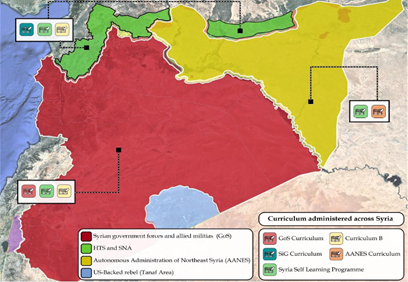
In addition to learning loss, ISIS also contributed to the overall decline of education in northeast Syria. As covered in the section on curriculum, ISIS dissolved the existing national Syrian curriculum in the regions of Syria that it ruled over.
Today, the education system remains largely fractured, in part due to ISIS rule but also as a result of ongoing conflicts in Syria.[173] This is evidenced by the curriculum map in Figure 6, taken from a report by the Middle East Institute (MEI),[174] illustrating the simultaneous use of five different curricula across the country.
Today, schools and communities in northeast Syria rely on a combination of the Syria Self-Learning Program (SLP) and the curriculum introduced by the Autonomous Administration. The SLP is an informal catch-up program that has been ‘widely adopted [by] humanitarian actors in non-formal education centres’[176] to serve approximately 14,250 out-of-school children who cannot physically attend school for several reasons—including violence, displacement, or work (because a child is out working to support their family, for example).[177] It is operated by UNICEF and uses Arabic and English as formal languages of instruction.
The Autonomous Administration’s curriculum, on the other hand, is operated by its education board and targets the different communities within northeast Syria, offering instruction in Arabic, Kurdish, and Syriac. It is not used in the parts of Hasakeh and Qamishli still controlled by the Syrian government (where the government’s curriculum is still taught).[178]
Overall, education across northeast Syria remains sporadic, informal, under-researched and underfunded, making it challenging for education providers to properly serve the needs of under-educated youth populations.[179] In terms of international funding, MEI’s report notes that northeast Syria is ineligible for certain funds, such as pooled funds from the UN Office for the Coordination of Humanitarian Affairs (OCHA), since the region has been excluded from the UN Security Council’s cross-border resolution.[180]
Looking forward: Rebuilding education
Schools are meant to be spaces that protect children from the physical dangers around them in times of emergencies, whether abuse, exploitation or recruitment into armed groups.[181] They should ‘provide children with lifesaving food, water, health care and hygiene supplies’ and ‘offer psychosocial support, giving children stability and structure to help them cope with the trauma they experience every day [during emergencies].’[182]
While addressing broader needs, an international researcher stated that in northeast Syria “nothing will happen [in terms of educational progress] if we don’t address the most basic needs of students.”[183] However, under ISIS, schools became both physically and emotionally dangerous spaces for students, educators and society at large.
Despite the withdrawal and territorial collapse of ISIS in northeast Syria, the state of education in the region remains fragile and subject to contention. According to the Global Coalition to Protect Education from Attack (GCPEA), there were at least 85 reported attacks on schools across Syria during the 2020-21 reporting period.[184] In some cases, de facto authorities in northeast Syria have implemented a local curriculum in schools, resulting in education that is not officially accredited and that impedes students’ ability to obtain recognised diplomas in government-controlled areas or beyond.[185] Meanwhile, teachers who defy the requirements of the local curriculum and instead teach the government-approved curriculum risk possible arrest and detention.[186] An international academic with first-hand research experience in Syria emphasised that the Autonomous Administration’s curriculum has been rejected by local communities for different reasons:
It is perceived by local communities as not meeting their needs and not aligning with their customs and traditions. This creates additional challenges for local communities who refuse to study this curriculum and instead desire an officially accredited curriculum represented by the Syrian government.[187]
The international community has been working to rebuild and rehabilitate schools and universities in northeast Syria: UNICEF, for example, allocated funding for the rehabilitation of educational facilities, and other initiatives are in place for children who have been displaced or are unable to attend school due to safety concerns. These include temporary learning centres and mobile schools.[188] A focus group participant in Kobane discussed the implementation of the Autonomous Administration and the Syrian government’s curricula, noting how:
For the past year or two, the city of Kobane has been able to recover from that shock. Now, there is significant progress in the field of education and development. Some students study in administration schools while others follow the curriculum of the government.[189]
Positive changes are sometimes emerging despite the meagre funding available for school reconstruction. According to the international education researcher:
I remember hearing from Autonomous Administration officials that they also have very little resources to invest into reconstruction and [that this] depends a lot on the international community. In April 2022, I witnessed school buildings that were completely new, [that] had been rebuilt completely from the ground. But at the same time, we were still seeing a lot of school buildings that were completely abandoned, completely destroyed, and had had absolutely no reconstruction work.[190]
Those interviewed also described what could be done to improve northeast Syria’s education prospects now and in the future. A male teacher from Tal Brak shared their perspective on the present and future, stating that “we are doing our utmost to return our students to the right direction […] to make them know right from wrong and to set a goal to attain.”[191]
Another focus group participant in Hasakeh emphasised the importance of continued education:
I insisted that [my son] continue his education. Through knowledge alone, we can rebuild our country. Japan is a great example of that. Perhaps all of you have seen the famous picture of a Japanese teacher and his students practicing their school activities amidst the ruins of houses after World War II. Education should not stop, even if it is done at home.[192]
A former student who had attended school during the years of ISIS rule spoke about the importance of education in reducing violence in the region “by activating self-protection […] in each region and intensifying courses to teach about the danger of weapons” as well as the danger of groups like ISIS.[193]
A reflection of the many challenges facing the northeast Syria’s education sector, a male teacher from Deir Ezzor suggested that to improve the current situation, educators should be:
Encouraging children to return to desks, introducing curricula that meet students’ needs […] training teachers to deal with children with psychological [traumas], repairing schools that were damaged to pave the way for children to return to school, aiding teachers financially to help them devote themselves fully to their mission, and adopting new technical methods to [motivate] students.[194]
Conclusion
ISIS’ five-year rule in northeast Syria had devastating consequences for the education system, transforming schools into danger zones and propagating misinformation, hate speech and fundamentalism throughout the region. Despite concerted efforts to rebuild and restore the education system, numerous challenges persist today. Ongoing conflict and insecurity in northeast Syria continue to disrupt education, leading to millions of children being deprived of schooling across the country.[195] This situation is only made worse by shortages of qualified teachers and education professionals, a fractured education system grappling with a lack of resources (including textbooks and other basic learning materials), overcrowded classrooms, inadequate water and sanitation facilities, and regular electricity outages.[196]
Addressing these many challenges will require a concerted effort from those on the ground as well as the international community,[197] and also a recognition of the central importance that education reform can play in dealing with some of the other challenges emanating from ISIS rule in northeast Syria. To this end, a male teacher from Deir Ezzor shared a call to action to support education in the future:
Ignorance is the ardent enemy of every evil phenomenon. [Preference should be given] to education, which is key to progress. Our societies have endured enough. We hope civil society associations and NGOs pay attention to these areas [in the future].[198]
Restoring stability and promoting psychosocial well-being as priorities in a post-ISIS northeast Syria will require a concerted effort to rebuild the education system and ensure that students have access to quality education. It is crucial to provide support for the reconstruction of damaged school infrastructure as well as the provision of educational resources. Additionally, implementing programs that prioritise the safety and security of students and teachers is essential.
These actions, along with other relevant initiatives that account for the voices of those affected, should contribute to the ongoing revival of the education system in northeast Syria.
[1] The ministry’s full name in Arabic was the “Ministry of Education and Teaching for the Islamic Caliphate State.”
[2] ISIS controlled Raqqa from January 2014. In late June 2014, when the group seized Mosul, there was a distinct escalation of violence.
[3] Tegwen Gadais and others, ‘Education under the Islamic State of Iraq and Syria: A Content Analysis of the Physical Education Curriculum’ (2022) 7 Frontiers in Education <https://www.frontiersin.org/articles/10.3389/feduc.2022.854413/full> accessed 30 May 2023.
[4] BBC, “Islamic State Group Defeated as Final Territory Lost, US-Backed Forces Say” BBC News (London, 23 March 2019) <https://www.bbc.com/news/world-middle-east-47678157> accessed 19 April 2023.
[5] UNICEF, ‘The Situation for Children in Syria’ (UNICEF) <https://www.unicef.org/syria/situation-children-syria> accessed 14 April 2023.
[6] Ibid.; Nabih Bulos, ‘Students in Syria are a textbook case for post-Islamic State re-education’ Los Angeles Times (Los Angeles, 1 April 2019), <https://www.latimes.com/world/la-fg-syria-children-20190401-story.html> accessed 29 May 2023.
[7] Because of the number and range of sources interviewed as KIIs for this chapter, footnotes referencing their interviews include an interview number as well as a description of each individual’s gender, job and place of origin in order to still anonymise their identities but also distinguish those with similar profiles (for example, current and former teachers) from one another.
[8] Al-Qahtaniyah is the official name given to the town by the Syrian government. However, this name is contested and political: the Kurdish population refer to it as Tirbe Spiye, Christians call it Qabre Hiyore, and Arabs refer to it as Qubour al-Bid. All three terms mean “the white grave.”
[9] In some cases, interviews were received that only included the origin governorate (rather than the city, town or village) of the interviewee, and are marked as such in subsequent references.
[10] North Press Agency, ‘Raqqa witnesses self-help five after liberated from ISIS’ (19 October 2022), <https://npasyria.com/en/85931/> accessed 11 May 2023.
[11] KII (#1): male former teacher, Tal Brak (Hasakeh), April 2023.
[12] KII (#3): male education official, Deir Ezzor, May 2023.
[13] KII (#11): male former student, Tal Brak (Hasakeh), May 2023.
[14] Albane Buriel, ‘Education under Totalitarian Regimes: The Case of the Islamic State in Iraq and Syria’ (2022) 7 PROSPECTS.
[15] KII (#8): male teacher, Sirrin (Kobane), May 2023.
[16] Aymenn Jawad al-Tamimi, ‘Archive of Islamic State Administrative Documents’ (Aymenn Jawad Al-Tamimi, 27 January 2015) <https://www.aymennjawad.org/2015/01/archive-of-islamic-state-administrative-documents> accessed 9 April 2023.
[17] Buriel, ‘Education under Totalitarian Regimes’.
[18] KII (#1): male former teacher, Tal Brak (Hasakeh), April 2023.
[19] KII (#3): male education official, Deir Ezzor, May 2023; KII (#7): male education official, Tabqa, May 2023.
[20] Focus group session 4.
[21] Ibid.
[22] KII (#1): male former teacher, Tal Brak (Hasakeh), April 2023.
[23] Ibid.
[24] Ibid.
[25] KII (#3): male education official, Deir Ezzor, May 2023.
[26] Ibid.
[27] KII (#11): male former student, Tal Brak (Hasakeh), May 2023.
[28] Aymenn Jawad al-Tamimi, ‘Islamic State Treatise on the Syrian Education System: Full Text, Translation & Analysis’ (Aymenn Jawad Al-Tamimi, 12 March 2016) < https://www.aymennjawad.org/18600/islamic-state-treatise-on-the-syrian-education > accessed 9 April 2023.
[29] Jacob Olidort, ‘Inside the Caliphate’s Classroom: Textbooks, Guidance Literature and Indoctrination Methods of the Islamic State’ (Washington Institute for Near East Policy, Policy Focus 147) <https://www.washingtoninstitute.org/policy-analysis/inside-caliphates-classroom-textbooks-guidance-literature-and-indoctrination> accessed 9 April 2023.
[30] Focus group session 5.
[31] Ibid.
[32] Aymenn Jawad al-Tamimi, ‘Archive of Islamic State Administrative Documents’.
[33] Ibid.
[34] KII (#12): female former teacher, Deir Ezzor, May 2023.
[35] Focus group session 143.
[36] KII (#3): male education official, Deir Ezzor, May 2023.
[37] Aymenn Jawad al-Tamimi, ‘Archive of Islamic State Administrative Documents’.
[38] This is the same body that issued rulings justifying the treatment of Yazidis and the filmed execution of Jordanian pilot Muath al-Kasasbah.
[39] KII (#1): male former teacher, Tal Brak (Hasakeh), April 2023.
The term ‘Nusayri’ is a derogatory sectarian term used by extremist Sunnis to refer to Alawis. It originally refers to Abu Shuaib Muhammad Ibn Nusayri, a Muslim scholar who spent his life in southern Iraq. For unknown reasons, he is venerated by Syrian Alawis. Extremist groups claim Alawis adore ibn Shu’aib more than Allah.
[40] Aymenn Jawad al-Tamimi, ‘Archive of Islamic State Administrative Documents’.
[41] Ibid.
[42] Ibid.
[43] Ahmad Khalil, ‘A Teacher in Raqqa, Living Under ISIS Rule’ Syria Deeply (18 November 2014) <https://deeply.thenewhumanitarian.org/syria/articles/2014/11/18/a-teacher-in-raqqa-living-under-isis-rule> accessed 9 April 2023.
[44] Ibid.
[45] Gina Vaile, ‘Cubs in the Lions’ Den: Indoctrination and Recruitment of Children Within Islamic State Territory’ (International Centre for the Study of Radicalisation, 2018), <https://icsr.info/wp-content/uploads/2018/07/Cubs-in-the-Lions-Den-Indoctrination-and-Recruitment-of-Children-Within-Islamic-State-Territory.pdf> accessed 9 April 2023.
[46] Aymenn Jawad al-Tamimi, ‘Archive of Islamic State Administrative Documents’.
[47] Buriel, ‘Education under Totalitarian Regimes’.
[48] Focus group session 41.
[49] Bahira Amin, ‘Syria’s lost generation isn’t lost: How teachers secretly kept education alive under ISIS’ SceneArabia (1 April 2019) <https://scenearabia.com/Life/underground-education-isis-syria-lost-generation-khotowat-bedaya-lamiaa-suleiman> accessed 19 April 2023.
[50] Ibid.
[51] Ibid.
[52] KII (#12): female former teacher, Deir Ezzor, May 2023.
[53] KII (#1): male former teacher, Tal Brak (Hasakeh), April 2023.
[54] KII (#4): male teacher, Deir Ezzor, May 2023.
[55] KII (#3): male education official, Deir Ezzor, May 2023.
[56] KII (#8): male teacher, Kobane, May 2023.
[57] KII (#18): former teacher’s wife, Kobane, May 2023.
[58] Focus group session 4.
[59] Kareem Shahin, ‘Beheaded Syrian scholar refused to lead ISIS to hidden Palmyra antiquities’ The Guardian (London, 19 August 2015) <https://www.theguardian.com/world/2015/aug/18/isis-beheads-archaeologist-syria> accessed 19 April 2023.
[60] Jack Moore, ‘ISIS Executes 12 in Palmyra, Including Teachers, Monitor Says’ Newsweek (19 January 2017) <https://www.newsweek.com/isis-executes-12-palmyra-including-teachers-monitor-says-544465> accessed 19 April 2023.
[61] KII (#1): male former teacher, Tal Brak (Hasakeh), June 2023.
[62] KII (#5): male teacher, Tal Brak (Hasakeh), May 2023.
[63] KII (#3): male education official, Deir Ezzor, May 2023.
[64] KII (#22): male civil council member, al-Qahtaniyah, March 2023.
[65] KII (#1): male former teacher, Tal Brak (Hasakeh), May 2023.
[66] Sardar Mlla Darwish, ‘The Kurdish School Curriculum in Syria: A Step Towards Self-Rule?’ Atlantic Council (20 December 2017) <https:// https://www.atlanticcouncil.org/blogs/syriasource/the-kurdish-school-curriculum-in-syria-a-step-towards-self-rule//> accessed 19 June 2023.
[67] The Kurdish Project, ‘Once Banned, 31,000 Syrian Children Now Learning Kurdish’ (n.d.) <https://thekurdishproject.org/once-banned-31000-syrian-children-now-learning-kurdish/> accessed 19 June 2023.
[68] KII (#2): female teacher, Manbij, 2023.
[69] KII (#10): teacher, al-Shaddadah, May 2023.
[70] KII (#7): male education official, Tabqa, May 2023.
[71] KII (#3): male education official, Deir Ezzor, May 2023.
[72] Focus group session 17.
[73] Focus group session 3; KII (#21): male grocer, Raqqa, April 2023.
[74] Focus group session 3.
[75] Olivier Arvisais & Mathieu Guidère, ‘Education in conflict: How Islamic State established its curriculum’ (2020) Journal of Curriculum Studies, 88:46.
[76] KII (#20): male teacher, Tabqa, May 2023.
[77] KII (#12): female former teacher, Deir Ezzor, May 2023.
[78] KII (#3): male education official, Deir Ezzor, May 2023; KII (#7): male education official, Tabqa, May 2023; KII (#1): male former teacher, Tal Brak (Hasakeh), April 2023.
[79] Communication with KII (#1) to authors, May 2023.
[80] Alexander J. Means & Graham B. Slater, ‘Cultural studies, education, and the apocalyptic threat of war’(2022) 44:2 Review of Education, Pedagogy, and Cultural Studies, pp.87-89.
[81] Focus group session 17.
[82] Focus group session 5.
Note: While it was unclear what the relationship was between submitting a complaint and committing a suicide bombing, it could be inferred from the context of the conversation and the quotation itself that the child here was threatening to blow up the school since the school owner was not obeying religious laws regarding smoking.
[83] KII (#22): male civil council member, al-Qahtaniyah, March 2023.
[84] KII (#1): male former teacher, Tal Brak (Hasakeh), April 2023.
[85] KII (#5): male teacher, Tal Brak (Hasakeh), May 2023; KII (#3): male education official, Deir Ezzor, May 2023; KII (#4): male teacher, Deir Ezzor, May 2023.
[86] Communication with KII (#1) to authors, May 2023.
[87] KII (#13): male former teacher, Deir Ezzor, May 2023.
[88] KII (#12): female former teacher, Deir Ezzor, May 2023.
[89] Communication with KII (#1) to authors, May 2023.
[90] KII (#1): male former teacher, Tal Brak (Hasakeh), April 2023; KII (#3): male education official, Deir Ezzor, May 2023; KII (#4): male teacher, Deir Ezzor, May 2023.
[91] KII (#3): male education official, Deir Ezzor, May 2023.
[92] KII (#13): male former teacher, Deir Ezzor, May 2023.
[93] KII (#4): male teacher, Deir Ezzor, May 2023.
While many quotations about the curriculum were taken from interviews in Deir Ezzor, this information is common across other regions. Other interviewees confirmed this information although their quotations may not have contained as much specific information.
[94] Jacob Olidort, ‘Inside the Caliphate’s Classroom’; KII (#1): male former teacher, Tal Brak (Hasakeh), May 2023.
[95] Alastair Crooke, ’You Can’t Understand ISIS If You Don’t Know the History of Wahhabism in Saudi Arabia’ (27 August 2014) <https://www.noemamag.com/you-cant-understand-isis-if-you-dont-know-the-history-of-wahhabism-in-saudi-arabia> accessed 22 June 2023.
[96] Saudi Arabia’s support for Wahhabism and jihad began during the Afghan-Soviet war, with significant investments made to spread the Wahhabi creed globally.
See: Carol E.B. Choksy and Jamsheed K. Choksy, ‘Saudi Arabia’s Wahhabi Folly: Domestic Crackdown, Global Export’ (World Politics Review, 2015) <https://www.worldpoliticsreview.com/saudi-arabia-s-wahhabi-folly-domestic-crackdown-global-export/?one-time-read-code=32269168655744579875 > accessed 24 June 2023.
[97] Crooke.
[98] Ali Al-Ahmed, ‘Analysis: Wahhabism’ PBS (n.d.) <https://www.pbs.org/wgbh/pages/frontline/shows/saudi/analyses/wahhabism.html> accessed 22 June 2023.
[99] Choksy and Choksy.
[100] KII (#2): female teacher, Manbij, May 2023.
[101] KII (#5): male teacher, Tal Brak (Hasakeh), May 2023.
[102] Bulos, ‘Students in Syria are a textbook case for post-Islamic State re-education’.
[103] KII (#5): male teacher, Tal Brak (Hasakeh), May 2023.
[104] UNICEF, ‘The UN Convention on the Rights of the Child (UNCRC)’ (n.d.) <https://www.unicef.org.uk/what-we-do/un-convention-child-rights/#:~:text=Every%20child%20has%20rights%20%E2%80%9Cwithout,status%E2%80%9D%20(Article%202).> accessed 30 May 2023.
[105] UNHCR, ‘Syria Refugee Crisis Explained’ (14 March 2023) <https://www.unrefugees.org/news/syria-refugee-crisis-explained/> accessed 30 May 2023.
According to UNHCR (2013), “Since 2011, more than 14 million Syrians have been forced to flee their homes in search of safety. More than 6.8 million Syrians remain internally displaced in their own country where 70% of the population is in need of humanitarian assistance and 90% of the population live below the poverty line,” para.1.
[106] KII (#5): male teacher, Tal Brak (Hasakeh), May 2023; KII (#3): male education official, Deir Ezzor, May 2023.
[107] Joshua Baraja, ‘Islamic State locks 670,000 children out of Syrian schools’ PBS News Hour (2015) <https://www.pbs.org/newshour/world/islamic-state-school-closures-syria-leave-670000-children-without-education> accessed 30 May 2023.
[108] Save the Children, ‘Over a million children living under ISIS in Iraq have missed out on education’ (7 November 2016) <https://reliefweb.int/report/iraq/over-million-children-living-under-isis-iraq-have-missed-out-education-save-children> accessed 30 May 2023.
[109] Focus group session 10.
[110] KII (#4): male education official, Deir Ezzor, May 2023.
[111] Reuters, ‘Islamic State school closures in Syria affect 670,000: U.N.’ (London, January 7 2015) <https://www.reuters.com/article/us-mideast-crisis-syria-unicef/islamic-state-school-closures-in-syria-affect-670000-u-n-idUSKBN0KF13720150106> accessed 30 May 2023.
[112] Focus group session 1.
[113] Muhannad Hadi and Ted Chaiban, ‘After almost ten years of war in Syria, more than half of children continue to be deprived of education’, (UNICEF, 24 January 2021) <https://www.unicef.org/press-releases/after-almost-ten-years-war-syria-more-half-children-continue-be-deprived-education> accessed 30 May 2023.
[114] Focus group session 27; KII (#1): male former teacher, Tal Brak (Hasakeh), April 2023.
[115] KII (#3): male education official, Deir Ezzor, May 2023; KII (#4): male teacher, Deir Ezzor, May 2023; Mia Bloom, ‘Child Soldiers in Armed Conflict’ (International Institute for Strategic Studies, 2018) <https://www.iiss.org/publications/armed-conflict-survey/2018/armed-conflict-survey-2018/acs2018-03-essay-3> accessed 30 May 2023.
[116] Robbie Gramer, ‘J Is For Jihad: How The Islamic State Indoctrinates Children With Math, Grammar, Tanks, and Guns’ Foreign Policy (16 February 2017). <https://foreignpolicy.com/2017/02/16/j-is-for-jihad-how-isis-indoctrinates-kids-with-math-grammar-tanks-and-guns/> accessed 30 May 2023.
[117] Bloom, ‘Child Soldiers in Armed Conflict’.
[118] Hosam Al-Jablawi, ‘A Closer Look at the Educational System of ISIS’ (Atlantic Council, 26 April 2016) <https://www.atlanticcouncil.org/blogs/syriasource/a-closer-look-at-isis-s-educational-system/> accessed 30 May 2023.
[119] KII (#1): male former teacher, Tal Brak (Hasakeh), April 2023.
[120] Ibid.
[121] Focus group session 6.
[122] Focus group session 3.
[123] Focus group session 62.
[124] While the research team was unable to confirm this case, it was likely to have occurred during the period when ISIS ruled over Raqqa but not Deir Ezzor.
[125] KII (#2): female teacher, Manbij, May 2023.
[126] Focus group session 2.
[127] KII (#12): female former teacher, Deir Ezzor, May 2023.
[128] While boys were typically promoted as fighters, this was not always the case. In an article on the Al-Hol camp, Ya’quobe writes about ISIS’ first all-female battalion in 2014 called the ‘al-Khansa Brigade.’
See: Lazghine Ya’qoube, ‘Al-Hol camp: ISIS’ feminine enclave that keeps growing’ Rudaw (12 September 2022) <https://www.rudaw.net/english/opinion/12092022> accessed 17 June 2023.
[129] KII (#4): male teacher, Deir Ezzor, May 2023.
[130] KII (#12): female former teacher, Deir Ezzor, May 2023.
[131] KII (#11): male former student, Tal Brak (Hasakeh), May 2023.
[132] KII (#5): male teacher, Tal Brak (Hasakeh), May 2023.
[133] KII (#8): male teacher, Sirrin (Kobane), May 2023.
[134] As part of these changes, ISIS also initiated a six-day school week with only Friday as a vacation day. Due to a shortage of schools, with many destroyed or damaged from the conflict, schooldays were often on a limited schedule with alternative days assigned for boys and girls.
[135] KII (#5): male teacher, Tal Brak (Hasakeh), May 2023.
[136] KII (#1): former male teacher, Tal Brak (Hasakeh), April 2023.
[137] In 2022, a pro-Islamic State Telegram channel criticised the Taliban for preventing girls from attending school on the grounds that it was not rooted in Islam. With the Taliban declaring Afghanistan an “Islamic” state, Sayyaf, the author of the article, questions the Taliban’s basis for preventing women from fulfilling what he considers to be their religious obligation and then argues that the explanation lies within the framework of cultural gender roles, which patriarchal regimes endeavour to maintain, rather than purely religious motivations.
See: ‘Essay By Islamic State (ISIS) Supporter’ (MEMRI, 2022) <https://www.memri.org/jttm/essay-islamic-state-isis-supporter-lashes-out-afghan-taliban-banning-girls-education-claims-ban> accessed 22 June 2023.
[138] KII (#1): male former teacher, Tal Brak (Hasakeh), April 2023.
[139] Focus group session 19.
[140] KII (#1): male former teacher, Tal Brak (Hasakeh), April 2023.
[141] Focus group session 132.
[142] Ibid.
[143] Global Coalition to Protect Education from Attack (GCPEA), ‘Education under attack 2018’ (n.d.) <https://eua2018.protectingeducation.org/syria> accessed 30 May 2023.
[144] KII (#12): female former teacher, Deir Ezzor, May 2023.
[145] KII (#3): male education official, Deir Ezzor, May 2023.
[146] Ibid.
[147] KII (#12): female former teacher, Deir Ezzor, May 2023.
[148] Communication with KII (#1) to authors, May 2023.
[149] KII (#3): male education official, Deir Ezzor, May 2023.
[150] Hadi and Chaiban, UNICEF.
[151] Ibid.
[152] KII (#7): male education official, Tabqa, May 2023.
[153] Interagency Network for Education in Emergencies (INEE), ‘Psychosocial Support and Social and Emotional Learning (PSS and SEL)’ (n.d.) <https://inee.org/collections/psychosocial-support-and-social-and-emotional-learning> accessed 30 May 2023.
[154] KII (#9): female international researcher, Paris, May 2023.
[155] Focus group session 47; KII (#3): male education official, Deir Ezzor, May 2023.
[156] KII (#4): male teacher, Deir Ezzor, May 2023.
[157] Focus group session 19.
[158] Focus group session 20.
[159] KII (#3): male education official, Deir Ezzor, May 2023.
[160] Ibid.
[161] KII (#12): female former teacher, Deir Ezzor, May 2023.
[162] Focus group session 36.
[163] KII (#9): female international researcher, Paris, May 2023.
[164] Focus group session 110.
[165] Focus group session 127.
[166] Focus group session 26; Focus group session 138.
[167] Focus group session 36.
[168] Focus group session 35.
[169] Focus group session 13.
[170] KII (#8): male teacher, Kobane, May 2023.
[171] Focus group session 16.
[172] KII (#18): former teacher’s wife, Kobane, May 2023.
[173] Kinana Qaddour and Salman Husain, ‘Syria’s Education Crisis: A Sustainable Approach After 11 Years of Conflict’ (Middle East Institute, March 2022) <https://www.mei.edu/sites/default/files/2022-03/Syria%E2%80%99s%20Education%20crisis%20-%20A%20Sustainable%20Approach%20After%2011%20years%20of%20Conflict_1.pdf> accessed 16 May 2023.
[174] Qaddour and Husain, MEI.
[175] Ibid.
[176] Ibid.
[177] UNICEF, ‘Self-learning programme helps children catch up on education’ (20 October 2020) <https://www.unicef.org/syria/stories/self-learning-programme-helps-children-catch-education> accessed 22 May 2023.
[178] Qaddour and Husain, MEI.
[179] Ibid.
[180] Ibid.
[181] UNICEF, ‘Education in emergencies: Education is a lifeline for children in crises’ (n.d.) <https://www.unicef.org/education/emergencies> accessed 30 May 2023.
[182] Ibid.
[183] KII (#9): female international researcher, Paris, May 2023.
[184] Global Coalition to Protect Education from Attack.
[185] UN Security Council, ‘Report of the Secretary-General on Children and Armed Conflict in the Syrian Arab Republic’ (23 April 2021) <https://reliefweb.int/report/syrian-arab-republic/children-and-armed-conflict-syrian-arab-republic-report-secretary> accessed May 30 2023.
[186] Global Coalition to Protect Education from Attack.
[187] KII (#9): female international researcher, Paris, May 2023.
[188] UNICEF, ‘Education’ (2023) <https://www.unicef.org/syria/education> accessed 23 April 2023.
[189] Focus group session 31.
[190] KII (#9): female international researcher, Paris, May 2023.
[191] KII (#5): male teacher, Tal Brak (Hasakeh), May 2023.
[192] Focus group session 7.
[193] KII (#11): male former student, Tal Brak (Hasakeh), May 2023.
[194] KII (#4): male teacher, Deir Ezzor, May 2023.
[195] Global Coalition to Protect Education from Attack.
[196] Hadi and Chaiban, UNICEF.
[197] WFP, ‘Syria emergency’ (2023) <https://www.wfp.org/emergencies/syria-emergency> accessed 30 May 2023.
[198] KII (#4): male teacher, Deir Ezzor, May 2023.