
Bringing Business In: The Case for Corporate Engagement in Peacemaking
31/10/2025
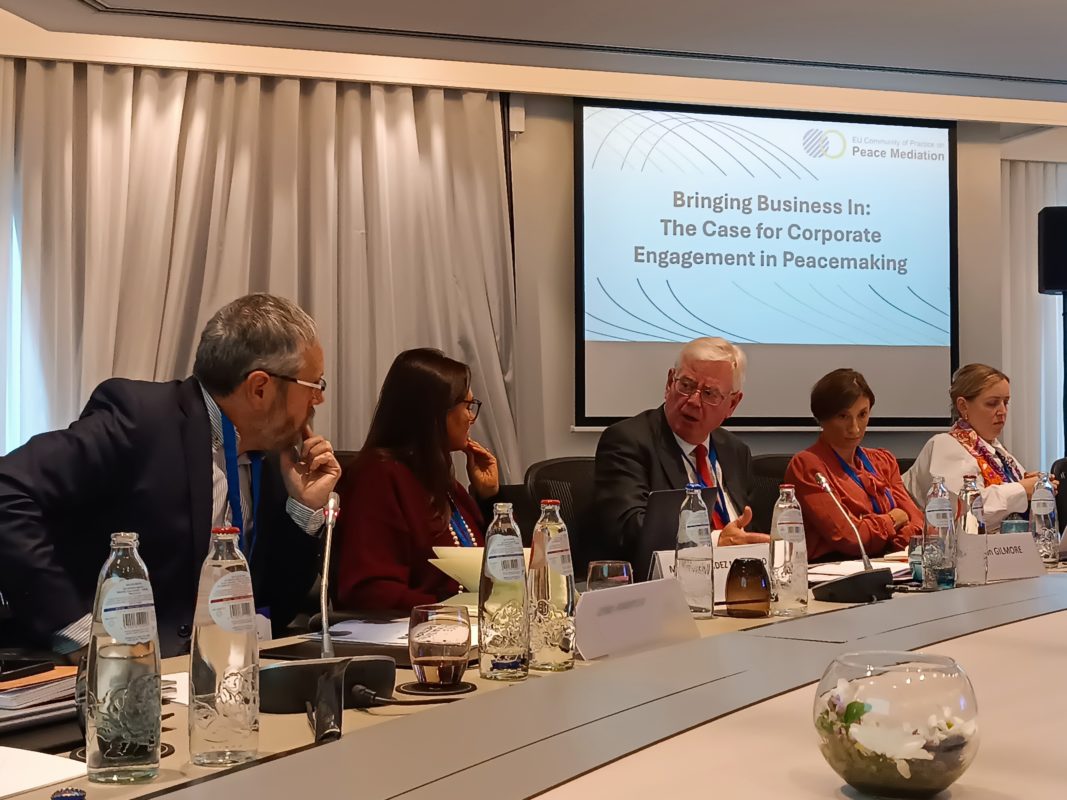
At this week’s EU Community of Practice on Peace Mediation the Institute organised the session “Bringing Business In: The Case for Corporate Engagement in Peacemaking”.
The Institute’s Senior Advisors Eamon Gilmore and Urko Aiartza discussed the business community’s multifaceted role in contexts of conflict and peacemaking together with speakers Myriam Mendez-Montalvo, founder of the Colombian national dialogue platform Valiente es Dialogar (“Dare to Dialogue)and Sarah Cechvala, post-doctoral researcher at the University of Oslo focused on the role of the private sector in peace and conflict.
The discussion underscored the complexity and diversity of the business community and its multifaceted role in contexts of conflict and peacemaking.
Key reflections included:
- Diverse roles of business actors.The private sector is not monolithic and, while all companies aim for survival and profit, their incentives and impact vary widely. Businesses can be both allies in peace processes and, in some cases, conflict profiteers.
- Multiple pathways to peace. Business actors can contribute to peace not only through direct involvement in peace processes, but also by strengthening the social fabric, promoting inclusive growth, and creating conditions for stability. Good business is essential for peace, and, similarly, peace and a stable environment are in the business sector’s interest.
- The impact of business on fragile environments. Companies can create “peace pathways,” but the key issue is how they can shape and transform fragile environments. Their influence extends beyond traditional peacebuilding roles.
- The role of small businesses. Small businesses: Often deeply embedded in their communities, small enterprises tend to make strong socioeconomic contributions and show reluctance to engage in conflict. Given their social proximity and local impact, they can be seen as a hybrid between private sector and civil society actors, bridging the economic and the social dimensions of peacebuilding.

Throughout the conversation, different case studies where business actors contributed to peacemaking were also analysed, including:
- South Africa: The consultative business movement and the National Business Initiative (NBI) played a pivotal role in supporting dialogue and reform during the post-apartheid transition.
- Basque Country: Businesses avoided public roles due to security risks – which shows that engagement strategies are highly dependent on context. But they did work on developing and strengthening the social fabric.
- Colombia: Peace remains a polarising issue, even within the private sector. While there is no coordinated, national-level effort, localized initiatives, particularly in agriculture, have made meaningful contributions.
Finally, the discussion highlighted the importance of the “peace-positive” impact of business. Actions such as job creation, ethical investment, and community engagement may not fit traditional peacebuilding definitions, but are nonetheless crucial in creating the conditions for sustainable peace.


