
From waste to resolution: Assessing the impact of armed conflict on the solid waste sector in Yemen
10/09/2025
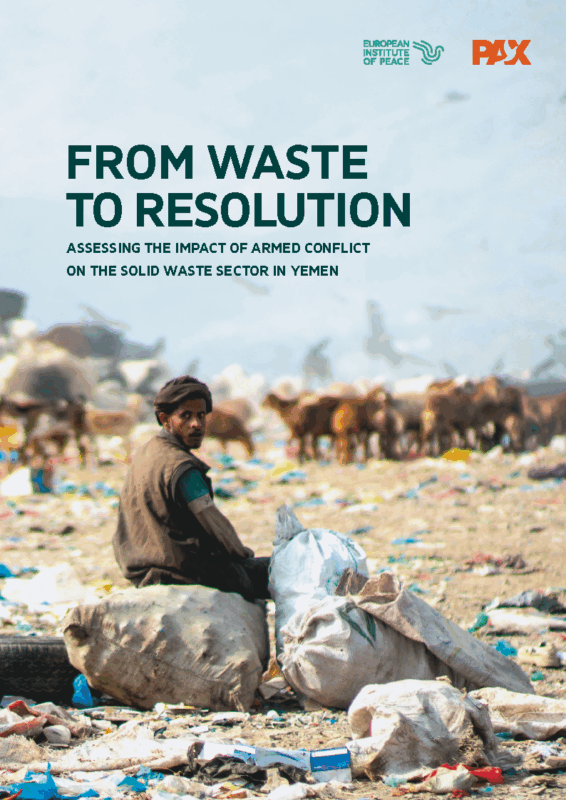
The European Institute of Peace and PAX are proud to announce our joint publication, “From waste to resolution: Assessing the impact of armed conflict on the solid waste sector in Yemen”, which provides insight into Yemen’s waste management crisis and its impact on the local environment, population, and society.
Throughout a decade of war, Yemen has been experiencing significant environmental degradation, both through direct impacts of armed conflict and indirectly through the decay of governance structures that could prevent and respond to environmental needs.
The conflict has eroded the capacity of public entities to protect crucial ecosystems, enact and implement relevant legislation, and provide essential services to Yemen’s population. When it comes to waste management, this has resulted in widespread illicit dumping, an uncontrolled expansion of solid waste, and a lack of adequate collection, disposal, and treatment facilities.
This report investigates Yemen’s waste crisis as a result of the armed conflict and reflects on ways to address it as a contribution to peacemaking, conflict prevention, and stabilisation. It identifies the main governance challenges in relation to effective waste management, including exponential demographic growth, lack of updated data, and weak institutional capacity. It analyses the environmental impact of Yemen’s solid waste crisis on air, water, and land, as well as its social and security implications, ranging from outbreaks of diseases to the degradation of agricultural land and an increase in competition for resources.
The report identifies three entry points to respond to the waste management crisis:
- Fostering collaboration and social cohesion: Strengthened coordination between various actors can offer co-benefits by improving solid waste management (SWM) services, while enhancing relationships between these stakeholders through joint decision-making or implementation. Collaboration, for instance on mapping needs, data sharing, or recycling initiatives, can be fostered between authorities and with the broader population alike, offering valuable opportunities for meaningful engagement of various groups. By involving communities in decision-making and implementation on SWM, authorities can garner popular support as a central pillar of lasting peace.
- Enhancing governance and building trust through technical cooperation: Technical subjects such as SWM offer opportunities for local and national authorities to strengthen their role and legitimacy in governance, hence improving the delivery of services and supporting public trust in institutions. At the same time, it can provide opportunities for dialogue, learning and knowledge-sharing across institutions and governorates to enhance the capacities of relevant SWM agencies, while contributing to increased coherence and trust between different institutions or parties.
- Strengthening livelihoods and unlocking economic opportunities: Investments and partnerships to improve SWM infrastructure can provide local economic opportunities through job creation and livelihood diversification, while providing revenue for municipalities and businesses. This way, investments in waste management infrastructure and enhanced waste governance can play a role in bolstering the local economy as a fundamental pillar of resilience and stability, especially if complemented with community-driven structures or solutions.
Based on these entry points, the report provides the following recommendations to provide guidance for local and national policymakers, donors, as well as international and multilateral organisations seeking to support peace and stability in Yemen.
- Addressing policy, legal and institutional gaps: Policymakers in Yemen are recommended to systematically review and update the legislative SWM framework, including the National SWM Strategy; strengthen institutional capacity of the CCIFs; and centralise collection and monitoring of waste data, all of which can contribute to improved waste management and environmental health.
- Mitigating environmental impacts of the waste crisis: Humanitarian and development organisations operating in Yemen are recommended to support expanded research on other dimensions of pollution and environmental degradation in the context of the conflict; enhance recycling and composting initiatives to depart from dumping; establish collection and disposal systems of hazardous waste; and expand waste-to-energy projects.
- Supporting resilience-building and preventing tensions: Local authorities and SWM entities are recommended to promote community-led approaches to waste management and engage in dialogue and peer learning to enhance coordination across the SWM sector.
This report is part of the Environmental Pathways for Reconciliation in Yemen project, implemented by the European Institute of Peace with support from the German Federal Foreign Office as part of the Weathering Risk Peace Pillar led by adelphi.


