
Southern Dialogue Process in Yemen: Participants announce upcoming launch of “The Platform of Political Forces in Southern Yemen”
11/12/2025
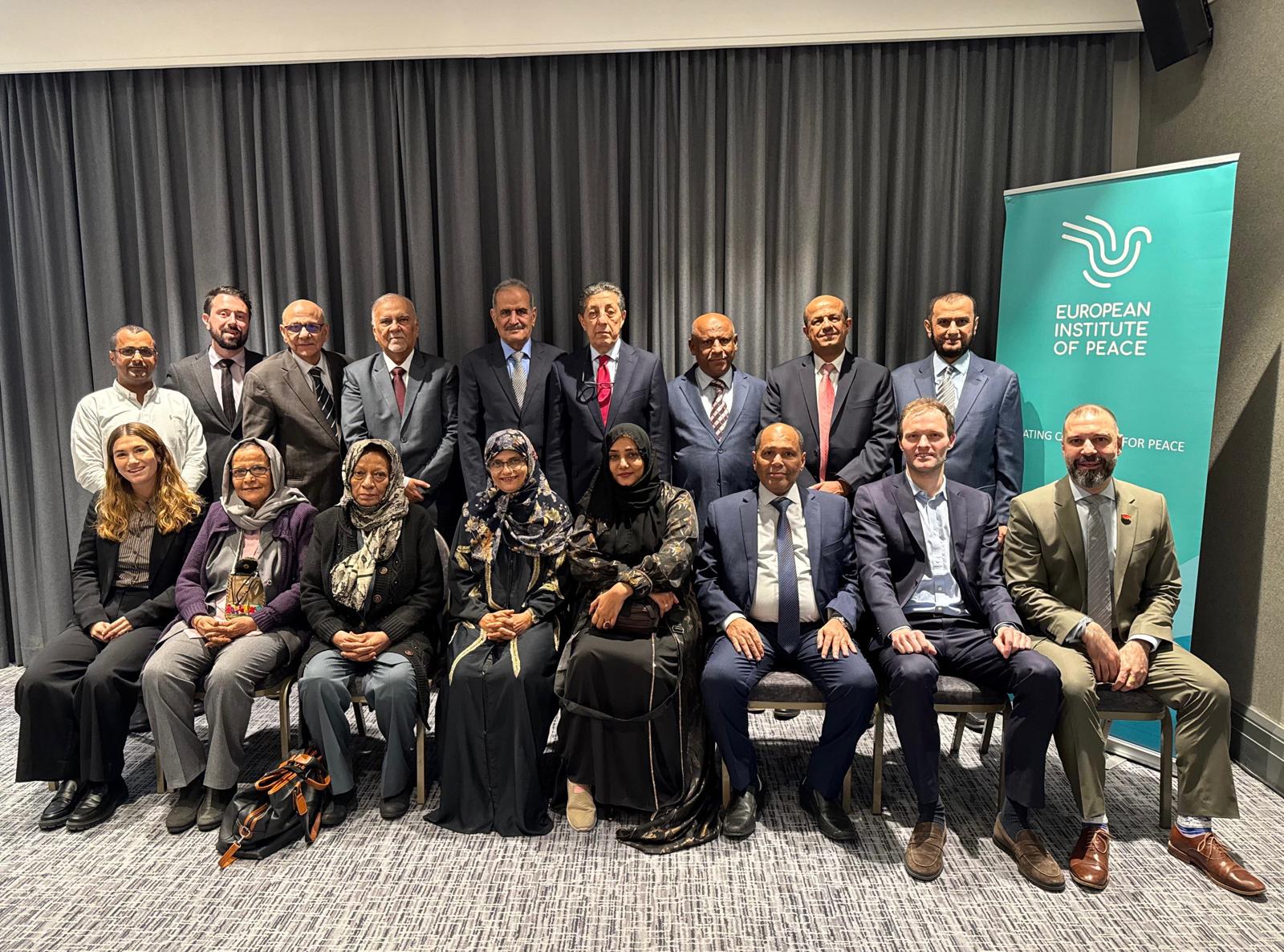
On 9–11 December 2025, the European Institute of Peace facilitated the fifth round of the Southern Dialogue Process in Yemen in Amman, Jordan. The participants discussed the political situation in Yemen and expressed their grave concerns regarding recent developments in Hadhramaut. They agreed a foundational document and statutes for the upcoming launch of “The Platform of Political Forces in Southern Yemen.” The participants issued the following statement and released an agreed document on Common Ground among Southern Political Components.
Final Statement of the Fifth Round of Dialogue, 9-11 December 2025
Translated from the original Arabic
- The European Institute of Peace facilitated the fifth round of dialogue between various political forces and components in southern Yemen in the Jordanian capital, Amman, December 9-11, 2025. Representatives from the following components participated in the dialogue: the Supreme Council of the Revolutionary Movement for the Liberation and Independence of the South (Hirak), Nahdha Movement for Peaceful Change, the Southern Movement participating in the National Dialogue Conference (NDC Hirak), the Hadhramaut Inclusive Conference, Southern Women for Peace Group, the United Alliance of the Sons of Shabwa, the Shabwa National General Council, and the Hadhramaut National Council. The Southern National Coalition and the Peaceful Sit-in Committee in Al-Mahra Governorate were unable to participate due to acceptable circumstances.
- The political forces and components reviewed the political, economic, and security conditions in the southern governorates, particularly Hadramawt, and Yemen in general, and the deteriorating security, living conditions, and basic services they are facing.
- The political forces and components also followed the rapidly evolving developments and events in Hadramawt, including the accompanying political, security, and military tensions and the serious repercussions on the political process and national partnership in the south. They expressed deep concern regarding these developments and stressed that the use of violence and military force is a clear departure from the norms and values upon which peaceful political dialogue is based.
- The political forces and components also welcomed the truce agreement signed between the Governor of Hadramawt and the head of the Hadramawt Tribal Alliance, which was guaranteed by the Kingdom of Saudi Arabia, and stressed the need for its full implementation, addressing the causes of tension, and restoring stability in a way that defuses tensions, preserves civil peace, and enables local authorities to carry out their duties in accordance with the law.
- The political forces and components held the Presidential Leadership Council fully responsible for the current situation, which resulted from the escalation of internal disputes and conflicting powers and interests. They demanded that the Council assume its responsibilities and implement what was stated in the Riyadh Agreement and in the subsequent declaration of the transfer of power, and ensure the principle of partnership and fair representation of the political forces in the south without exclusion or marginalization.
- The southern political forces and components affirmed that dialogue, respect for partnership, and implementation of agreed-upon commitments are the true foundations for building a stable political situation and protecting the southern governorates. They called on the countries sponsoring the political process and the international community to assume their responsibilities and move towards achieving the required progress on the path of the political process.
- The political forces and components continued their discussions on establishing a platform for political forces in southern Yemen and agreed on the founding document and bylaws of the platform. This platform will include political forces that embrace the vital Southern cause, the specificities of its governorates, and the aspirations of its people. It will work to promote dialogue, coordination, and the defence of their issues, rights, and future at the national, regional, and international levels, in accordance with principles and objectives that regulate the relationship between the political forces and parties concerned with developments in the South in particular and Yemen in general. They also discussed the steps required in the next phase to launch this platform as soon as possible.
- The political forces and components agreed on a paper – copied below – which includes the commonalities of the southern political forces participating in the dialogue, and addresses their common position towards the current situation, the necessity of political partnership, the references for a political solution, the resolution of the southern issue and the issues of the governorates, the representation of the south in the political process, the necessity of conducting a dialogue on ways to reform the legitimate authority, the position on militias and armed factions, and achieving transitional justice and reparation.
- The political forces and groups discussed ways to cooperate in addressing the current crisis facing the South in particular and Yemen in general. They agreed to continue these discussions to develop ideas and proposals for dealing with the crisis in a way that alleviates the burdens of daily life and the difficult conditions faced by citizens.
- The political forces and groups appreciated the important meeting they held with the European Union Ambassador to Yemen to exchange views on developments in Yemen in general and the South in particular.
Common Ground among Southern Political Factions Participating in the Dialogue Sponsored by the European Institute of Peace
Translated from the original Arabic
The most important commonalities agreed upon by the southern political components participating in the dialogue sponsored by the European Institute of Peace, which they see as fulfilling the interests of the Yemeni people in general and the South in particular.
- The stance on war and peace:
The belief that a political solution is the best way to end the conflict in Yemen, and that the continuation of the war threatens the future of society and deepens the humanitarian tragedy. - The future form of the state:
A federal democratic framework is the appropriate framework for the future at this stage. - The Southern Cause:
Emphasizing the importance of the Southern cause and establishing guarantees for its resolution within a national framework that prevents a recurrence of the severe damage inflicted on the political, economic, and social levels. The people of the South have the right to demand and exercise their right to self-determination through peaceful means and internationally recognized legal mechanisms. - Governorate Causes:
The governorates have the right to determine their political and economic future within the framework of what is agreed upon in this regard. - Political Solution Framework:
The outcomes of the National Dialogue represent one of the fundamental frameworks for a political settlement, while emphasizing the importance of opening a dialogue on any other frameworks considering recent developments. - Representation of the South:
The South is politically diverse, and its constituent groups reject any single political entity monopolizing its representation or making decisions on its behalf unilaterally. - Political Partnership:
Agreement on the necessity of achieving partnership in political decision-making and rejecting exclusion and marginalization. - The current legitimate authority:
The Presidential Leadership Council in Yemen has shown its inability to manage the current phase in accordance with its national responsibilities, and there is a need to conduct a dialogue on ways to reform it. - The stance on weapons:
• Rejection of militias and armed factions, and affirmation that the State alone must have a monopoly on the use of force. Therefore, there is an urgent need to end this negative phenomenon immediately.
• Emphasis that any political settlement must lead to a just and lasting peace, thereby dismantling all parallel state entities and all forms of armament outside the framework of state institutions. - Transitional justice and reparation:
The need to ensure transitional justice through accountability and reparation by all possible means, including political isolation (while keeping the discussion open about other aspects of justice required and the starting date of the period covered by the accountability process).


