

Report Launch – Climate, Peace and Security Consultation in Yemen
09/03/2026
The European Institute of Peace is thrilled to announce its latest report, presenting the findings of an extensive consultation with over 3,600 Yemenis about environmental aspects of conflict, peace and security. The consultation was conducted as part of the project Environmental Pathways for Reconciliation in Yemen, which aims to support locally led and sustainable peace by using the environment as an entry point and key element of peacemaking.
The project builds upon the findings of a prior consultation that reached out to 15,870 individuals facilitated by the Institute in 2020-21, which found that environmental issues ranked among the highest priorities of the local population in the context of the search for peace and reconciliation.
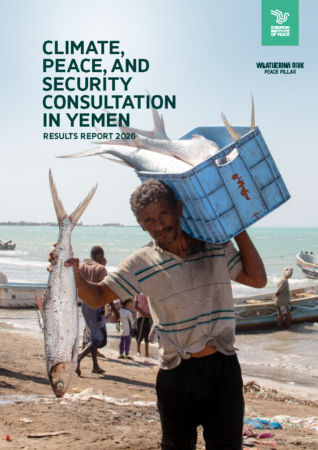
To better understand what environment means to Yemenis, and why it matters in the context of the conflict, the Institute rolled out a second consultation specifically on natural resources, environment and climate change. Conducted in three waves between 2023 and 2024, this environmental security consultation reached a total of 3,694 additional people across the thirteen governorates of Aden, Taiz, Marib, Al-Mahra, Al-Hodeidah, Shabwah, Sana’a, Al-Dhale’, Hajjah, Hadramawt, Al-Jawf, Abyan, and Ibb. It consisted of a survey conducted with ordinary citizens, whose views are often overlooked in political and peace efforts, as well as semi-structured focus group discussions and key informant interviews with influential individuals.
The results of the consultation reveal the local impact of natural resources, environmental and climate risks on social cohesion, human security, and, more importantly, their implications in driving conflict. This report compiles the results and examines the environmental dimension of local grievances and conflict further by exploring Yemenis’ perceptions of environmental issues, their impact on peace and security, and existing or potential environmental peacemaking solutions. Moreover, the analysis provides insights into the gaps and potential entry points when addressing these risks, with a focus on contributing to building peace and reconciliation, so that peacemakers and peacebuilders, as well as environmental and humanitarian actors from the local to the international level, can be better informed in their policymaking and programming.
Key findings
The results of this consultation reveal an urgency to implement conflict resolution and prevention approaches that are sensitive to the perspectives, needs, and priorities of Yemenis in a context of multifaceted security risks that are significantly connected to natural resources, environment and climate change. The consultation also highlighted the major opportunities for peacemaking through environmental dialogue, conflict-sensitive natural resources management, environmental protection, and climate change adaptation efforts, some of which are already ongoing, led by local and international actors alike. Lastly, the results highlight a need to promote more efforts to better understand and address environment-related security risks in Yemen, including their impact on livelihoods and community cohesion, and the untapped opportunities to leverage them for peacemaking at the community and national levels.
- Yemenis across the country are knowledgeableand concerned about climate change and environmental degradation. Seven out of ten Yemenis recognise climate change as having at least a moderate impact on their daily lives, withnearly 85% expressing concern.
- Yemen’s population faces a myriad of environmental risks affecting livelihoods and human security. As over 80% of survey respondents consider the natural environment essential or important to secure their income, it is deeply worrying that 92% perceive a reduction in the availability of and access to natural resources in recent years, notably in water, gas, and fuel.
- Unaddressed environmental issues drive tensions in Yemen, especially at the local level. Over half of respondents reported tensions or conflicts in their districts due to environmental factors. Pollution and water scarcity are the main environmental issues perceived as leading to conflict.
- Addressing environmental risks with an integrated approach can be a solution to build resilience and social cohesion in Yemen, including as part of the peace process. Over 80% of Yemenis consulted consider it essential to respond to climate change and protect the environment in the short term. A significant majority (57%) also believe that environmental challenges should be integrated into peace negotiations.
Given the severity of the environmental crisis and the impact of the national conflict on governance and the provision of basic services, it is no surprise that local institutions are weak and almost non-existent in some places. In this context, rather than a demand for improved environmental governance as a precursor to sustainable peace, the issues identified in this report provide an opportunity to build an approach to environmental peacemaking that engages the agency of those most directly affected by the conflict and the environmental crisis. The report provides a basis to inform action that helps build, rather than wait for, accountable governance structures. The core of that structure lies in three areas:
- Engagement with the environmental concerns of the affected population,
- Encouragement and facilitation of their participation in identifying plausible strategies to address the environmental and climate risks in relation to the ongoing conflict, and
- Around these processes, build effective institutions that can both implement and be held accountable.
This report is part of the Environmental Pathways for Reconciliation in Yemen project, implemented by the European Institute of Peace with support from the German Federal Foreign Office as part of the Weathering Risk Peace Pillar led by adelphi.


