On 9–11 December 2025, the European Institue of Peace facilitated the fifth round of the Southern Dialogue Process in Yemen in Amman, Jordan. The participants discussed the political situation in Yemen and expressed their grave concerns regarding recent developments in Hadhramaut. They agreed a foundational document and statutes for the upcoming launch of “The Platform of Political Forces in Southern Yemen.” The participants issued the following statement and released an agreed document on Common Ground among Southern Political Components.
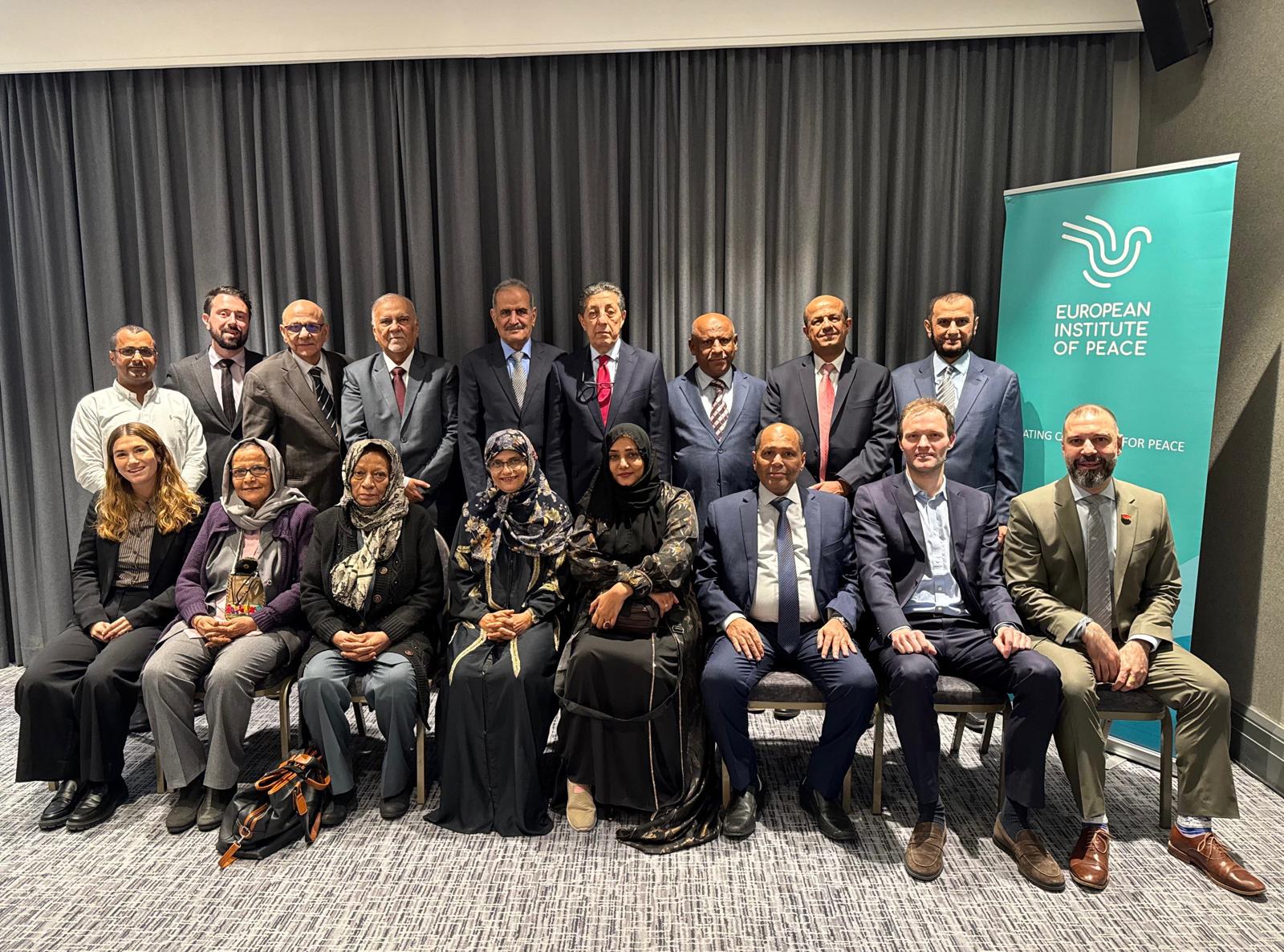
Final Statement of the Fifth Round of Dialogue, 9-11 December 2025
Translated from the original Arabic
- The European Institute of Peace facilitated the fifth round of dialogue between various political forces and components in southern Yemen in the Jordanian capital, Amman, December 9-11, 2025. Representatives from the following components participated in the dialogue: the Supreme Council of the Revolutionary Movement for the Liberation and Independence of the South (Hirak), Nahdha Movement for Peaceful Change, the Southern Movement participating in the National Dialogue Conference (NDC Hirak), the Hadhramaut Inclusive Conference, Southern Women for Peace Group, the United Alliance of the Sons of Shabwa, the Shabwa National General Council, and the Hadhramaut National Council. The Southern National Coalition and the Peaceful Sit-in Committee in Al-Mahra Governorate were unable to participate due to acceptable circumstances.
- The political forces and components reviewed the political, economic, and security conditions in the southern governorates, particularly Hadramawt, and Yemen in general, and the deteriorating security, living conditions, and basic services they are facing.
- The political forces and components also followed the rapidly evolving developments and events in Hadramawt, including the accompanying political, security, and military tensions and the serious repercussions on the political process and national partnership in the south. They expressed deep concern regarding these developments and stressed that the use of violence and military force is a clear departure from the norms and values upon which peaceful political dialogue is based.
- The political forces and components also welcomed the truce agreement signed between the Governor of Hadramawt and the head of the Hadramawt Tribal Alliance, which was guaranteed by the Kingdom of Saudi Arabia, and stressed the need for its full implementation, addressing the causes of tension, and restoring stability in a way that defuses tensions, preserves civil peace, and enables local authorities to carry out their duties in accordance with the law.
- The political forces and components held the Presidential Leadership Council fully responsible for the current situation, which resulted from the escalation of internal disputes and conflicting powers and interests. They demanded that the Council assume its responsibilities and implement what was stated in the Riyadh Agreement and in the subsequent declaration of the transfer of power, and ensure the principle of partnership and fair representation of the political forces in the south without exclusion or marginalization.
- The southern political forces and components affirmed that dialogue, respect for partnership, and implementation of agreed-upon commitments are the true foundations for building a stable political situation and protecting the southern governorates. They called on the countries sponsoring the political process and the international community to assume their responsibilities and move towards achieving the required progress on the path of the political process.
- The political forces and components continued their discussions on establishing a platform for political forces in southern Yemen and agreed on the founding document and bylaws of the platform. This platform will include political forces that embrace the vital Southern cause, the specificities of its governorates, and the aspirations of its people. It will work to promote dialogue, coordination, and the defence of their issues, rights, and future at the national, regional, and international levels, in accordance with principles and objectives that regulate the relationship between the political forces and parties concerned with developments in the South in particular and Yemen in general. They also discussed the steps required in the next phase to launch this platform as soon as possible.
- The political forces and components agreed on a paper – copied below – which includes the commonalities of the southern political forces participating in the dialogue, and addresses their common position towards the current situation, the necessity of political partnership, the references for a political solution, the resolution of the southern issue and the issues of the governorates, the representation of the south in the political process, the necessity of conducting a dialogue on ways to reform the legitimate authority, the position on militias and armed factions, and achieving transitional justice and reparation.
- The political forces and groups discussed ways to cooperate in addressing the current crisis facing the South in particular and Yemen in general. They agreed to continue these discussions to develop ideas and proposals for dealing with the crisis in a way that alleviates the burdens of daily life and the difficult conditions faced by citizens.
- The political forces and groups appreciated the important meeting they held with the European Union Ambassador to Yemen to exchange views on developments in Yemen in general and the South in particular.
Common Ground among Southern Political Factions Participating in the Dialogue Sponsored by the European Institute of Peace
Translated from the original Arabic
The most important commonalities agreed upon by the southern political components participating in the dialogue sponsored by the European Institute of Peace, which they see as fulfilling the interests of the Yemeni people in general and the South in particular.
- The stance on war and peace:
The belief that a political solution is the best way to end the conflict in Yemen, and that the continuation of the war threatens the future of society and deepens the humanitarian tragedy. - The future form of the state:
A federal democratic framework is the appropriate framework for the future at this stage. - The Southern Cause:
Emphasizing the importance of the Southern cause and establishing guarantees for its resolution within a national framework that prevents a recurrence of the severe damage inflicted on the political, economic, and social levels. The people of the South have the right to demand and exercise their right to self-determination through peaceful means and internationally recognized legal mechanisms. - Governorate Causes:
The governorates have the right to determine their political and economic future within the framework of what is agreed upon in this regard. - Political Solution Framework:
The outcomes of the National Dialogue represent one of the fundamental frameworks for a political settlement, while emphasizing the importance of opening a dialogue on any other frameworks considering recent developments. - Representation of the South:
The South is politically diverse, and its constituent groups reject any single political entity monopolizing its representation or making decisions on its behalf unilaterally. - Political Partnership:
Agreement on the necessity of achieving partnership in political decision-making and rejecting exclusion and marginalization. - The current legitimate authority:
The Presidential Leadership Council in Yemen has shown its inability to manage the current phase in accordance with its national responsibilities, and there is a need to conduct a dialogue on ways to reform it. - The stance on weapons:
• Rejection of militias and armed factions, and affirmation that the State alone must have a monopoly on the use of force. Therefore, there is an urgent need to end this negative phenomenon immediately.
• Emphasis that any political settlement must lead to a just and lasting peace, thereby dismantling all parallel state entities and all forms of armament outside the framework of state institutions. - Transitional justice and reparation:
The need to ensure transitional justice through accountability and reparation by all possible means, including political isolation (while keeping the discussion open about other aspects of justice required and the starting date of the period covered by the accountability process).
في الفترة من 9 إلى 11 ديسمبر 2025، يسّر المعهد الأوروبي للسلام الجولة الخامسة من عملية الحوار الجنوبي في اليمن، التي عُقدت في عمّان، الأردن. ناقش المشاركون الوضع السياسي في اليمن، وأعربوا عن قلقهم البالغ إزاء التطورات الأخيرة في حضرموت .و اتفقوا على الوثيقة التأسيسية والنظام الأساسي لإطلاق ”منصة القوى السياسية في جنوب اليمن“. أصدر المشاركون البيان التالي، ونشروا وثيقة متفقا عليها حول القواسم المشتركة بين المكونات السياسية الجنوبية.
البيان الختامي للجولة الخامسة، 9 إلى 11 ديسمبر
- عقد المعهد الأوروبي للسلام الجولة الخامسة للحوار بين العديد من القوى والمكونات السياسية في جنوب اليمن وذلك في العاصمة الأردنية عمان في الفترة 9-11 ديسمبر 2025، ولقد شارك في الحوار ممثلو عن المكونات التالية: المجلس الأعلى للحراك الثوري لتحرير واستقلال الجنوب- حزب حركة النهضة للتغيير السلمي- الحراك الجنوبي المشارك في مؤتمر الحوار الوطني- مؤتمر حضرموت الجامع- جنوبيات من أجل السلام- التحالف الموحد لأبناء شبوة- مجلس شبوة الوطني العام- مجلس حضرموت الوطني، ولم يتمكن الائتلاف الوطني الجنوبي ولجنة الاعتصام السلمي في محافظة المهرة من المشاركة لظروف مقبولة.
- قامت القوى والمكونات السياسية باستعراض الأوضاع السياسية والاقتصادية والأمنية التي تمر بها المحافظات الجنوبية وحضرموت بشكل خاص، واليمن بشكل عام، وما تواجهه من تردٍ في الأوضاع الأمنية والمعيشية والخدمات الأساسية.
- كما تابعت مجريات التطورات والأحداث المتسارعة في حضرموت وما رافقها من توتر سياسي وأمني وعسكري وانعكاسات خطيرة على مسار العملية السياسية والشراكة الوطنية في الجنوب، وأعربت عن بالغ القلق إزاء هذه التطورات، وأكدت أن استخدام العنف والقوة العسكرية يعد خروجًا بيّنًا عن الأعراف والقيم التي يقوم عليها الحوار السياسي السلمي.
- كما رحّبت باتفاق التهدئة الموقّع بين محافظ حضرموت ورئيس حلف قبائل حضرموت والذي ضمنته المملكة العربية السعودية، واكدت ضرورة التطبيق الكامل لبنوده ومعالجة أسباب التوتر واستعادة الاستقرار بما يضمن نزع فتيل التوتر والحفاظ على السلم الأهلي، وبما يمكن السلطات المحلية من ممارسة مهامها وفقا للقانون.
- وقد حملت القوى والمكونات السياسية مجلس القيادة الرئاسي كامل المسئولية عما وصلت اليه الأوضاع نتيجة تفاقم الخلافات الداخلية وتضارب الصلاحيات والمصالح وطالبت المجلس تحمل مسؤولياته وتنفيذ ماورد في اتفاق الرياض وإعلان نقل السلطة وضرورة تحقيق مبدأ الشراكة والتمثيل العادل للقوى السياسية في الجنوب دون إقصاء او تهميش.
- وأكدت القوى والمكوّنات السياسية الجنوبية أن الحوار، واحترام الشراكة، وتنفيذ الالتزامات المتفق عليها، هي الأسس الحقيقية لبناء وضع سياسي مستقر ولحماية محافظات الجنوب، ودعت الدول الراعية للعملية السياسية والمجتمع الدولي إلى تحمل مسؤولياته والتحرك نحو تحقيق التقدم المطلوب على مسار العملية السياسية.
- كما تابعت القوى والمكوّنات السياسية مناقشاتها حولَ إنشاء منصة القوى السياسية في جنوب اليمن، واتفقت على الوثيقة التأسيسية والنظام الأساسي للمنصة التي ستضم قوى سياسية تتبنى قضية الجنوب الحيوية وخصوصيات محافظاته وتطلعات أبنائها وتعمل على دفع الحوار والتنسيق والدفاع عن قضاياهم وحقوقهم ومستقبلهم على المستوى الوطني والاقليمي والدولي وفق مبادئ واهداف تنظم العلاقة فيما بين القوى السياسية والأطراف المعنية بتطورات الأوضاع في الجنوب بشكل خاص واليمن بشكل عام. كما ناقشت الخطوات المطلوبة في المرحلة القادمة لإطلاق هذه المنصة في أقرب فرصة ممكنة.
- اتفقت القوى والمكونات السياسية على الورقة المرفقة والتي تتضمن القواسم المشتركة للقوى السياسية الجنوبية المشاركة في الحوار حيث تعرضت لموقفها تجاه الأوضاع الحالية، وضرورة الشراكة السياسية، ومرجعيات الحل السياسي، وحل القضية الجنوبية وقضايا المحافظات، وتمثيل الجنوب في العملية السياسية، وضرورة اجراء حوار حول سبل اصلاح السلطة الشرعية، والموقف من المليشيات والفصائل المسلحة، وتحقيق العدالة الانتقالية وجبر الضرر.
- ناقشت القوى والمكونات السياسية سبل التعاون مع الأزمة الحالية التي تواجه الجنوب بشكل خاص واليمن بشكل عام واتفق على متابعة هذا النقاش لطرح الأفكار والاقتراحات للتعامل معها بما يؤدي الى تخفيف الأعباء المعيشية والظروف الصعبة التي يمر بها المواطنون.
ثمنت القوى والمكونات السياسية اللقاء المهم الذي جمعهم مع سفير الاتحاد الأوروبي لدى اليمن لتبادل الآراء حول تطورات الأوضاع في اليمن ب
القواسم المشتركة بين المكونات السياسية الجنوبية
المشاركة في الحوار الذي يرعاه المعهد الأوروبي للسلام
أهم القواسم المشتركة التي تتوافق بشأنها المكونات السياسية الجنوبية المشاركة في الحوار الذي يرعاه المعهد الأوروبي للسلام وتراها محققة لمصالح الشعب اليمني بشكل عام والجنوب بشكل خاص.
- الموقف من الحرب والسلام:
الإيمان بأن الحل السياسي هو السبيل الأمثل لإنهاء النزاع في اليمن، وأن استمرار الحرب يهدد مستقبل المجتمع ويعمق المأساة الإنسانية. - شكل الدولة المستقبلية:
ان الإطار الاتحادي الديمقراطي في المرحلة الحالية هو الإطار المناسب للمستقبل. - القضية الجنوبية:
التأكيد على أهمية القضية الجنوبية ووضع ضمانات معالجتها في إطار مسار وطني يمنع تكرار ما وقع من أضرار بالغة على المستويات السياسية والاقتصادية والاجتماعية، ويحق للشعب في الجنوب ان يطالب بممارسة حقه في تقرير مصيره من خلال الوسائل السلمية والاليات القانونية المعترف بها دولياً. - قضايا المحافظات:
للمحافظات الحق في تقرير مستقبلها السياسي والاقتصادي في إطار ما يتم التوافق عليه في هذا الشأن. - مرجعيات الحل السياسي:
أن مخرجات الحوار الوطني تمثل أحد المرجعيات الأساسية للتسوية السياسية مع أهمية فتح حوار حول أية مرجعيات أخرى في ظل ما شهدته الأوضاع من تطورات. - تمثيل الجنوب:
أن الجنوب متعدد سياسياً والمكونات الجنوبية ترفض احتكار أي مكون سياسي لتمثيله او اتخاذ القرارات نيابة عنه بشكل منفرد. - الشراكة السياسية:
الاتفاق على ضرورة تحقيق الشراكة في صنع القرار السياسي ورفض الإقصاء والتهميش. - السلطة الشرعية الحالية:
أظهر مجلس القيادة الرئاسي في اليمن عدم قدرته على إدارة المرحلة وفق ما تقتضيه مسئولياته الوطنية وهناك حاجه إلى إجراء حوار حول سبل إصلاحه. - الموقف من السلاح:
• رفض المليشيات والفصائل المسلحة والتأكيد على أن احتكار السلاح يجب أن يكون بيد الدولة فقط، ومن هذا المنطلق فان هناك ضرورة لإنهاء هذه الظاهرة السلبية بشكل فوري.
• التأكيد على أن أي تسوية سياسية يجب أن تفضي إلى سلام عادل ومستدام، تنتهي بموجبه كافة الكيانات الموازية للدولة، وأشكال التسلح خارج إطار مؤسساتها. - العدالة الانتقالية وجبر الضرر:
ضرورة إنفاذ العدالة الانتقالية من خلال المحاسبة وجبر الضرر بكل الوسائل الممكنة بما في ذلك العزل السياسي لمن يثبت إدانته (مع بقاء النقاش مفتوحاً حول جوانب العدالة المطلوبة الأخرى وتاريخ بدء الفترة التي تشملها عملية المحاسبة).
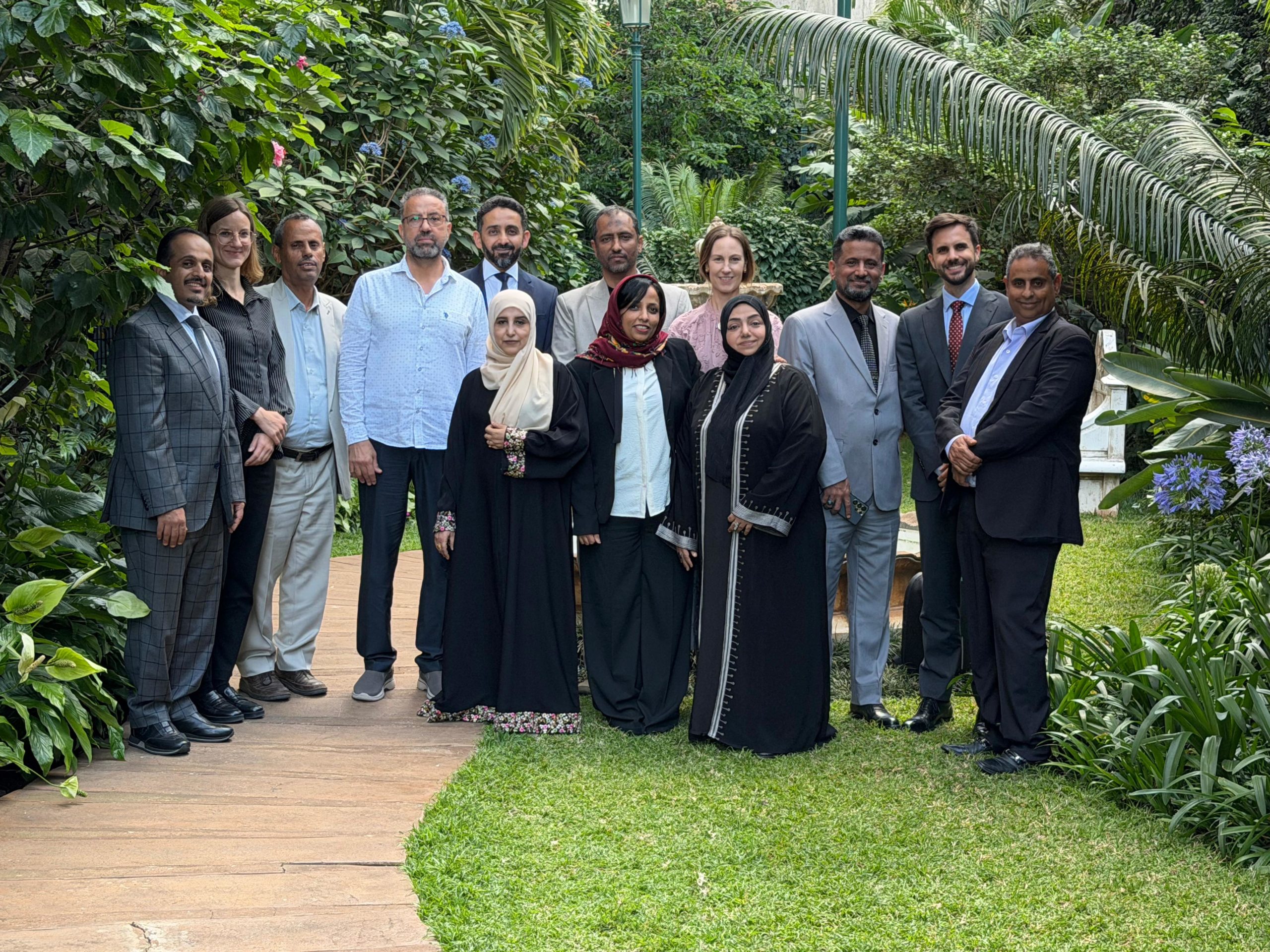
عُقد في نيروبي، كينيا، من 28 نوفمبر إلى 1 ديسمبر، الحوار الفني الثاني حول صنع السلام المناخي والبيئي في اليمن. واستند هذا الاجتماع إلى نجاح الاجتماعات الثنائية السابقة والحوار الفني الأول الذي عُقد في أغسطس 2025 في عمّان، والذي حقق تفاهمًا مشتركًا حول قضايا المياه، بما في ذلك دورها في سوء التكيف والنزاعات والصراعات. وخلال الحوار في نيروبي، بادر المشاركون إلى وضع رؤية مشتركة ومسودة خارطة طريق للتعاون لمعالجة ندرة المياه في اليمن.
كان هذا الاجتماع المشترك الثاني للمشاركين الفنيين والسياسيين للحكومة اليمنية والمجلس الانتقالي الجنوبي، والذي دعا إليه المعهد الأوروبي للسلام، في إطار عمل متفق عليه للحوار والتعاون البيئي. وتهدف هذه العملية إلى معالجة القضايا المتعلقة بالموارد الطبيعية والبيئة ومخاطر المناخ بشكل مشترك، دعماً لفوائد السلام في تحقيق الاستقرار والمصالحة وتعزيز القدرة على الصمود. وتضمن الحوار عروضاً تقديمية حول حوكمة وإدارة المياه على المستويين الوطني والمحلي، مما وفر فهماً دقيقاً أتاح إجراء مناقشات عملية تهدف إلى حل قضايا المياه الملحة بما يتماشى مع أولويات سياسات الجهات المعنية.
أجرى المشاركون مناقشات معمقة، وعززوا التفاهم المشترك حول تحديات المياه الأكثر إلحاحًا في اليمن وأثرها على المجتمعات المحلية. نوقشت خلال الحوار الفني الثاني مجالات العمل الاستراتيجية والحلول العملية على المدى القصير والمتوسط والطويل لتحسين إدارة موارد المياه، ودعم التوفير المستدام لخدمات المياه في المناطق الحضرية والريفية، وتحسين الإدارة البيئية، كل ذلك باتباع نهج يراعي ظروف النزاع ويدعم السلام.
على هامش جمعية الأمم المتحدة للبيئة، أتاحت العاصمة الكينية فرصةً ثمينة للمشاركين للقاء المنظمات الدولية المعنية بمواجهة مخاطر الأمن المناخي في منطقة القرن الأفريقي وشبه الجزيرة العربية. وفي زيارةٍ لمركز التنبؤ بالمناخ وتطبيقاته التابع للهيئة الحكومية الدولية المعنية بالتنمية (IGAD)، اطلع المشاركون على امكانية أن تتطور المخاطر الناجمة عن تغير المناخ والتدهور البيئي إلى كوارث ونزاعات، وكيفية الوقاية منها من خلال الإنذار المبكر والاستجابة لهذه المخاطر من خلال برامج التأهب.
كدراسة حالة، قامت الهيئة الحكومية الدولية المعنية بالتنمية (IGAD) بتحليل إعصار تيج، الذي ضرب ساحل المهرة في أكتوبر/تشرين الأول 2023. كما زار المشاركون مستشار الأمن المناخي التابع لبرنامج الأمم المتحدة للبيئة في الصومال للتعرف على مشروع رائد في جوهر، الصومال، يهدف إلى بناء القدرة على الصمود في مواجهة تغير المناخ وتحسين الأمن المائي والغذائي من خلال نهج متكامل يجمع بين بناء السلام والعمل المناخي.
المياه كأساس للصراع والتعاون في اليمن
في اليمن، حيث يُقدَّر أن حوالي 17 مليون شخص – أي ما يقرب من نصف السكان – يعانون من انعدام الأمن المائي، تتفاقم ندرة المياه الفعلية بسبب آثار النزاع المسلح، الذي قوَّض قدرة المجتمعات والسلطات على مواجهة المخاطر البيئية. في هذا السياق، يمكن للمياه أن تُفاقم التوترات، ولكنها قد تُشكِّل أيضًا مدخلًا للتعاون وبناء الثقة والحوار. تسعى عملية الحوار والتعاون البيئي التابعة للمعهد إلى تحويل القضايا البيئية من مصدر للخلاف إلى فرص لدعم السلام والاستقرار من خلال جهود مشتركة لتعزيز القدرة على الصمود في وجه المخاطر المناخية والبيئية. وقد مثّل الحوار الفني الأول حول صنع السلام المناخي والبيئي في اليمن، الذي اختُتم في أغسطس/آب 2025، نقطة انطلاق لاستكشاف هذه الفرص.
حول المشروع
يهدف مشروع “المسارات البيئية للمصالحة” (EPfR) إلى المساهمة في تحقيق سلام مستدام في اليمن من خلال الحوار والتعاون البيئي. ومن خلال نهجه الشامل، يُعزز المشروع أصوات اليمنيين في المناقشات السياسية ومناقشات السلام، مستخدمًا القضايا البيئية كمدخلات وعناصر للسلام. يُنفذ مشروع EPfR من قِبل المعهد الأوروبي للسلام بدعم من وزارة الخارجية الألمانية الاتحادية، وهو جزء من ركيزة السلام “مقاومة المخاطر” التي تقودها منظمة أديلفي. يمكنكم الاطلاع على المزيد حول المشروع على الموقع الإلكتروني www.epfryemen.org .
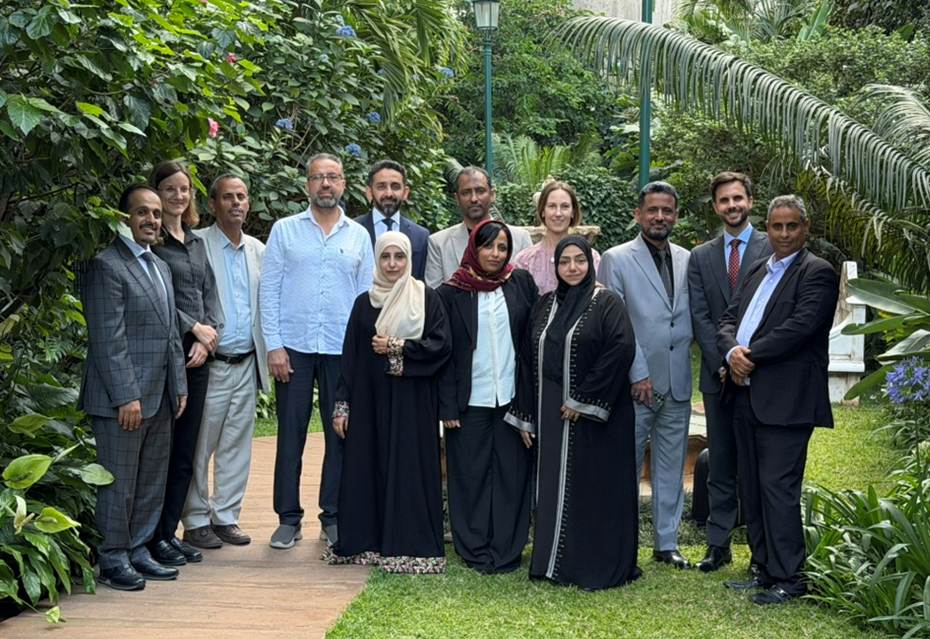
From 28 November to 1 December, the Second Technical Dialogue on Climate and Environmental Peacemaking in Yemen took place in Nairobi, Kenya. The convening built on the success of previous bilateral meetings and the First Technical Dialogue facilitated in August 2025 in Amman, which achieved a joint understanding of water issues, including as a driver of maladaptation, disputes and conflict. During the dialogue in Nairobi, the delegates initiated the development of a common vision and draft roadmap for cooperation to address water scarcity in Yemen.
This was the second joint meeting of technical and political representatives of the Government of Yemen (GOY) and the Southern Transitional Council (STC) convened by the European Institute of Peace as part of an agreed framework of environmental dialogue and cooperation. The process seeks to jointly address issues related to natural resources, environment and climate risks in support of peace benefits on stabilisation, reconciliation, and enhanced resilience. The dialogue included presentations on water governance and management at the national and local levels, providing a nuanced understanding that enabled practical discussions aimed at solving pressing water issues in alignment with the policy priorities of the relevant authorities.
The delegates engaged in in-depth discussions and strengthened the joint understanding on the most pressing water challenges in Yemen and their impact on local communities. Concretely, during the Second Technical Dialogue, strategic areas of action and practical solutions were discussed at the short-, medium-, and long-term to better manage water resources, support the sustainable provision of water services in urban and rural areas, and improve environmental management, all with a conflict-sensitive and peace-positive approach.
On the sidelines of the United Nations Environmental Assembly, the Kenyan capital offered a great opportunity for the delegates to meet international organisations working on addressing climate security risks in the Horn of Africa region and the Arabian Peninsula. In a visit to IGAD’s Climate Prediction and Applications Centre, the delegates explored how hazards emerging from climate change and environmental degradation can develop into disaster and conflict risks, and how to prevent them through early warning and respond to these risks with preparedness programmes. As a case study, IGAD analysed Cyclone Tej, which hit the Yemeni coast of Al-Mahra in October 2023. The delegates also visited UNEP’s Climate Security Advisor to Somalia to learn about a flagship project in Jowhar, Somalia, building resilience to climate change and improving water and food security through an integrated approach combining peacebuilding with climate action.
Water as a ground for conflict and cooperation in Yemen
In Yemen, where about 17 million people – almost half of the population – are estimated to experience water insecurity, physical water scarcity is exacerbated by the effects of armed conflict, which has undermined the capacity of communities and authorities to address environmental risks. In this context, water can exacerbate tensions, but it can also serve as an entry point for cooperation, trust-building, and dialogue. The Institute’s Environmental Dialogue and Cooperation Process seeks to transform environmental issues from a source of contention into opportunities to support peace and stability through joint efforts to foster resilience to climate and environmental risks. The First Technical Dialogue on Climate and Environmental Peacemaking in Yemen, concluded in August 2025, has marked a starting point for exploring these opportunities.
About the project
The Environmental Pathways for Reconciliation (EPfR) project aims to contribute to sustainable peace in Yemen through environmental dialogue and cooperation. With its inclusive approach, the project amplifies Yemeni voices in political and peace discussions, using environmental issues as entry points and elements for peace. The EPfR project is implemented by the European Institute of Peace with support from the German Federal Foreign Office and is part of the Weathering Risk Peace Pillar led by adelphi. You can read more about the project at www.epfryemen.org.
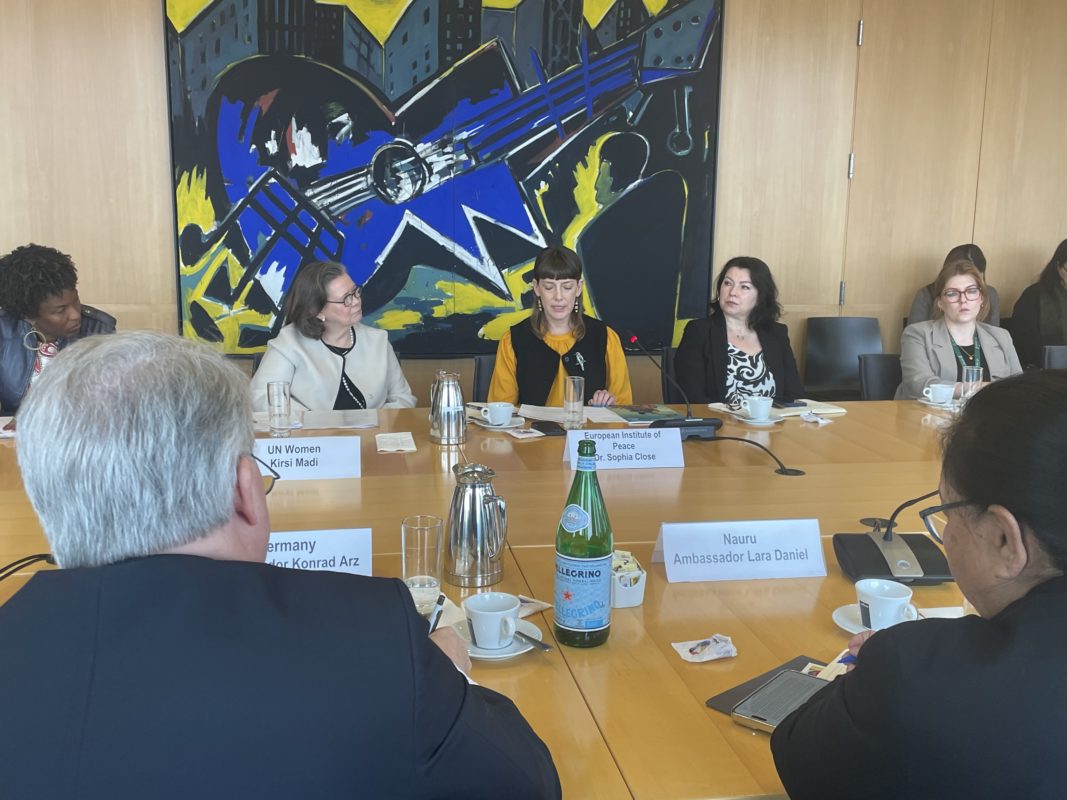
In October our Programme Manager Miriam Østergaard Reifferscheidt and Senior Advisor Sophia Close shared evidence from our Breaking Barriers, Making Peace research with practitioners and policymakers at events hosted by UN Women, Women’s Peace and Humanitarian Fund, Women’s International League for Peace and Freedom (WILPF), PartnersGlobal and Alliance for Peacebuilding (AfP) in New York and Washington DC.
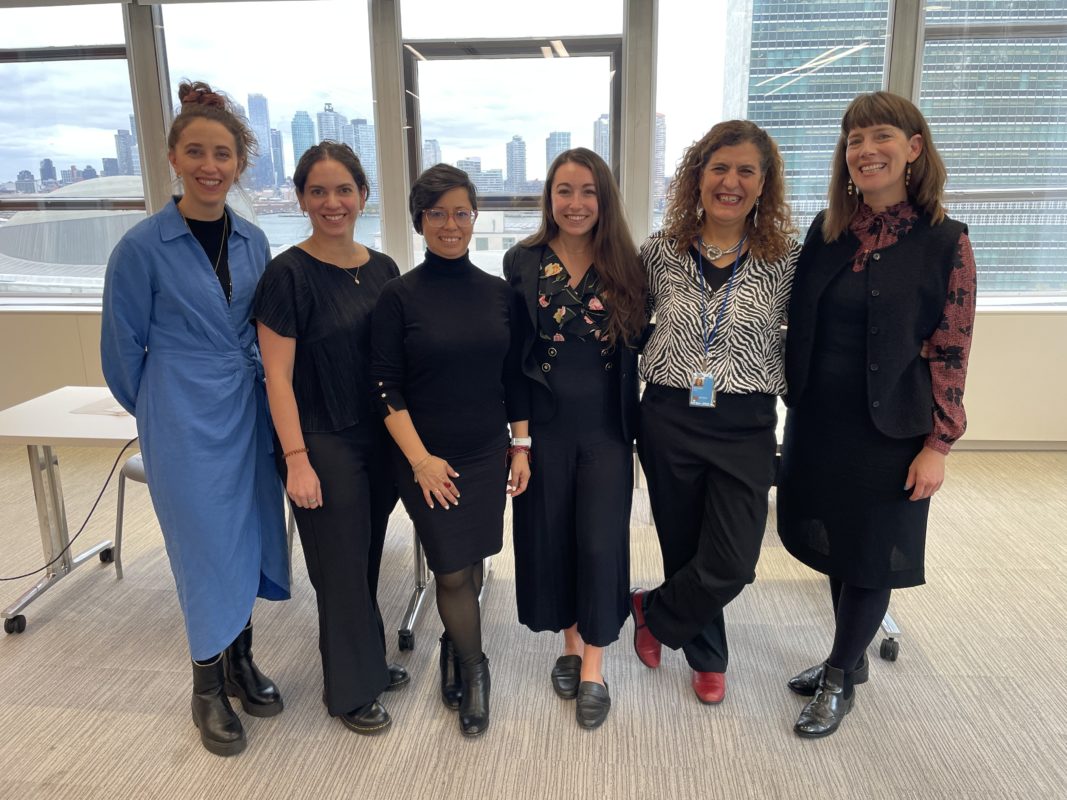
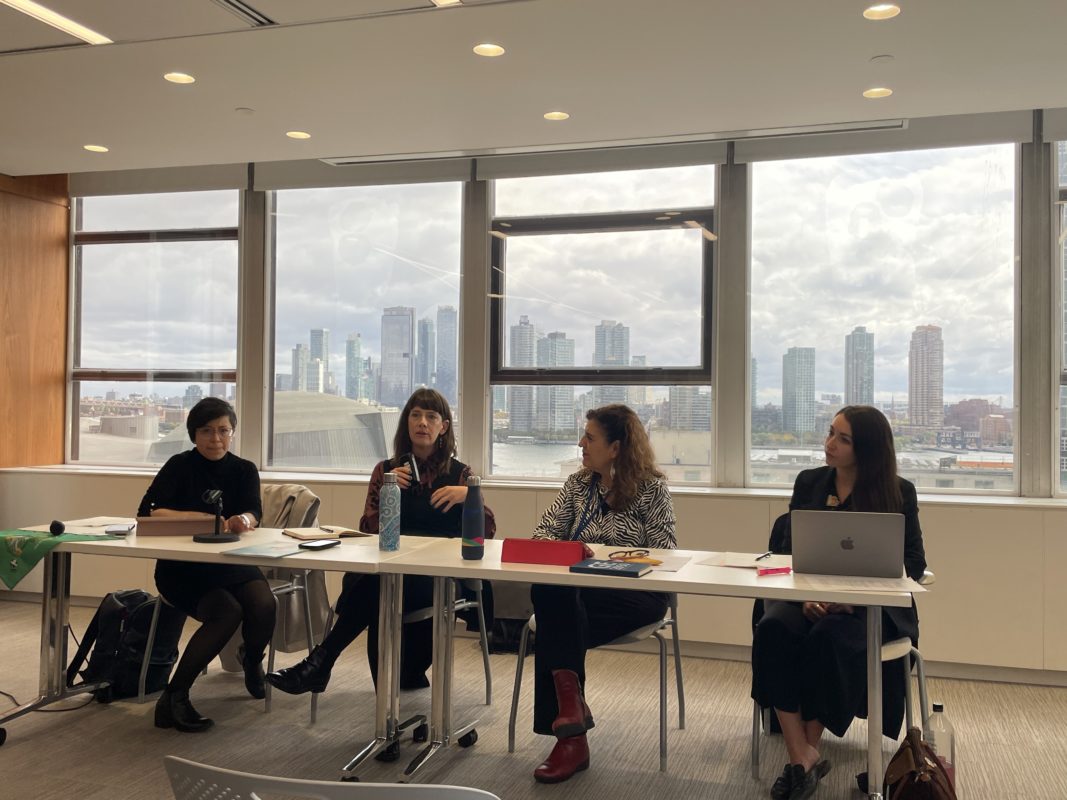
Our research across Myanmar, Ethiopia and Sudan reveals a sobering truth: 25 years after UNSCR 1325, the Women, Peace and Security agenda is ‘lost in plain sight’. We have robust normative frameworks but serious implementation gaps. We identified five persistent barriers limiting women’s meaningful participation in peacebuilding:
- Persistent patriarchal power and resistance – woven through international institutions and local structures. Many male-dominated organisations use ‘neutrality’ to avoid pushing for gender-inclusive outcomes.
- Threats to women’s security – Technology-facilitated GBV, conflict-related trauma and threats silence women’s leadership.
- Narrow, hierarchical and siloed efforts – Women remain mostly excluded from Track 1 peace processes despite 75% of peace processes involving women in informal peacebuilding.
- Incrementalism, exclusion and marginalisation – There’s a persistent belief that gradual inclusion is sufficient. This ignores the active systems maintaining exclusion.
- Underfunding and weak political investment – 99% of gender-related international aid fails to reach women’s rights organisations directly. Most receive funding for under 18 months, making sustained impact impossible.
These barriers aren’t accidental oversight. They are loaded with colonial history and oppressive gendered power dynamics, deeply embedded in global and local structures.
But we also found hope.
Our research assessed 12 promising practices to revive WPS implementation, including:
- Gender quotas: We call for mandated minimum 30% women in all preparatory talks, ceasefires and peace mediation processes. E.g. involving women in water project design increases effectiveness by up to seven times.
- Sub-national WPS Plans: Moving beyond traditional foreign affairs and defence silos to integrate climate resilience, economic security and health with culturally appropriate language.
- Radical reparative funding: Long-term, flexible core funding to feminist organisations, replacing colonial risk-management frameworks. Budget for physical, digital and psychosocial security as a participation right, not an extra.
- Building solidarity with men: Working with men in power to change discriminatory laws and social practices preventing women from participating in decision-making.
The climate-peace-security nexus is critical. From Myanmar’s monsoon disasters to Sudan’s desertification and Ethiopia’s droughts, climate shocks drive displacement, resource conflict and gendered insecurity. Women’s leadership in adaptation and resource governance must be recognised as a strategic security investment, not an add-on.
Resisting militarism is central to effective WPS implementation. Militarised values that elevate hierarchy, domination and force while sidelining cooperation, inclusion and care are inherently patriarchal. Without confronting militarism, new political formations simply reproduce patriarchal structures.
This isn’t only about justice: it’s about effectiveness. Our evidence shows meaningful women’s participation is a strategic imperative for sustainable peace.
Thanks to our partners for creating space for these useful conversations, and to all the women peacebuilders globally, and especially in Myanmar, Ethiopia and Sudan whose courage and insights shaped this research.
The full research is available here.
On 5 November 2025, UN Women, PAX and the European Institute of Peace jointly organised a high-level discussion on “Women, Peace and Security at a Crossroads: Funding, Localising and Reclaiming the Next 25 Years” at the European Parliament. Marking the 25th anniversary of UNSCR 1325 and the European Parliament Gender Equality Week, the event was co-hosted by MEP Abir Al-Sahlani (Renew), MEP Evin Incir (S&D), and MEP Hannah Neumann (The Greens) and brought together frontline activists from Iraq, Sudan, and Ukraine, Members of the European Parliament, EU Member States, UN representatives, and civil society leaders.
The message was clear: the next 25 years of WPS must be funded, localised, and reclaimed.
In the EU and Beyond
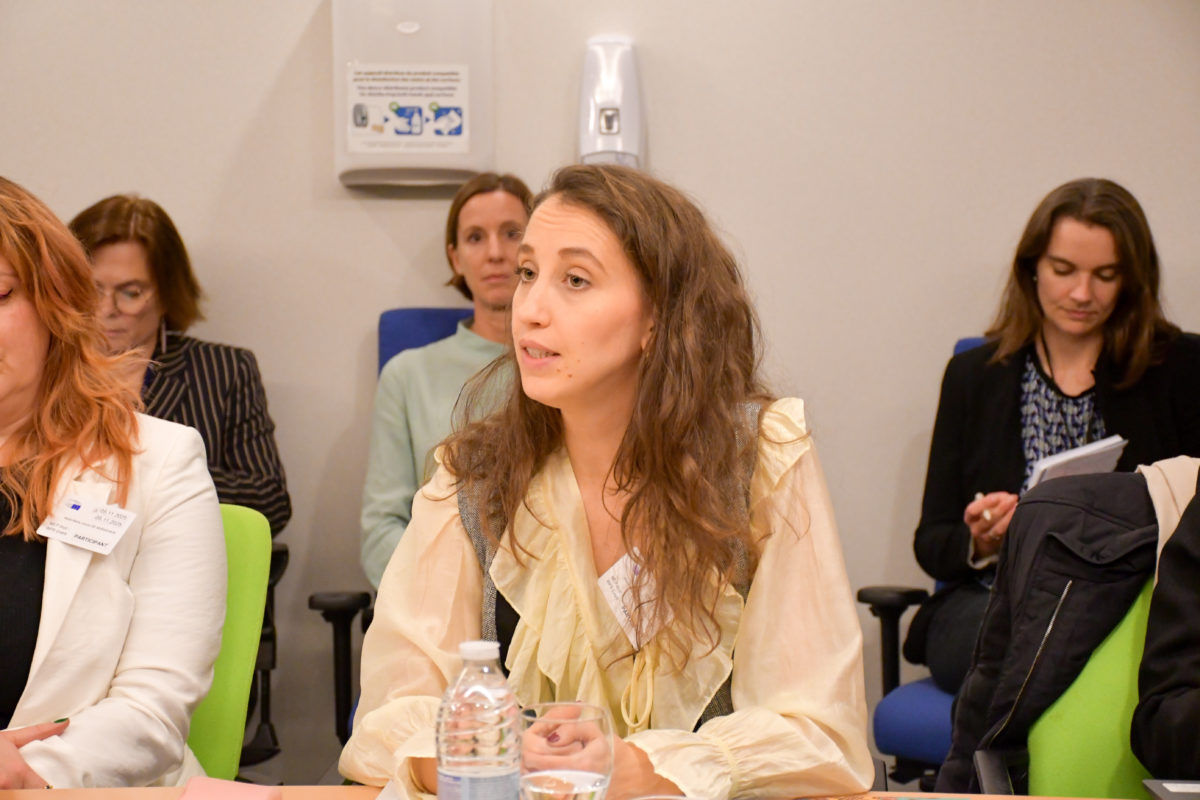
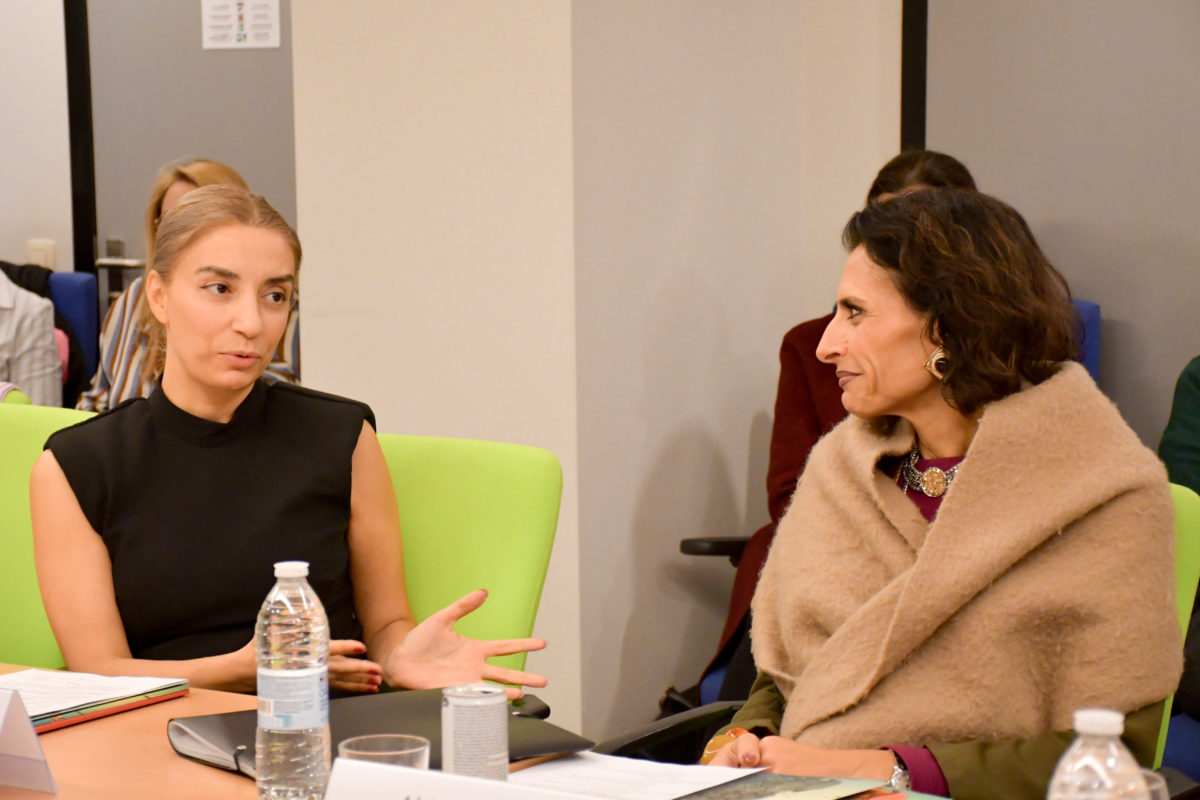
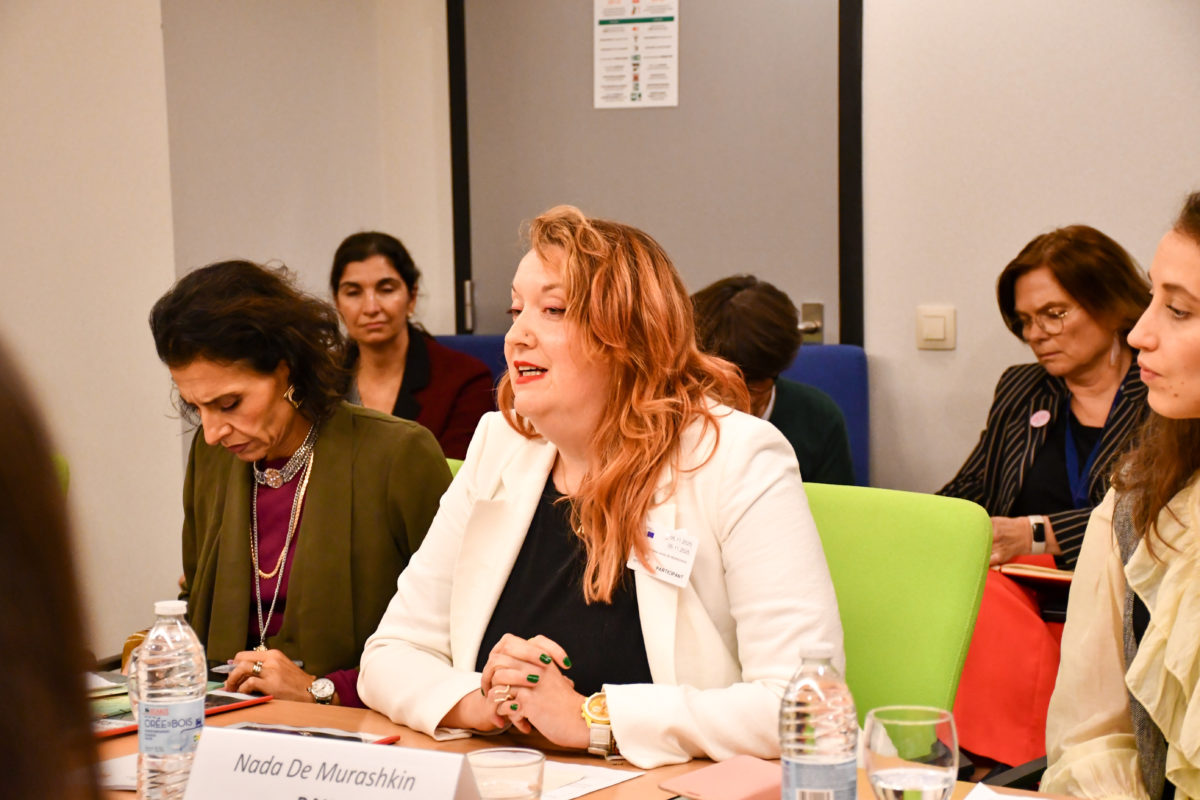
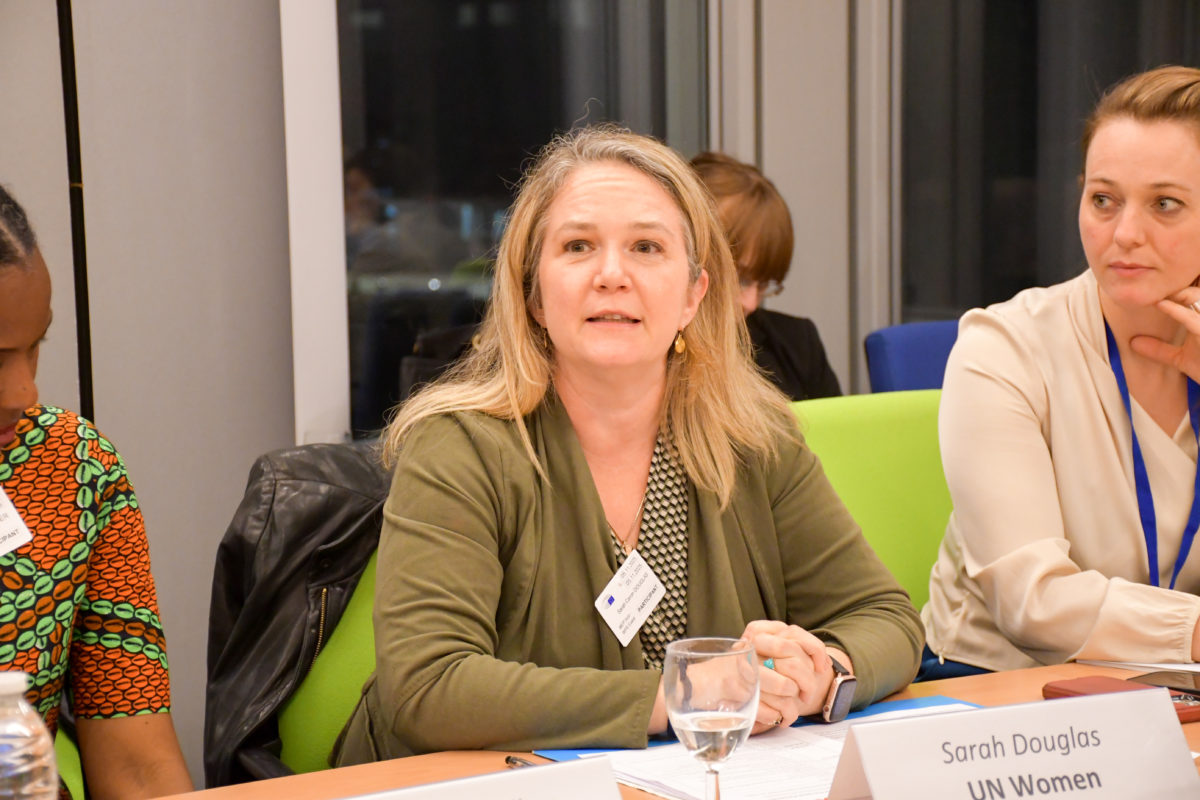
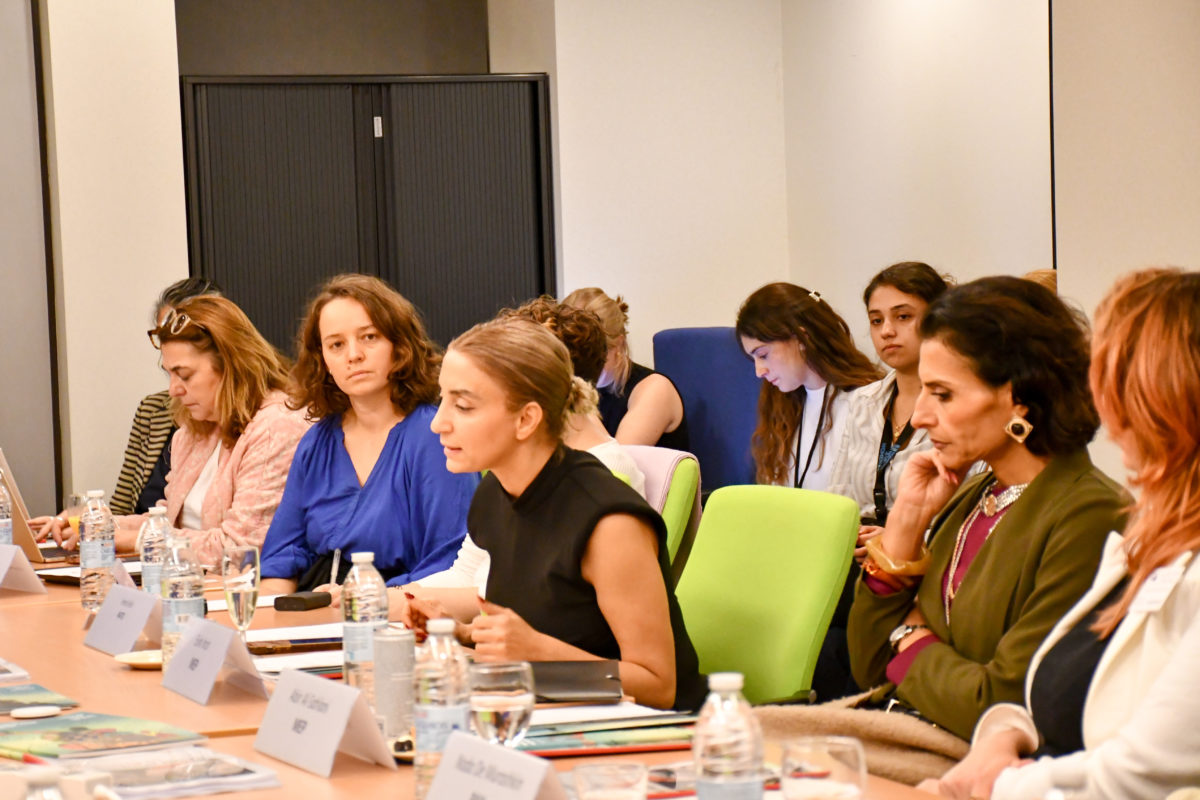
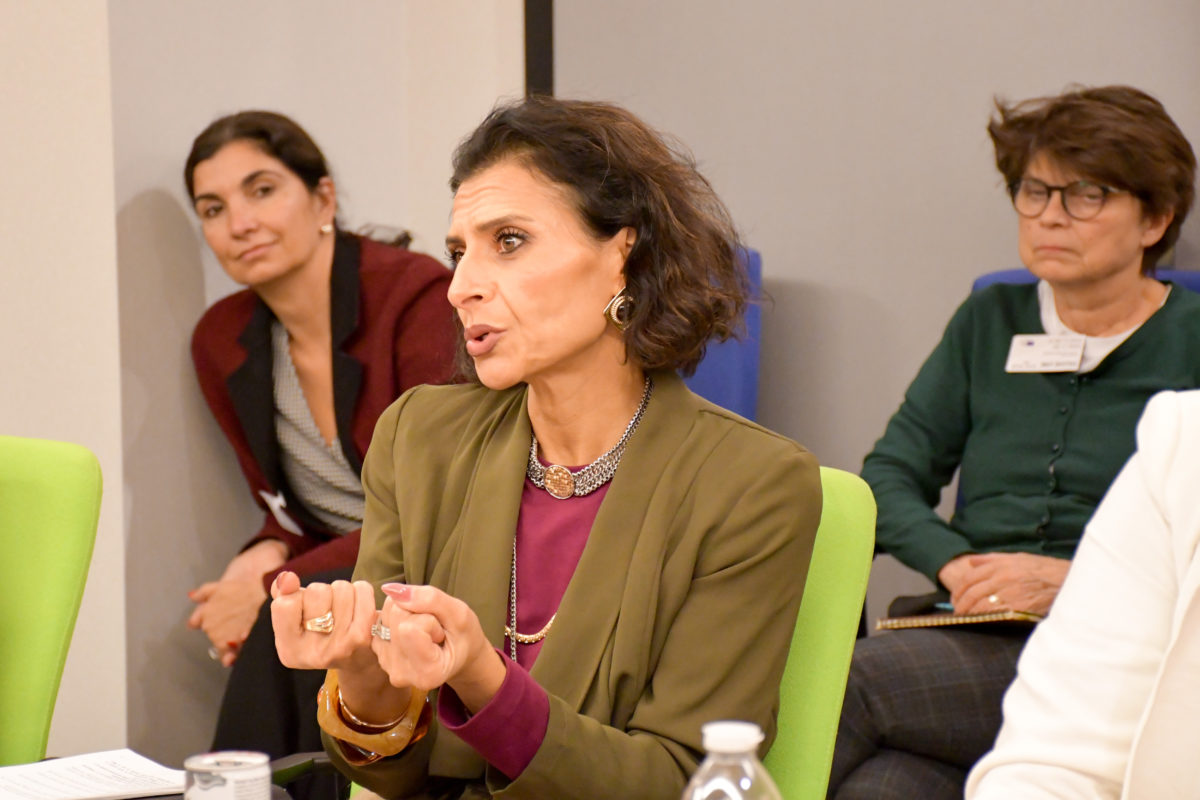
Evin Incir MEP warned of a growing backlash against the WPS agenda within the EU, stressing that meaningful progress requires cross-party cooperation and partnerships between institutions and civil society. She pointed to crises in Ukraine, Palestine, Sudan, and Syria, and reminded participants that violence against women persists both in conflict and in peace.
Abir Al-Sahlani MEP reflected on the changing nature of conflict, now more complex and societal, and cautioned that international law is being challenged as never before. She noted that many principles once taken for granted are now questioned, risking the erosion of commitments to gender equality and peace.
Marit Maij MEP added that women are not only victims of war, but also key to building peace: the face of conflict is often on women, but so is the face of the solution.
Sarah Douglas (Deputy Chief of Peace and Security at UN Women) described alarming trends: the proportion of women living in conflict zones has quadrupled, and conflict-related sexual violence has increased by 85%. At the same time, funding for women’s organisations has declined.
Miriam Reifferscheidt (Gender and Peacemaking Programme Manager at the European Institute of Peace) highlighted that defence spending is surging while resources for women and peace initiatives are shrinking. Donors often provide only short-term, activity-based projects, leaving women’s organisations weak and dependent.
Nada Murashkin (Policy Advisor Gender, Peace and Security at PAX) asked participants to think carefully about “whose peace” is being pursued, stressing that without accountability there is no real peace. WPS is a call to action, and policymakers are urged to translate commitments into concrete, justice-orientated measures.
Voices from the Ground
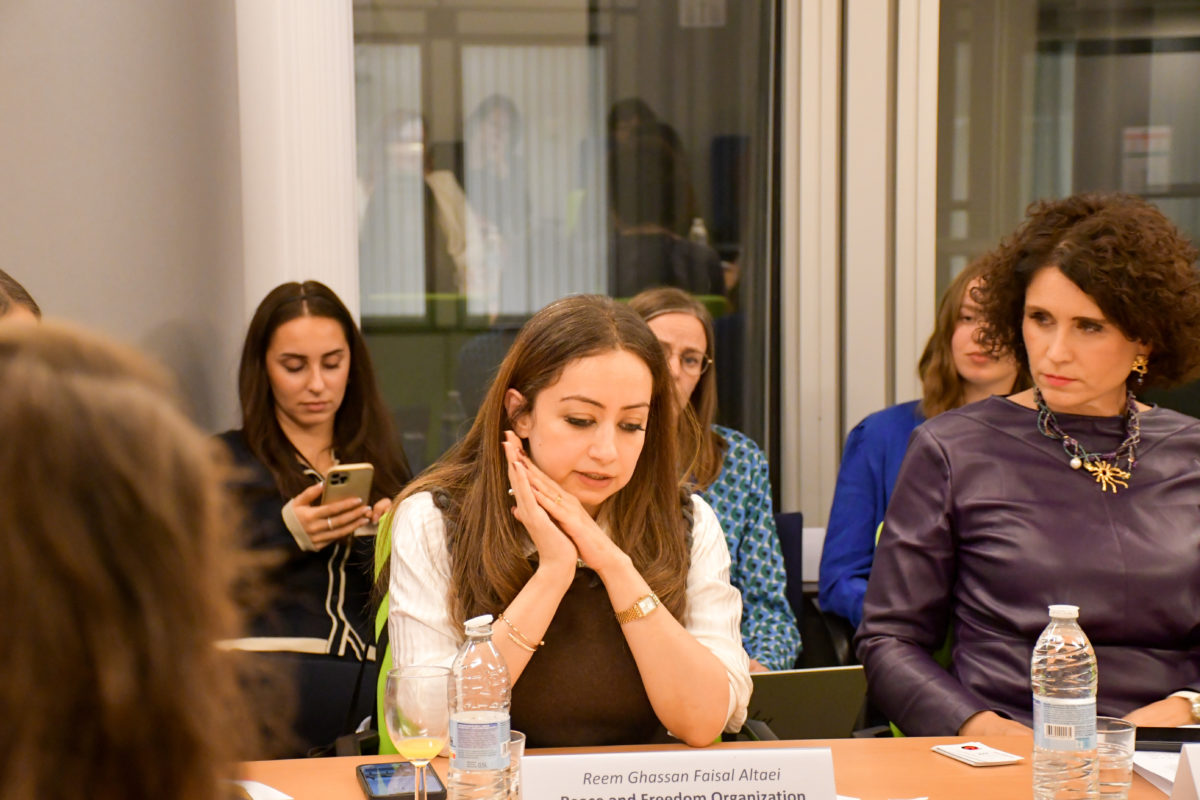
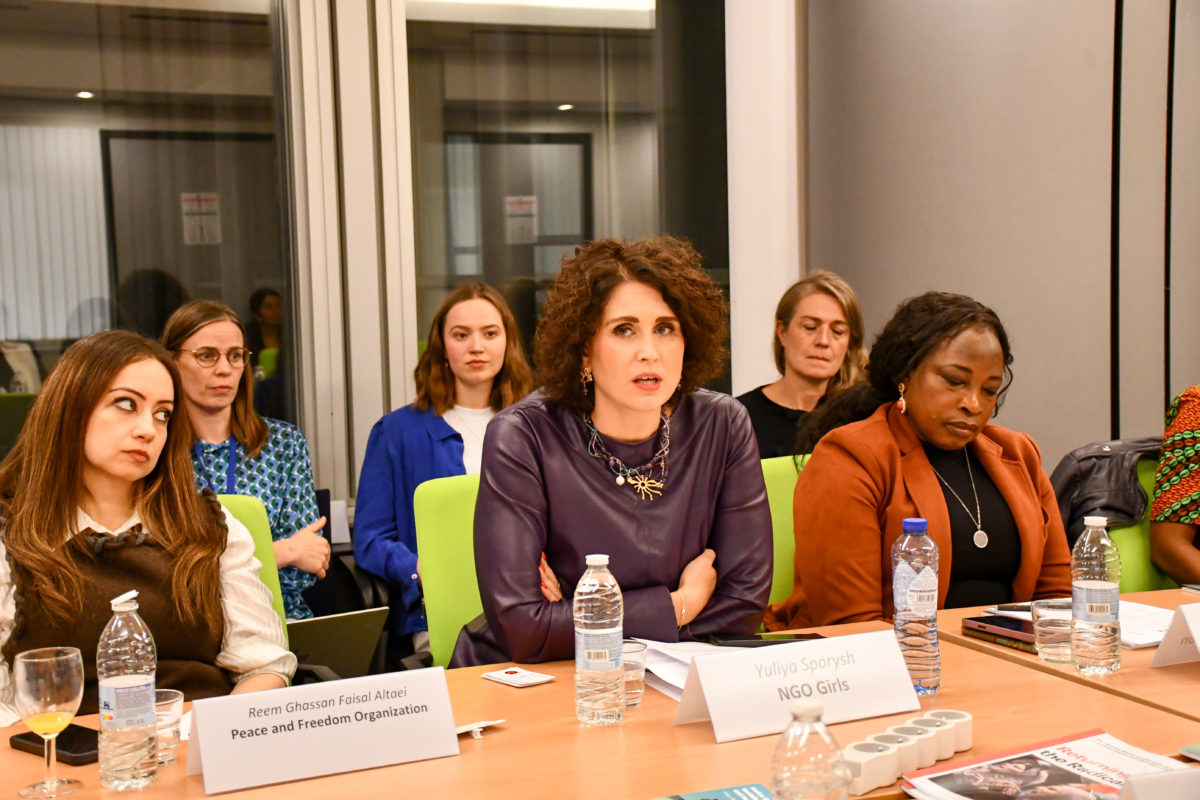
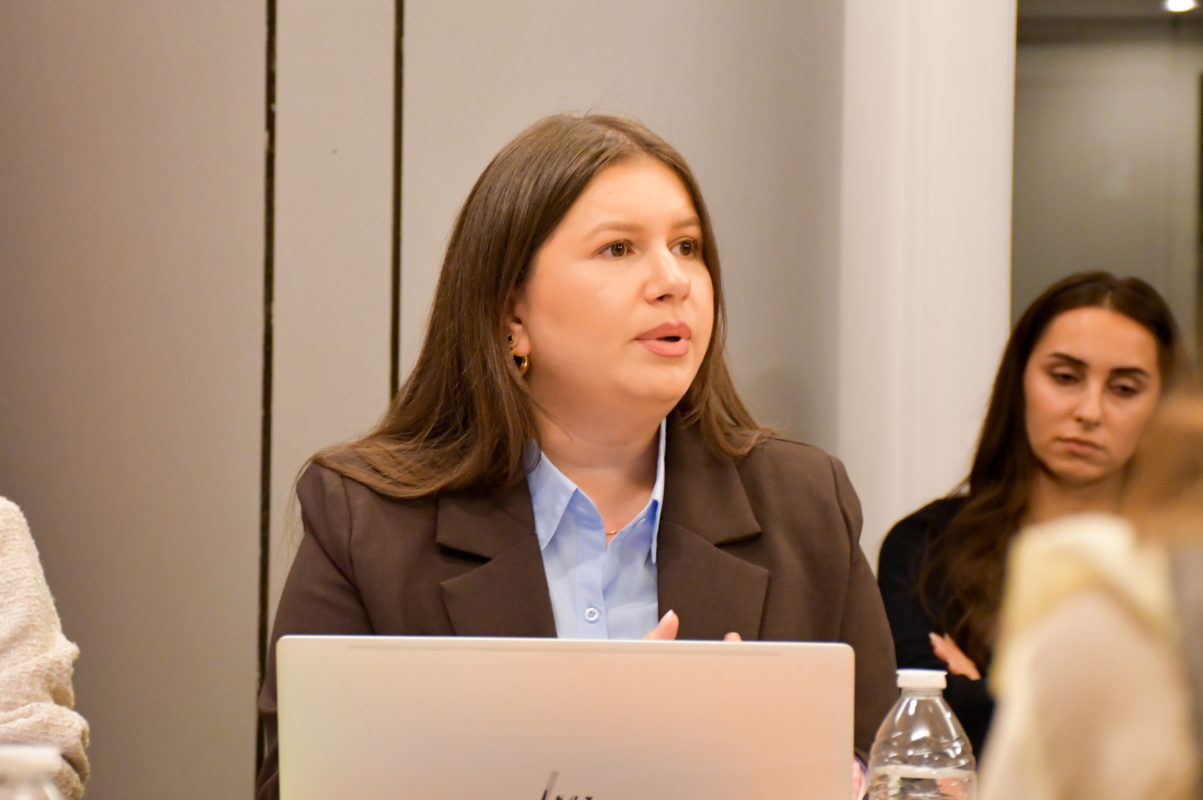
Reem Ghassan (Women Programme Manager at Peace and Freedom Organization (PFO), a human rights defender based in Erbil, Iraq, explained that the WPS agenda is often dismissed by political leaders, while armed groups and militias divert funding away from civil society. Cutting support, she warned, strengthens extremist mindsets and undermines stability.
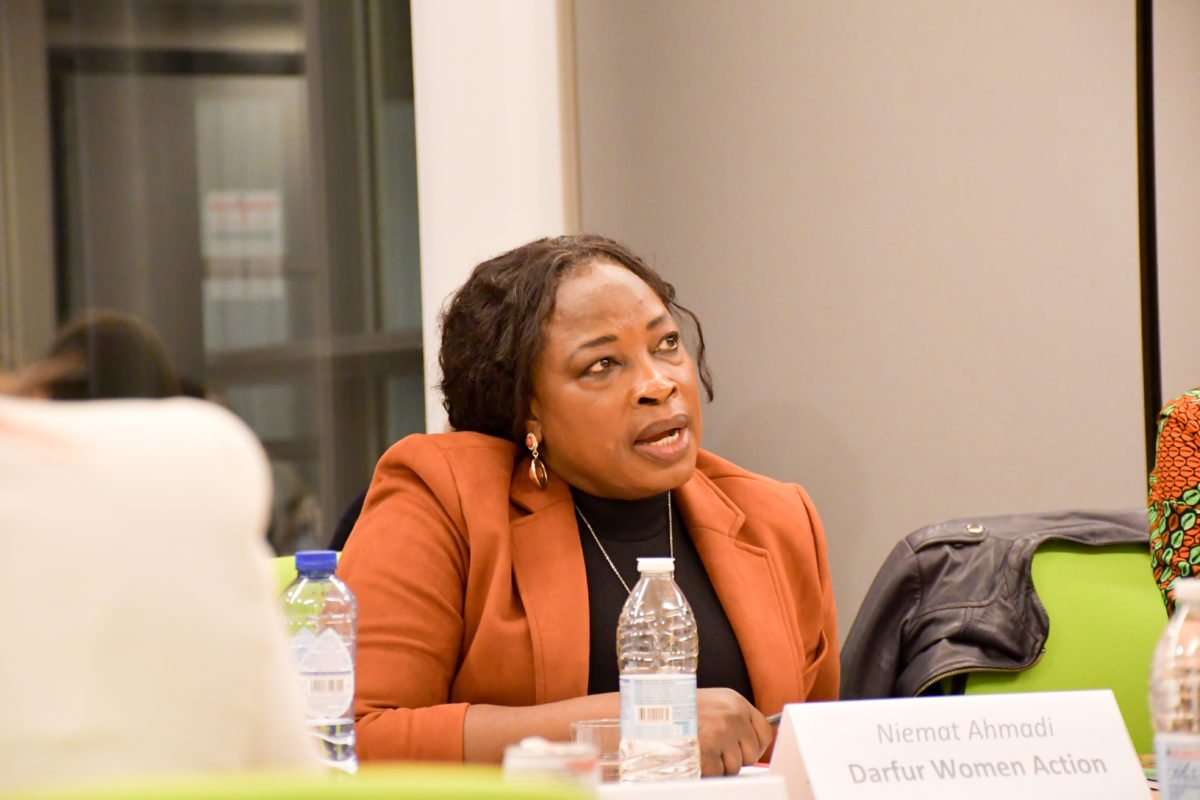
Sudanese activist Niemat Ahmadi (President, Darfur Women Action Group, CEO and Founder, Unique22 Strategies) gave a powerful testimony of women facing starvation, slaughter, and violence, yet continuing to care for others and lead ceasefire efforts. She insisted that women earned their place and deserve to be at the negotiation table.
Ukrainian Expert in Gender Equality, Governance, and GBV, Yuliya Sporysh (PhD, Founder and Director, NGO GIRLS / ГО “Дівчата”) described the daily reality of war, where she checks in with her team each day to confirm they are alive. More than 75,000 women serve in the armed forces, yet 95 safe spaces for women have closed due to lack of funding. Gender-based violence has risen by 25% annually, while women-led organisations have almost no funding despite being on the frontlines.
Tonni Ann Brodber (Head of Secretariat, UN Women’s Peace and Humanitarian Fund) emphasized that their nine-year-old mechanism is the only UN mechanism that directly reaches civil society quickly and effectively. She cautioned that “one hand cannot clap,” stressing the need for collaboration and direct support for activists.
Armenian activist, Knarik Mkrtchyan warned against supporting women only in reactive positions, urging investment in prevention, early warning systems, and intersectional approaches to resilience.
Reclaiming the WPS Agenda: the Way Forward
1. Representation and Participation
- Guarantee women’s direct participation in peace processes and recognise women as key actors of peacebuilding not only victims.
- Apply gender quotas at all levels of peace processes and insist on a minimum 30 percent women representation to ensure a critical mass for real influence
- Uphold commitments to feminist agendas.
- Ensure reconstruction projects include women at the table (in bigger projects as well – not just in micro-initiatives such as bee-keeping and hairdressing).
- Move WPS policies beyond treating protection and participation as separate pillars by transforming the systems that make women’s participation dangerous.
2. Funding and Resources
- Provide long-term, flexible, equitable core funding to feminist organisations and movements.
- Move away from short-term, activity-based projects that keep organisations weak and dependent.
- Budget for physical, digital, and psychosocial security as a participation right; funding evacuation routes, digital encryption, mental health and trauma care, and legal defense for women leaders.
- Sustain funding and political backing for grassroots WPS actors to prevent the expansion of armed groups.
- Guarantee funding for survivors of sexual violence.
- Invest in existing civil society-led, feminist and rapid funding mechanisms and remove the risk-management away from grassroots organisations and individuals.
- Cover essential operational needs like office space and equipment.
3. Protection and Safety
- Adopt zero-tolerance policies against harassment and violence, online and offline.
- Provide self-care funds for staff working in high-stress environments
- Support frontline activists with rapid, accessible funds and protection windows.
- Recognize safety as the enabling condition of participation, not a reason for exclusion.
- Apply a focus of human security at all levels of financing including defence spending.
4. Accountability and Justice
- Adopt accountability as a fifth pillar of the WPS agenda, incorporating it into the EU-WPS action plan and into the CLIPS (Country Level Implementation Plans).
- Build accountability processes on inclusive consultations, systematic monitoring, independent audits, and enforcement of sanctions.
- Apply feminist analysis to financial shifts and set targets to redirect defence spending toward human security.
- Prioritize ceasefires and justice as critical, especially for relief and recovery.
5. Intersectionality, Masculinities, and Prevention
- Integrate a masculinities lens into foreign policy to counter militarized masculinities and engage men and boys as allies.
- Explore intersectional and decolonial approaches, creating safe and brave spaces for civil society partners.
- Mainstream human security, inclusivity, and intersectionality to ensure resilience during peacetime.
- Reinforce the preventive dimension of WPS, investing in women’s grassroots organisations and early warning systems and reporting mechanisms.
6. Bridging Global and Local Efforts
- Create bridges between actors to complement each other’s roles (including between UN and CSOs).
- Recognize WPS investment as prevention and a strategy for peace, not a strategy to react and respond to conflict.
- Focus donor support on independent civil society actors who share the vision of peacebuilding, rather than government-endorsed organisations.
- Ensure grassroots partnerships deliver the biggest and most sustainable impact.
Closing the event, moderator Sandra Melone (Chairwoman, Search for Common Ground Europe and Co-President, Elles du Sahel) captured the spirit of the discussion: despite the challenges, there remains hope and possibility galore. For the Europe that we want, the WPS agenda we want, progress must be accelerated, alliances built, and conversations made increasingly specific—including with unlikely partners.
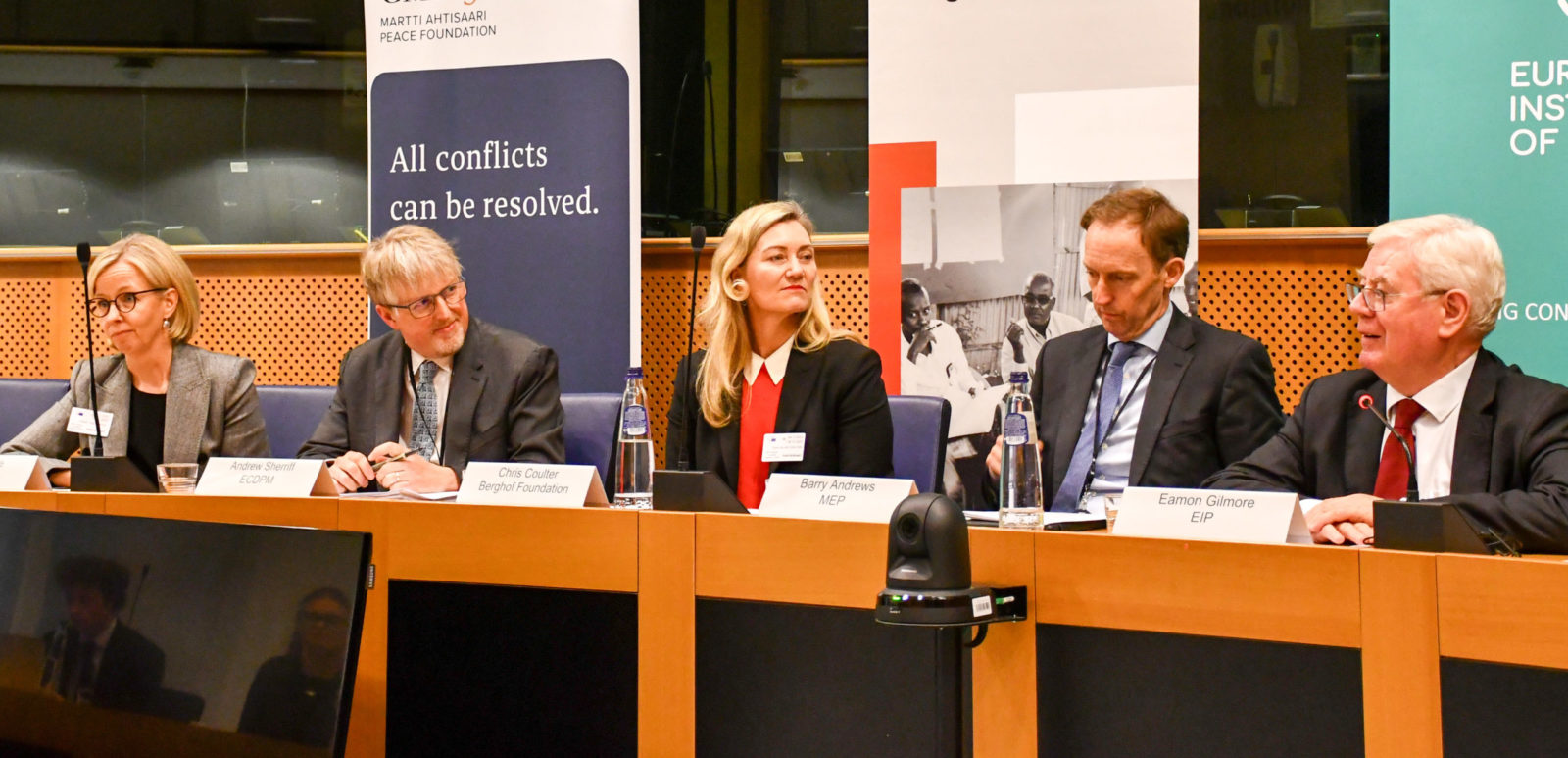
On Tuesday 4 November, the European Institute of Peace co-hosted a high-level roundtable at the European Parliament, titled “Investing in Peace: The role of dialogue and conflict mediation in ensuring Europe’s security” with CMI – Martti Ahtisaari Peace Foundation, the Berghof Foundation, and Barry Andrews MEP.
The roundtable made the case for investing in peacemaking in the European Union’s Multiannual Financial Framework (MFF) 2028-34, which will be negotiated between the European Parliament, European Commission and Council of the EU for the next two years.
Eamon Gilmore, Senior Advisor at the Institute, set the scene by highlighting how, in a world with more conflict than at any time since the Second World War, there is a pressing need to make and sustain peace. This, however, requires significant investment of both time and resources: “If you want peace, you need to invest in it. Peace takes effort, investment, resources, and human power to make it happen, and needs far more support than it is getting.”
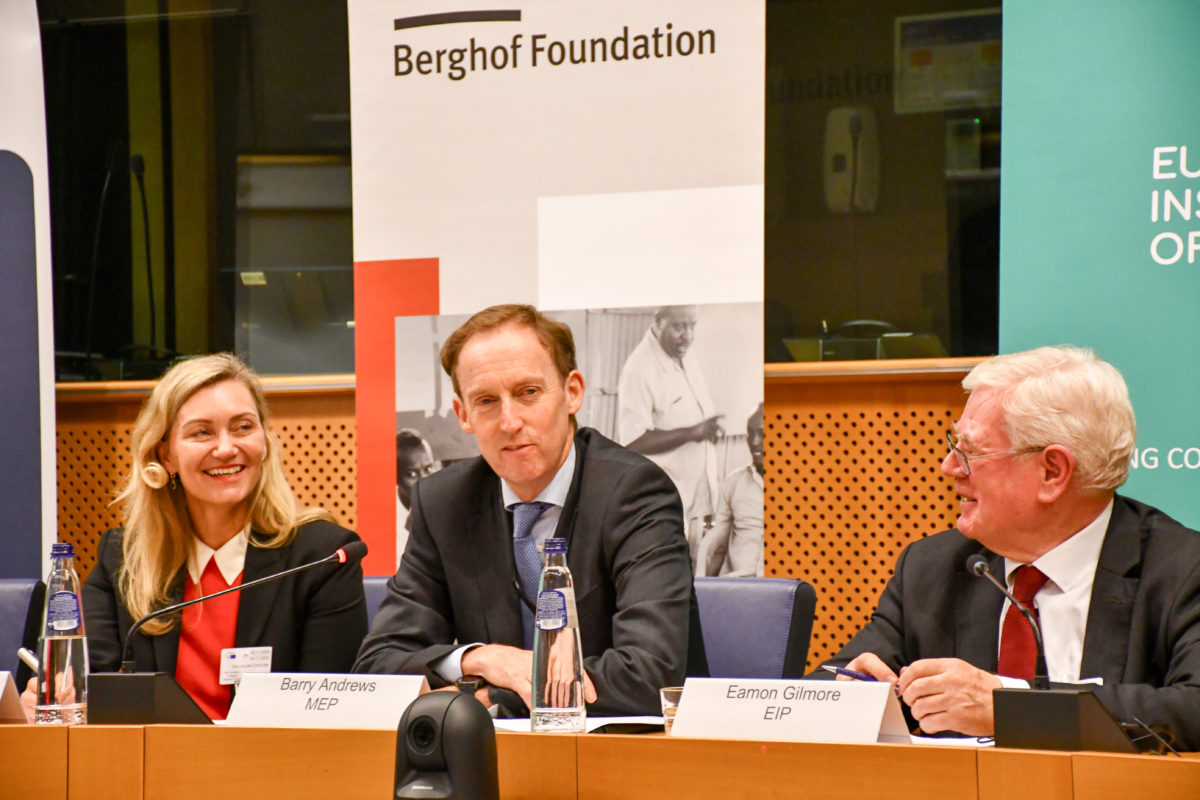
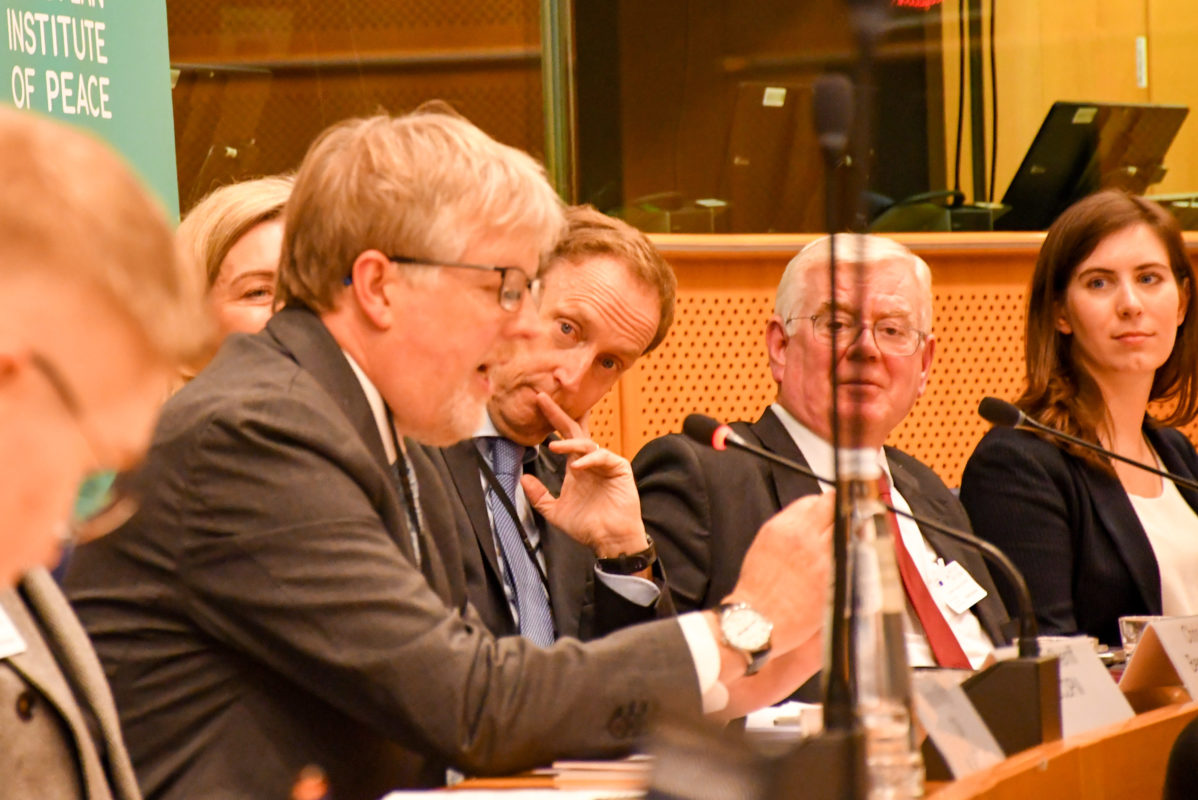
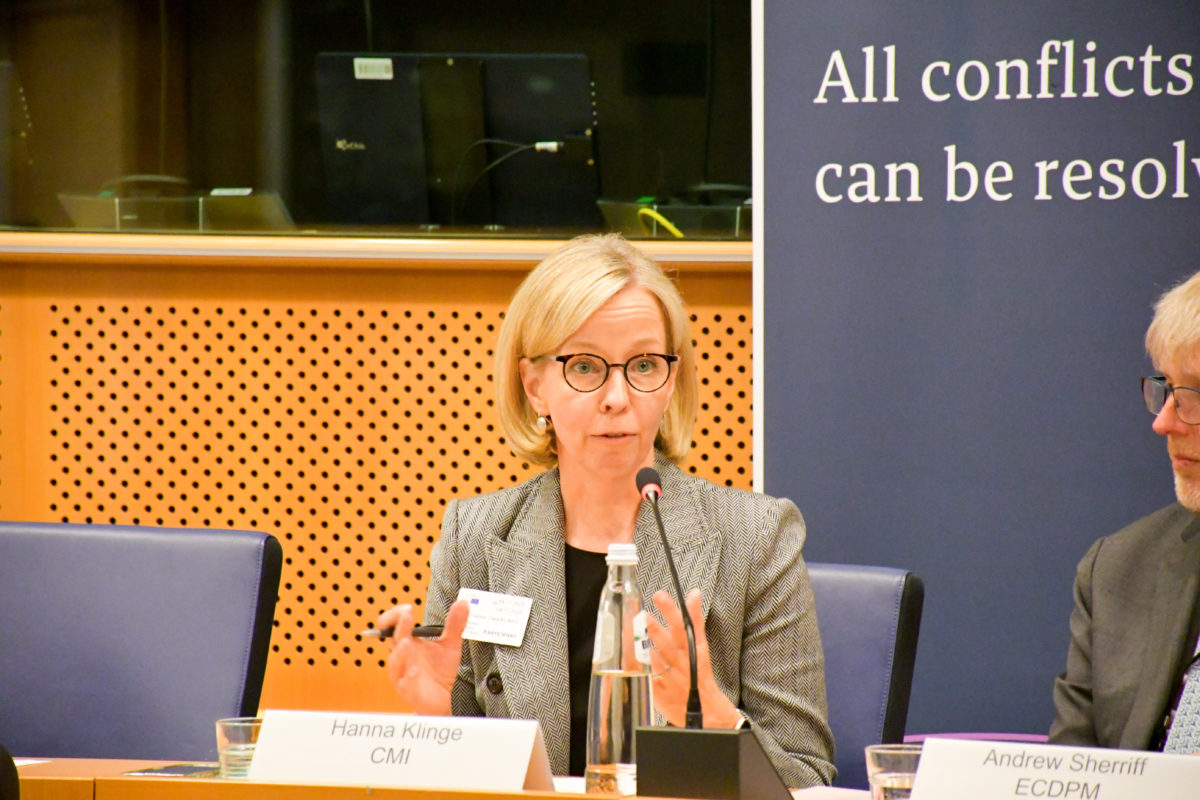
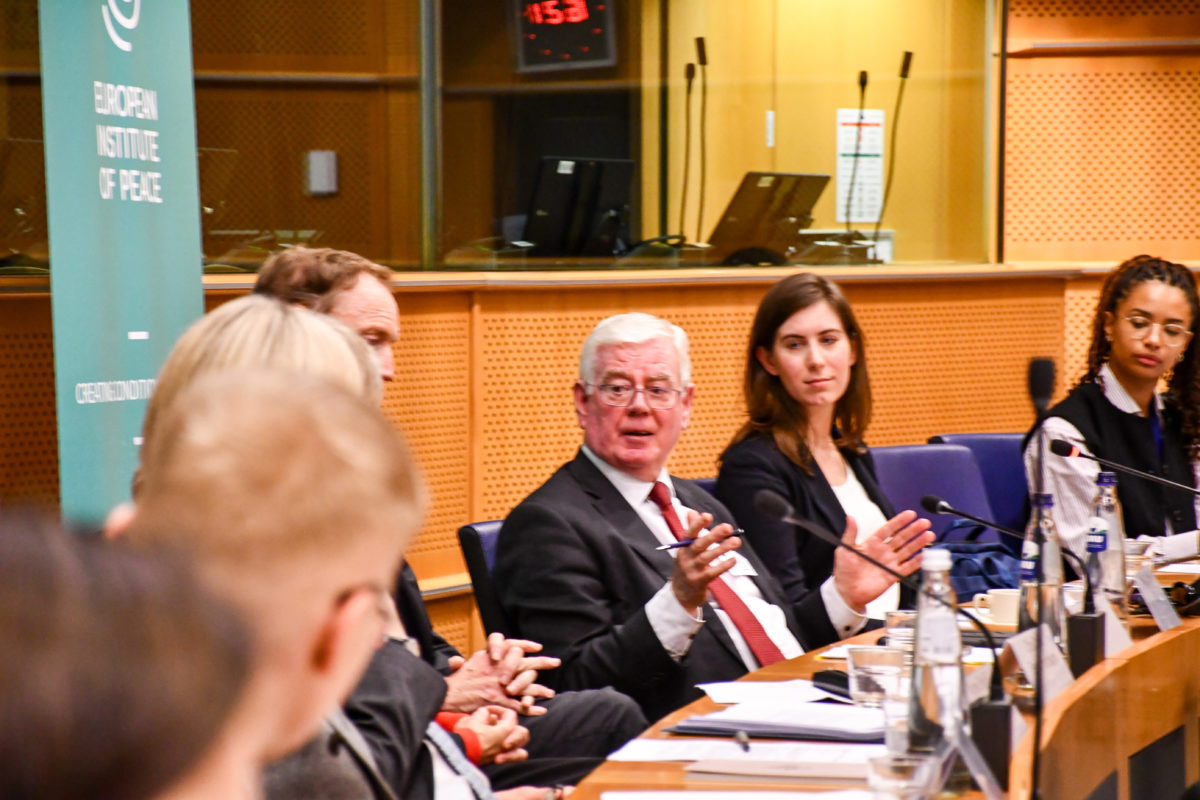
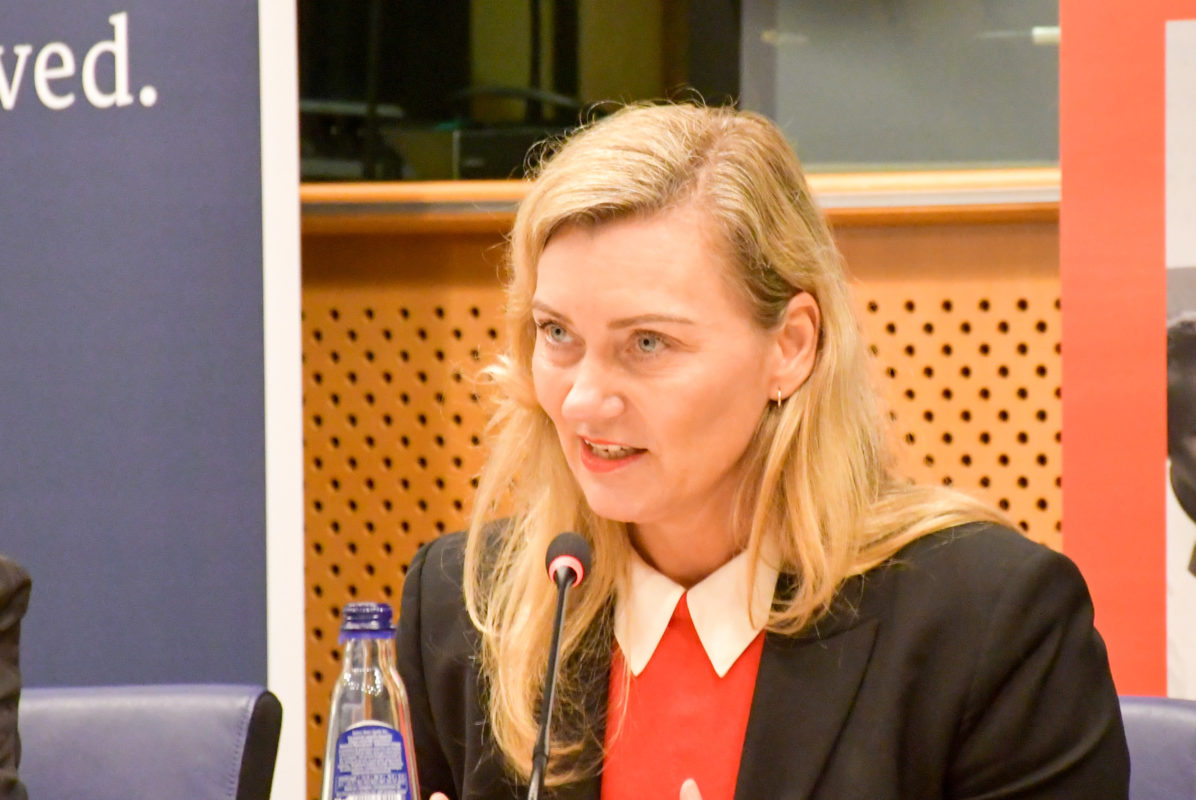
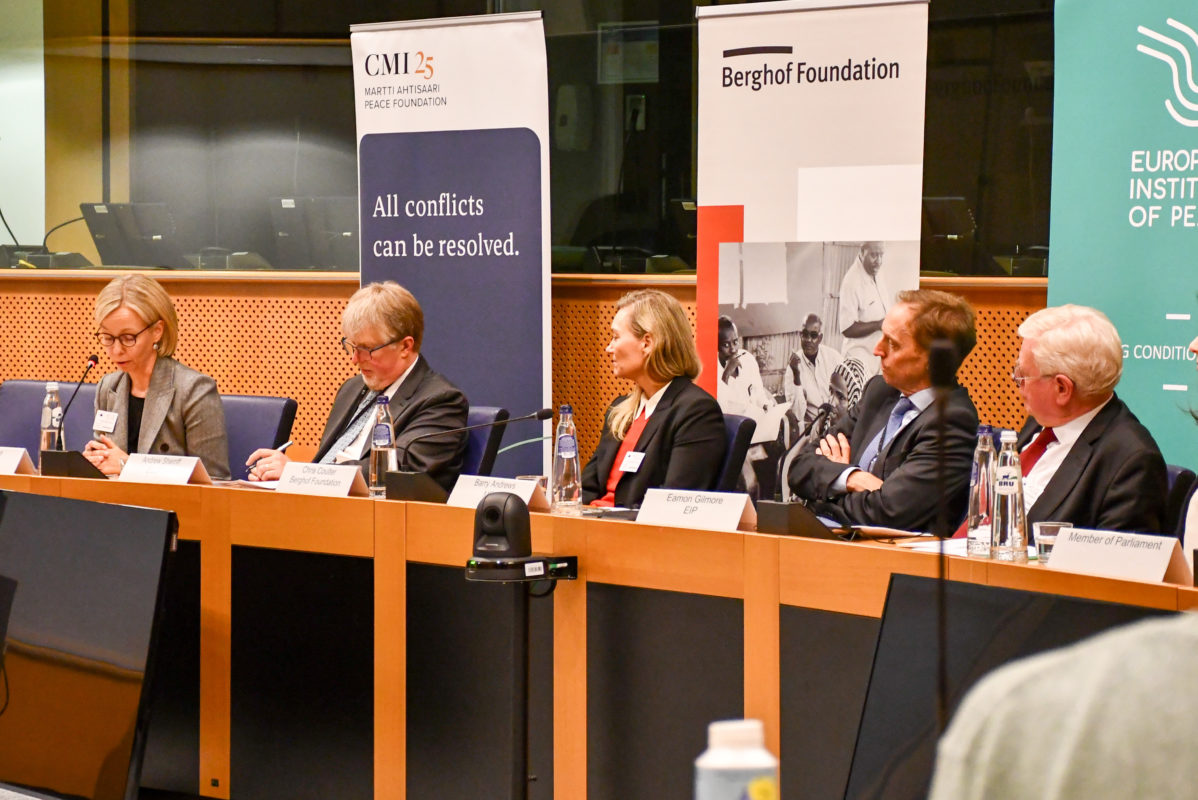
Throughout the discussion, speakers Barry Andrews MEP (Renew Europe, Ireland), Chris Coulter (Executive Director, Berghof Foundation), Hanna Klinge, (Deputy CEO, CMI) and Andrew Sherriff (Associate Director of Institutional Relations and Partnerships, ECDPM), brought up practical examples of their work in peacemaking, and highlighted a few key messages about European investment in peace:
- Peacemaking is cost-effective and sustainable. Military spending can be extremely costly, with a single fighter jet in the range of 70-110 million euros. Peace investment, on the other hand, is less expensive: a widely cited study by the World Bank states that for every dollar spent in conflict prevention 16 dollars can be saved in conflict costs: Investing in peacemaking is not just a moral imperative, but also a smart economic decision.
- Dialogue and mediation take time and resources but deliver real results. Peace processes require formal and informal networks, a clear understanding of local contexts and agendas, resources, and human powers. They also do not happen overnight: speakers highlighted how the Irish and Colombian peace processes went on for more than a decade. But peace is worth the wait, and the investment.
- The new MFF will need to balance defence spending with peace and development priorities. Military investment is very costly and cannot guarantee European security alone; it will need to be accompanied by investment in diplomacy, mediation, and conflict prevention that tackle root causes and support peacebuilders.
- This is a crucial moment for the EU to reaffirm its role as a leader in supporting sustainable peace around the world. As other global powers are investing less and less in sustainable peace Europe can and should step up to fill the gaps. This will strengthen the perception of EU’s external action worldwide and contribute to European security without compromising the EU’s values.
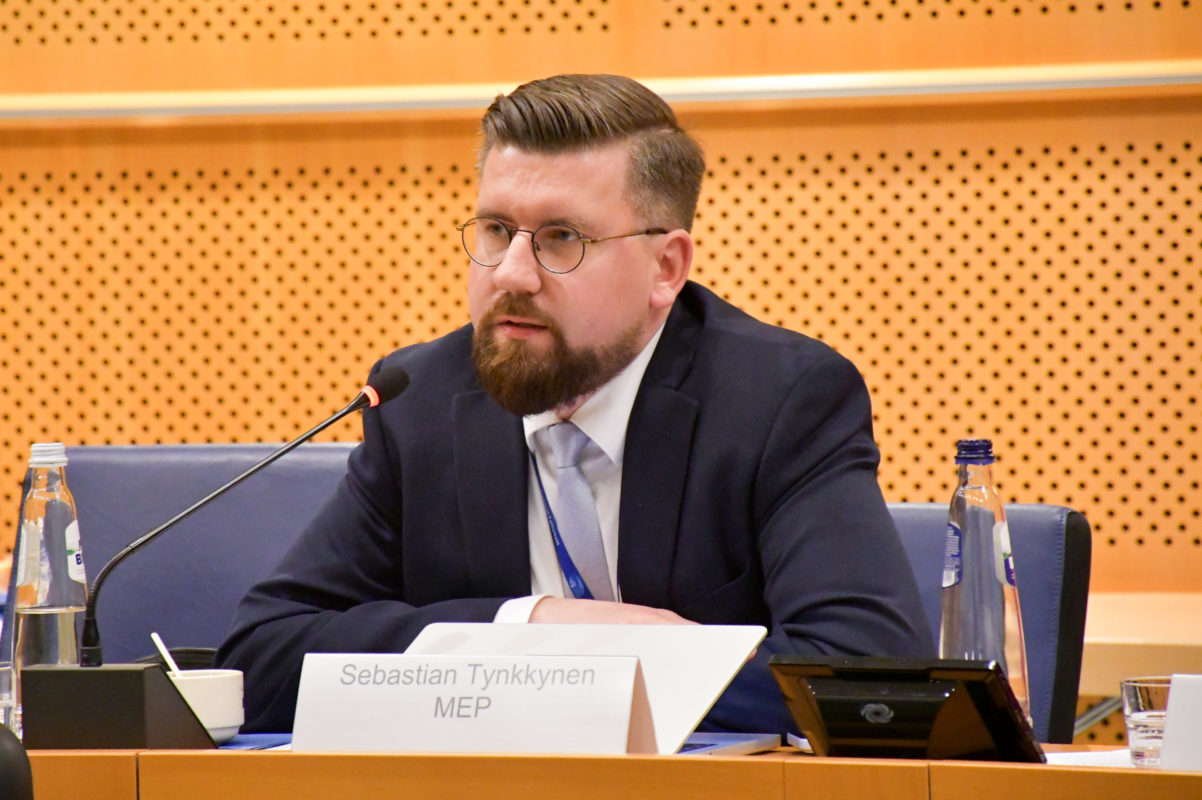
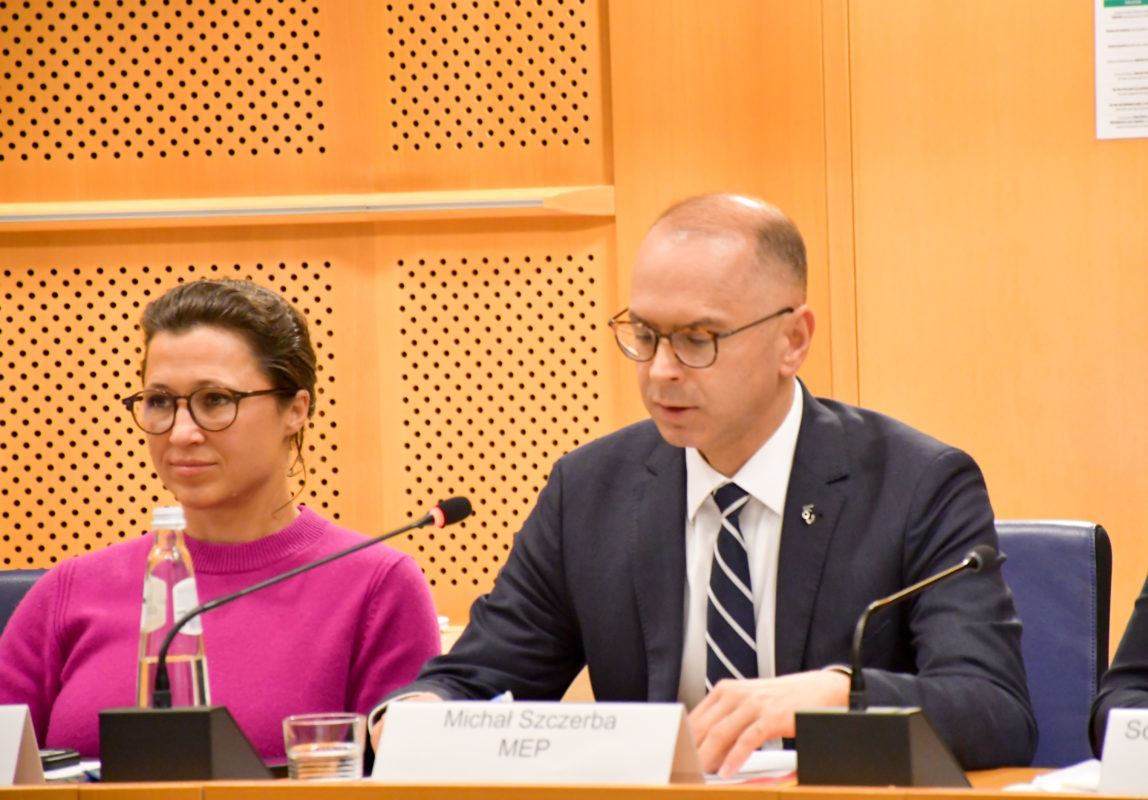
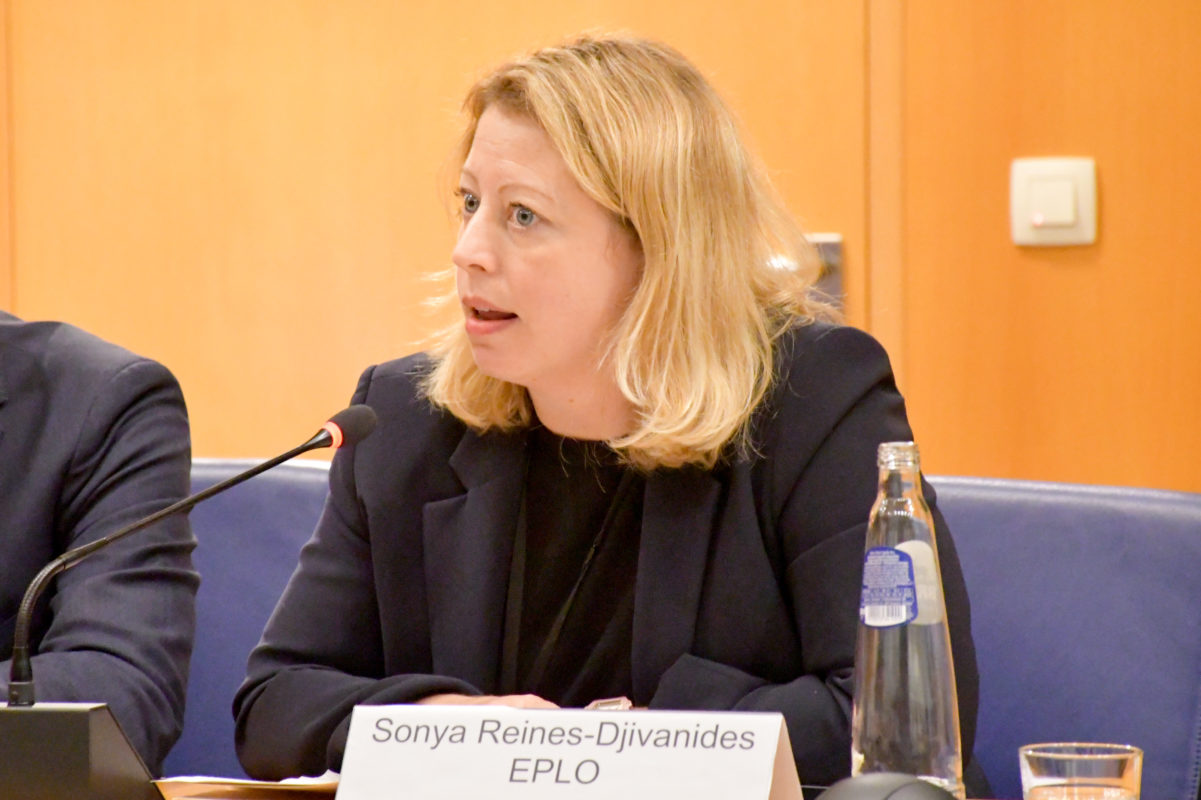
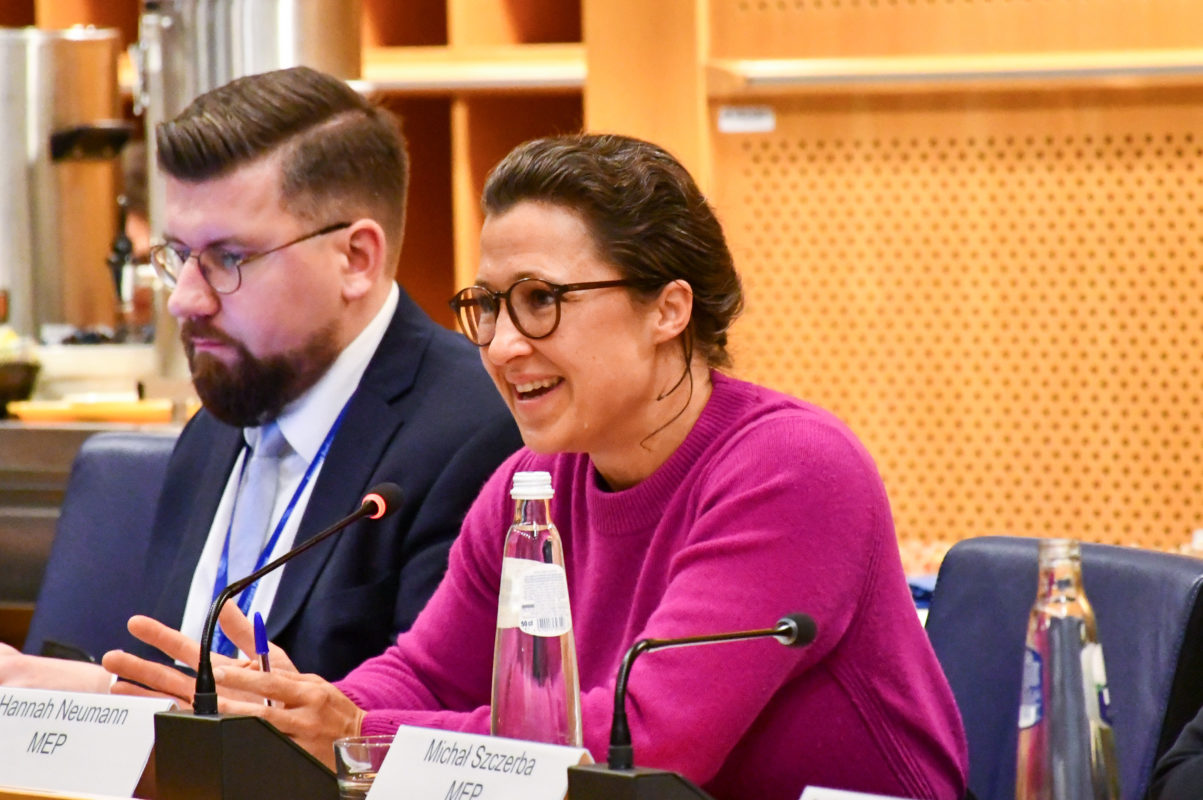
The roundtable also saw interventions from Michal Szczerba MEP (EPP, Poland, and advisor to the Institute’s Board), Hannah Neumann MEP (The Greens, Germany), Sebastian Tynkkynen MEP (ECR, Finland), and Sonya Reines-Djivanides (Executive Director, EPLO), who provided a wide range of perspectives on Europe’s global role and on investing in peacemaking in the next MFF.
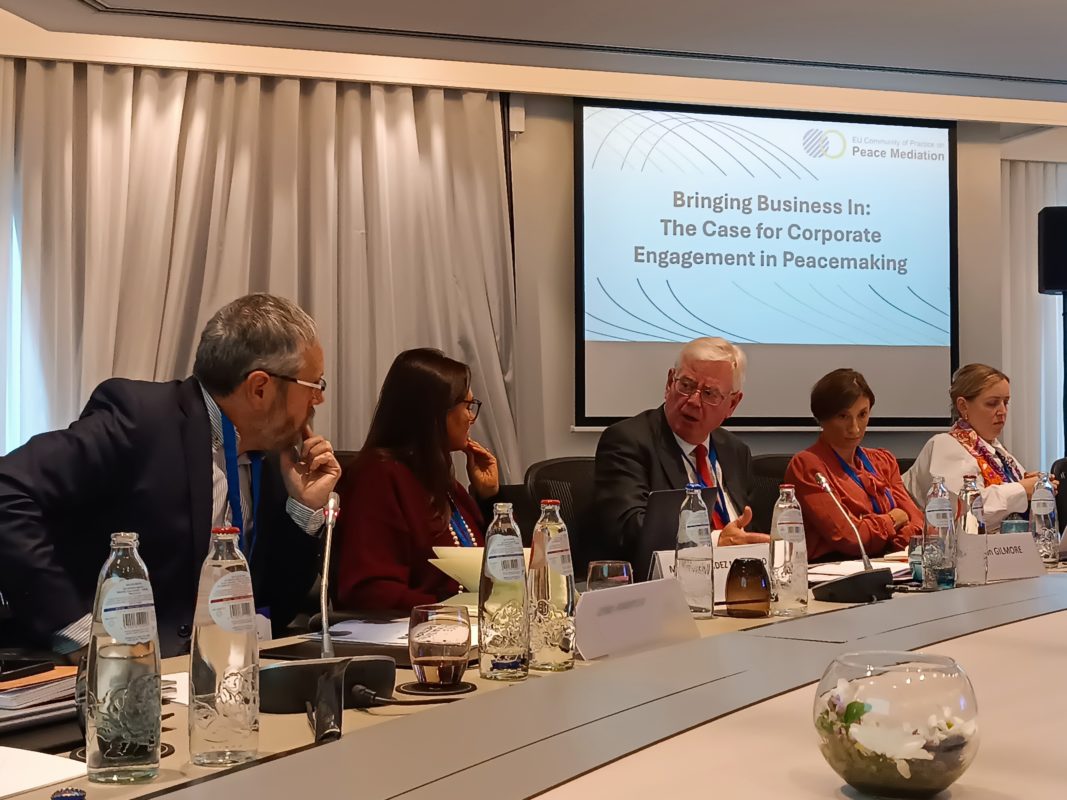
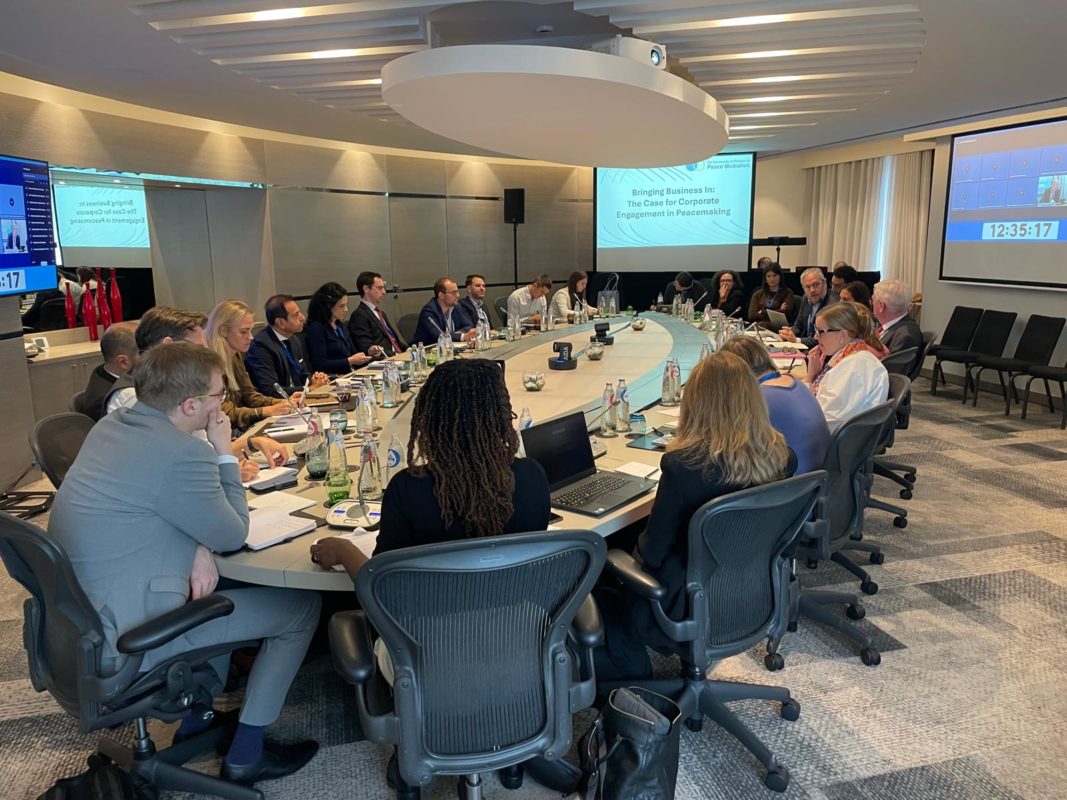
At this week’s EU Community of Practice on Peace Mediation the Institute organised the session “Bringing Business In: The Case for Corporate Engagement in Peacemaking”.
The Institute’s Senior Advisors Eamon Gilmore and Urko Aiartza discussed the business community’s multifaceted role in contexts of conflict and peacemaking together with speakers Myriam Mendez-Montalvo, founder of the Colombian national dialogue platform Valiente es Dialogar (“Dare to Dialogue)and Sarah Cechvala, post-doctoral researcher at the University of Oslo focused on the role of the private sector in peace and conflict.
The discussion underscored the complexity and diversity of the business community and its multifaceted role in contexts of conflict and peacemaking.
Key reflections included:
- Diverse roles of business actors.The private sector is not monolithic and, while all companies aim for survival and profit, their incentives and impact vary widely. Businesses can be both allies in peace processes and, in some cases, conflict profiteers.
- Multiple pathways to peace. Business actors can contribute to peace not only through direct involvement in peace processes, but also by strengthening the social fabric, promoting inclusive growth, and creating conditions for stability. Good business is essential for peace, and, similarly, peace and a stable environment are in the business sector’s interest.
- The impact of business on fragile environments. Companies can create “peace pathways,” but the key issue is how they can shape and transform fragile environments. Their influence extends beyond traditional peacebuilding roles.
- The role of small businesses. Small businesses: Often deeply embedded in their communities, small enterprises tend to make strong socioeconomic contributions and show reluctance to engage in conflict. Given their social proximity and local impact, they can be seen as a hybrid between private sector and civil society actors, bridging the economic and the social dimensions of peacebuilding.
Throughout the conversation, different case studies where business actors contributed to peacemaking were also analysed, including:
- South Africa: The consultative business movement and the National Business Initiative (NBI) played a pivotal role in supporting dialogue and reform during the post-apartheid transition.
- Basque Country: Businesses avoided public roles due to security risks – which shows that engagement strategies are highly dependent on context. But they did work on developing and strengthening the social fabric.
- Colombia: Peace remains a polarising issue, even within the private sector. While there is no coordinated, national-level effort, localized initiatives, particularly in agriculture, have made meaningful contributions.
Finally, the discussion highlighted the importance of the “peace-positive” impact of business. Actions such as job creation, ethical investment, and community engagement may not fit traditional peacebuilding definitions, but are nonetheless crucial in creating the conditions for sustainable peace.
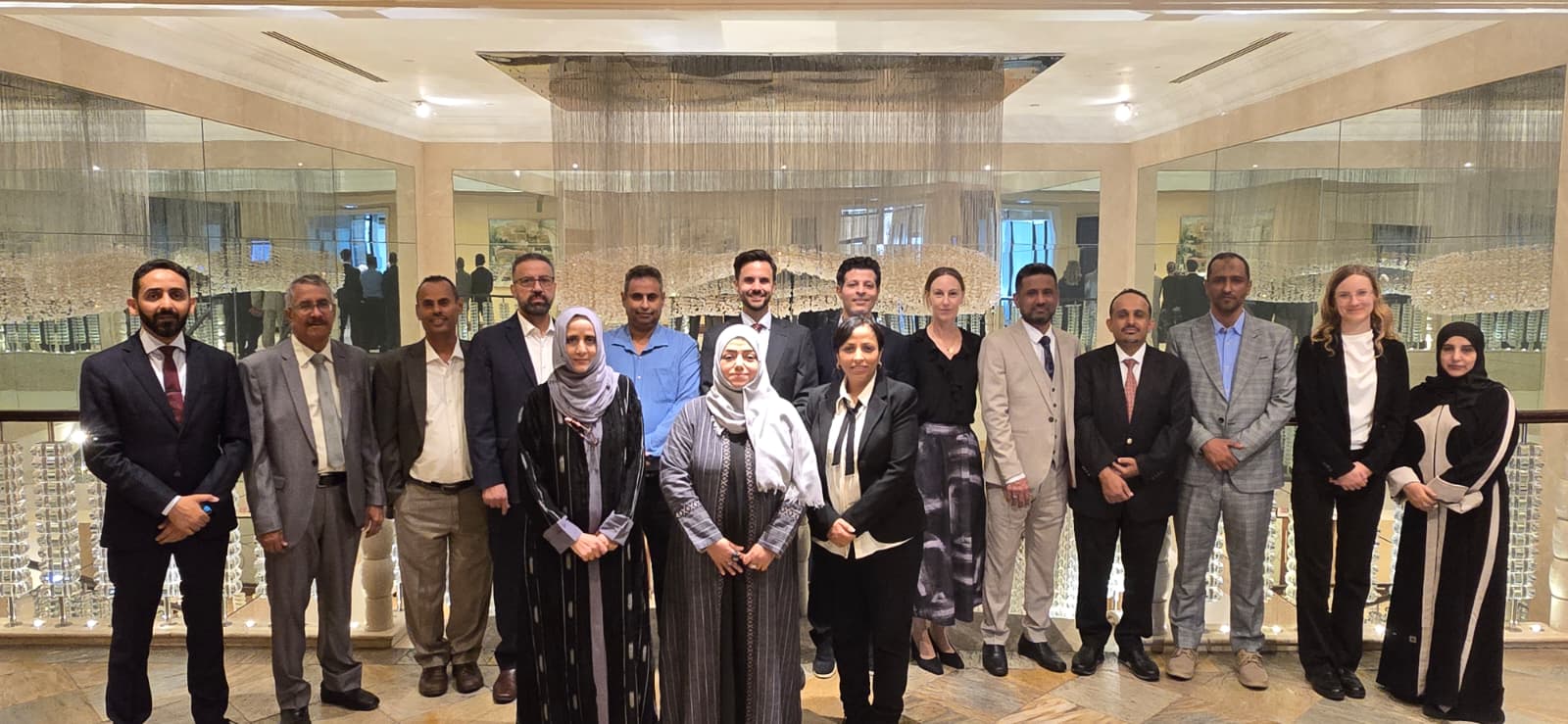
In August, the Institute’s Climate and Environmental Peacemaking Programme convened various parties from the relevant authorities within the Government of Yemen to jointly discuss the water situation in the country. The meeting took place in Amman and aimed to examine concrete challenges in specific governorates and cities, to find a common vision and identify potential solutions on how to address these issues from the water supply and demand sides. After four days of meetings, the delegates jointly developed a strategic list of practical solutions to address the country’s water issues. The group will reconvene at the end of 2025 to continue discussions.
Building on a series of unilateral meetings facilitated by the Institute, the Fourth Technical Meeting on Climate and Environmental Peacemaking in Yemen marked the first joint meeting of the relevant government parties, including the Southern Transitional Council (STC). The initiative is based on an agreed framework of environmental dialogue and cooperation, which recognises that jointly addressing natural resources, environment and climate risks can offer peace benefits on stabilisation, reconciliation, and enhanced resilience against both environmental and conflict risks.
The discussions helped to find common ground by recognising shared interests, values, and goals in a context of water scarcity. This mutual understanding included the need for updated and more accurate assessments of surface and groundwater availability, usage trends, and identification of the region’s most pressing water hotspots, especially where competition may lead to tensions and disputes.
Water, peace and conflict in Yemen
Yemen has long been struggling with water provision for agricultural, industrial, and household uses. With its semi-arid to arid climate, the country is naturally prone to physical water scarcity and largely dependent on non-renewable groundwater resources. After a decade of armed conflict, Yemen’s water situation has developed into a severe crisis, with about 17 million Yemenis lacking access to water for daily needs. Direct impacts of war, such as the destruction of water networks, have paired with financial challenges, a lack of capacity, and demographic growth, all of which have been exacerbated by the conflict. As the impacts of climate change, such as fluctuations in rainfall rates, are showing themselves more clearly, the issue of water scarcity is becoming ever-more pressing.
Not only does the water crisis have humanitarian implications, but it also affects social cohesion, fuels competition, and drives conflict. Already before the escalation of the war, water was identified as a significant factor contributing to tensions in Yemen. As the conflict continues and Yemen’s water resources are depleting, an integrated approach to peacemaking that recognises these connections is becoming indispensable. In this context, the Institute’s engagement seeks to leverage shared environmental concerns as a new avenue for peace, to transform environmental matters from a source of tension to an opportunity for joint action.
About the project
The Environmental Pathways for Reconciliation (EPfR) project aims to contribute to sustainable peace in Yemen through environmental dialogue and cooperation. With its bottom-up and inclusive approach, the project amplifies Yemeni voices in political and peace discussions, using environmental issues as entry points and elements for peace. The EPfR project is implemented by the European Institute of Peace with support from the German Federal Foreign Office and is part of the Weathering Risk Peace Pillar led by adelphi. You can read more about the project at www.epfryemen.org.
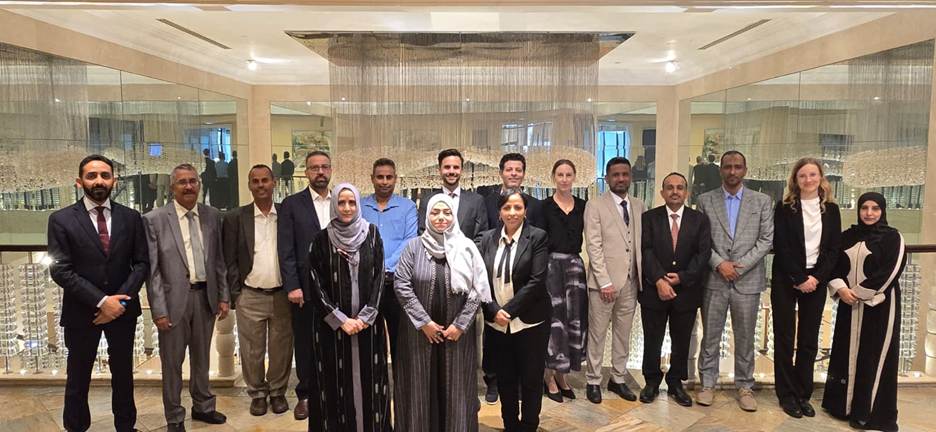
في مطلع أغسطس، عقد برنامج صنع السلام المناخي والبيئي التابع للمعهد الأوروبي للسلام اجتماعًا ضمّ جهات مختلفة من الجهات المعنية في الحكومة اليمنية لمناقشة الو ضع المائي في البلاد. عُقد الاجتماع في عمّان، وكان الهدف منه دراسة التحديات الملموسة في محافظات ومدن محددة، والتوصل إلى رؤية مشتركة وتحديد الحلول الممكنة لمعالجة هذه القضايا من حيث العرض والطلب على المياه. وبعد أربعة أيام من الاجتماعات، وضع المشاركون قائمة استراتيجية بالحلول العملية لمعالجة قضايا المياه في البلاد. وستجتمع المجموعة مجددًا في نهاية عام 2025 لمواصلة النقاش.
بناءً على سلسلة من الاجتماعات الأحادية التي يسّرها المعهد، مثّل الاجتماع الفني الرابع حول صنع السلام المناخي والبيئي في اليمن الاجتماع المشترك الأول للأطراف الحكومية المعنية، بما في ذلك المجلس الانتقالي الجنوبي. وتستند هذه المبادرة إلى إطار عمل متفق عليه للحوار والتعاون البيئي، يُقرّ بأن التصدي المشترك لمخاطر الموارد الطبيعية والبيئة والمناخ يُمكن أن يُحقق فوائد للسلام في تحقيق الاستقرار والمصالحة، وتعزيز القدرة على الصمود في وجه المخاطر البيئية ومخاطر الصراع.
ساهمت المناقشات في إيجاد أرضية مشتركة من خلال الإقرار بالمصالح والقيم والأهداف المشتركة في ظل ندرة المياه. وشمل هذا التفاهم المتبادل الحاجة إلى تقييمات محدثة وأكثر دقة لتوافر المياه السطحية والجوفية، واتجاهات استخدامها، وتحديد بؤر المياه الأكثر إلحاحًا في المنطقة، لا سيما حيث قد تؤدي المنافسة إلى توترات ونزاعات.
المياه والسلام والصراع في اليمن
يعاني اليمن منذ زمن طويل من نقص المياه للاستخدامات الزراعية والصناعية والمنزلية. فبفضل مناخه شبه الجاف إلى الجاف، يُصبح البلد بطبيعة الحال عُرضةً لندرة المياه، ويعتمد بشكل كبير على موارد المياه الجوفية غير المتجددة. وبعد عقد من الصراع المسلح، تفاقم الوضع المائي في اليمن إلى أزمة حادة، حيث يفتقر حوالي 17 مليون يمني إلى المياه لتلبية احتياجاتهم اليومية. وقد اقترنت الآثار المباشرة للحرب، مثل تدمير شبكات المياه، بالتحديات المالية، ونقص الإمكانيات، والنمو السكاني، وكلها تفاقمت بسبب الصراع. ومع تزايد وضوح آثار تغير المناخ، مثل تقلبات معدلات هطول الأمطار، أصبحت قضية ندرة المياه أكثر إلحاحًا من أي وقت مضى.
لا تقتصر أزمة المياه على الآثار الإنسانية فحسب، بل تؤثر أيضًا على التماسك الاجتماعي، وتؤجج التنافس، وتدفع الى الصراع. وحتى قبل تصاعد وتيرة الحرب، كان يُنظر إلى المياه كعامل رئيسي يُسهم في التوترات في اليمن. ومع استمرار الصراع ونضوب موارد المياه في اليمن، أصبح اتباع نهج متكامل لصنع السلام يُدرك هذه الروابط أمرًا لا غنى عنه. في هذا السياق، يسعى المعهد من خلال عمله إلى الاستفادة من الاهتمامات البيئية المشتركة كمسار جديد للسلام، وتحويل القضايا البيئية من مصدر للتوتر إلى فرصة للعمل المشترك.
نبذه عن المشروع
يهدف مشروع “المسارات البيئية للمصالحة” (EPfR) إلى المساهمة في تحقيق سلام مستدام في اليمن من خلال الحوار والتعاون البيئي. ومن خلال نهجه التصاعدي والشامل، يُعزز المشروع أصوات اليمنيين في المناقشات السياسية ومناقشات السلام، مستخدمًا القضايا البيئية كمدخل وعنصر للسلام. يُنفذ مشروع المسارات البيئية للمصالحة من قِبل المعهد الأوروبي للسلام بدعم من وزارة الخارجية الألمانية، وهو جزء من ركيزة السلام لمقاومة المخاطر بقيادة أديلفي. يمكنكم الاطلاع على المزيد عن المشروع على الموقع الإلكتروني www.epfryemen.org.
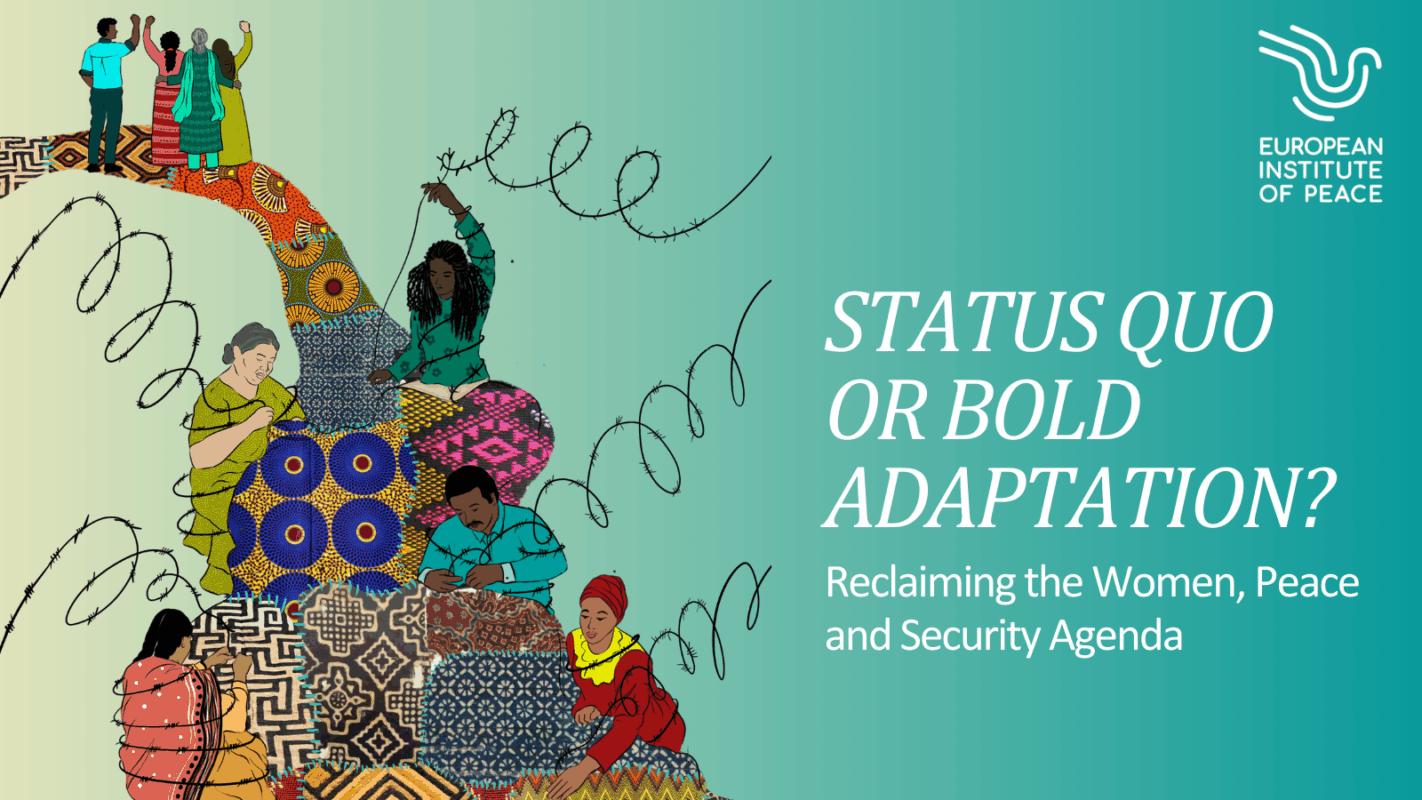
After 25 years of UN Security Council Resolution 1325, we stand at a critical crossroads. The Women, Peace and Security agenda – once a beacon of transformative possibility – faces multiple threats: political space for gender equality is narrowing, commitments and funding are eroding, and in many contexts, we are witnessing the agenda going into reverse.
Our new report, “Status Quo or Bold Adaptation? Reclaiming the Women, Peace and Security Agenda,” charts a path forward rooted in feminist principles: radical inclusivity and decolonial thinking.
Through extensive interviews, surveys and in-depth case studies in Ethiopia, Sudan and Myanmar, we identified five persistent barriers preventing women’s meaningful participation in conflict prevention and peace processes:
- Persistent patriarchal power and resistance
- Threats to women’s safety and ongoing trauma
- Narrow, hierarchical and siloed efforts
- Incrementalism, exclusion and marginalisation
- Inadequate financial and weak political investment
But this research goes beyond identifying the problems. We have analysed 12 promising practices that can work, distinguishing between well-meaning practices that fail and those grounded in feminist peace principles. The research revealed that many well-intentioned WPS efforts fail because they operate within existing limitations rather than transform the systems that create those limitations.
Our recommendations for practitioners to strengthen the WPS agenda from within call for:
- Men stepping up in solidarity
- Gender-responsive security and trauma-informed approaches
- Women, Peace and Security integrated across all government functions
- Meaningful gender quotas in all peace processes
- Radical reparative funding for feminist organisations
As we approach the 25th anniversary of UNSCR 1325, we have a choice: accept the status quo and watch the WPS agenda continue to erode, or embrace bold adaptation that matches the transformative vision women peacebuilders have been pushing for.
The evidence is clear. The solutions are available. The question now is whether we have the political will to implement them.
The time to act boldly is now.
This report exists thanks to the courage and wisdom of peacebuilders, especially those in Myanmar, Sudan and Ethiopia, who shared their lived experiences with us. Our recommendations reflect their shared knowledge. We are grateful for their contributions, and we extend our sincere appreciation to the German Federal Foreign for funding this critical research.
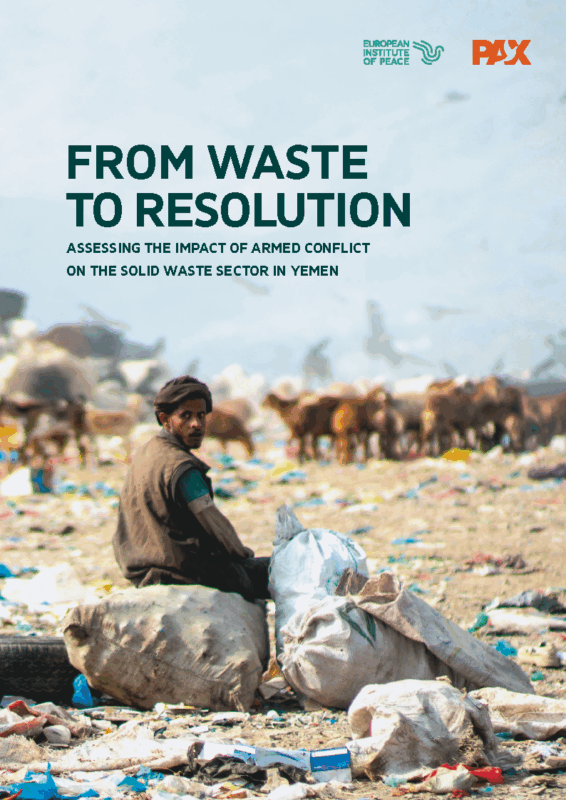
The European Institute of Peace and PAX are proud to announce our joint publication, “From waste to resolution: Assessing the impact of armed conflict on the solid waste sector in Yemen”, which provides insight into Yemen’s waste management crisis and its impact on the local environment, population, and society.
Throughout a decade of war, Yemen has been experiencing significant environmental degradation, both through direct impacts of armed conflict and indirectly through the decay of governance structures that could prevent and respond to environmental needs.
The conflict has eroded the capacity of public entities to protect crucial ecosystems, enact and implement relevant legislation, and provide essential services to Yemen’s population. When it comes to waste management, this has resulted in widespread illicit dumping, an uncontrolled expansion of solid waste, and a lack of adequate collection, disposal, and treatment facilities.
This report investigates Yemen’s waste crisis as a result of the armed conflict and reflects on ways to address it as a contribution to peacemaking, conflict prevention, and stabilisation. It identifies the main governance challenges in relation to effective waste management, including exponential demographic growth, lack of updated data, and weak institutional capacity. It analyses the environmental impact of Yemen’s solid waste crisis on air, water, and land, as well as its social and security implications, ranging from outbreaks of diseases to the degradation of agricultural land and an increase in competition for resources.
The report identifies three entry points to respond to the waste management crisis:
- Fostering collaboration and social cohesion: Strengthened coordination between various actors can offer co-benefits by improving solid waste management (SWM) services, while enhancing relationships between these stakeholders through joint decision-making or implementation. Collaboration, for instance on mapping needs, data sharing, or recycling initiatives, can be fostered between authorities and with the broader population alike, offering valuable opportunities for meaningful engagement of various groups. By involving communities in decision-making and implementation on SWM, authorities can garner popular support as a central pillar of lasting peace.
- Enhancing governance and building trust through technical cooperation: Technical subjects such as SWM offer opportunities for local and national authorities to strengthen their role and legitimacy in governance, hence improving the delivery of services and supporting public trust in institutions. At the same time, it can provide opportunities for dialogue, learning and knowledge-sharing across institutions and governorates to enhance the capacities of relevant SWM agencies, while contributing to increased coherence and trust between different institutions or parties.
- Strengthening livelihoods and unlocking economic opportunities: Investments and partnerships to improve SWM infrastructure can provide local economic opportunities through job creation and livelihood diversification, while providing revenue for municipalities and businesses. This way, investments in waste management infrastructure and enhanced waste governance can play a role in bolstering the local economy as a fundamental pillar of resilience and stability, especially if complemented with community-driven structures or solutions.
Based on these entry points, the report provides the following recommendations to provide guidance for local and national policymakers, donors, as well as international and multilateral organisations seeking to support peace and stability in Yemen.
- Addressing policy, legal and institutional gaps: Policymakers in Yemen are recommended to systematically review and update the legislative SWM framework, including the National SWM Strategy; strengthen institutional capacity of the CCIFs; and centralise collection and monitoring of waste data, all of which can contribute to improved waste management and environmental health.
- Mitigating environmental impacts of the waste crisis: Humanitarian and development organisations operating in Yemen are recommended to support expanded research on other dimensions of pollution and environmental degradation in the context of the conflict; enhance recycling and composting initiatives to depart from dumping; establish collection and disposal systems of hazardous waste; and expand waste-to-energy projects.
- Supporting resilience-building and preventing tensions: Local authorities and SWM entities are recommended to promote community-led approaches to waste management and engage in dialogue and peer learning to enhance coordination across the SWM sector.
This report is part of the Environmental Pathways for Reconciliation in Yemen project, implemented by the European Institute of Peace with support from the German Federal Foreign Office as part of the Weathering Risk Peace Pillar led by adelphi.
The full report is available here.
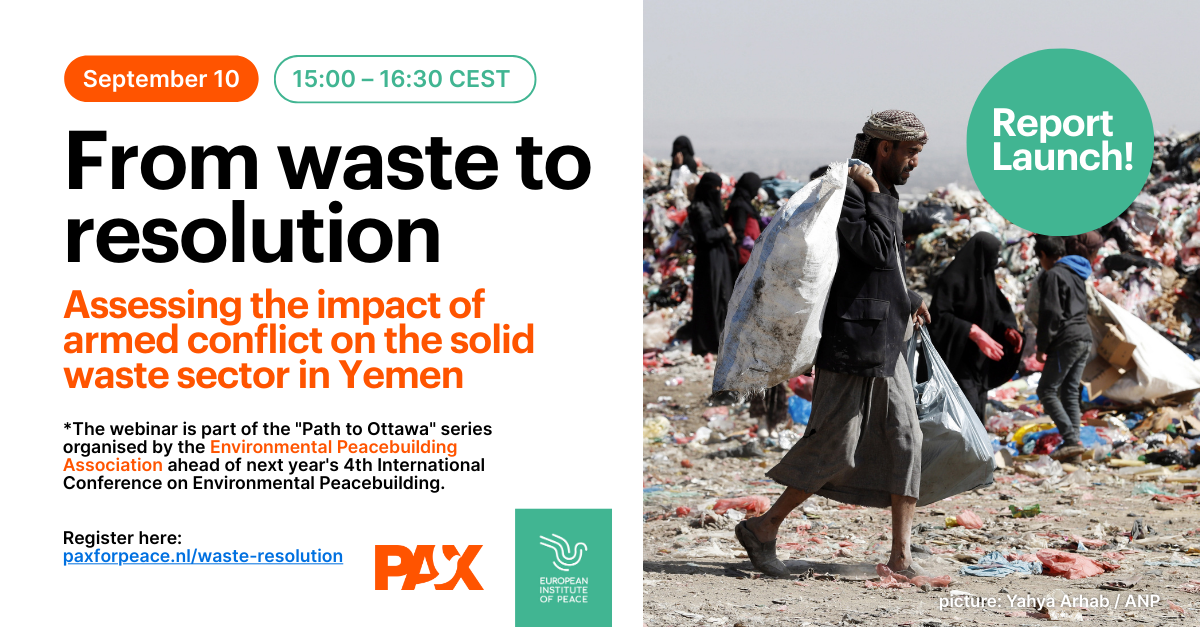
Join the European Institute of Peace and PAX for the online launch of our joint report “From waste to resolution: Assessing the impact of armed conflict on the solid waste sector in Yemen,” which provides insight into Yemen’s waste management crisis and its impact on public health, ecosystems, and long-term stability.
The webinar will present the findings from an extensive assessment of Yemen’s solid waste sector amid the conflict, drawing from geospatial mapping and policy analysis. It will explore the drivers and consequences of uncontrolled dumping and waste accumulation, as well as entry points to address them as a contribution to peacemaking, conflict prevention, and stabilisation.
The launch will take place in an online webinar on Wednesday, 10 September, from 15:00 to 16:30. The full report will be available online immediately after the event.
Speakers:
- Hisham Al-Omeisy, Senior Yemen Advisor, European Institute of Peace
- Elias Kharma, Research Analyst, European Institute of Peace
- Marie Schellens, Geospatial Analyst, PAX
- Wim Zwijnenburg, Project Leader Humanitarian Disarmament, PAX
Moderator:
- Alina Viehoff, Climate and Security Advisor, adelphi
This event is part of the Path to Ottawa series organised by EnPax ahead of the 4th International Conference on Environmental Peacebuilding, which will take place in June 2026 in Ottawa, Canada.
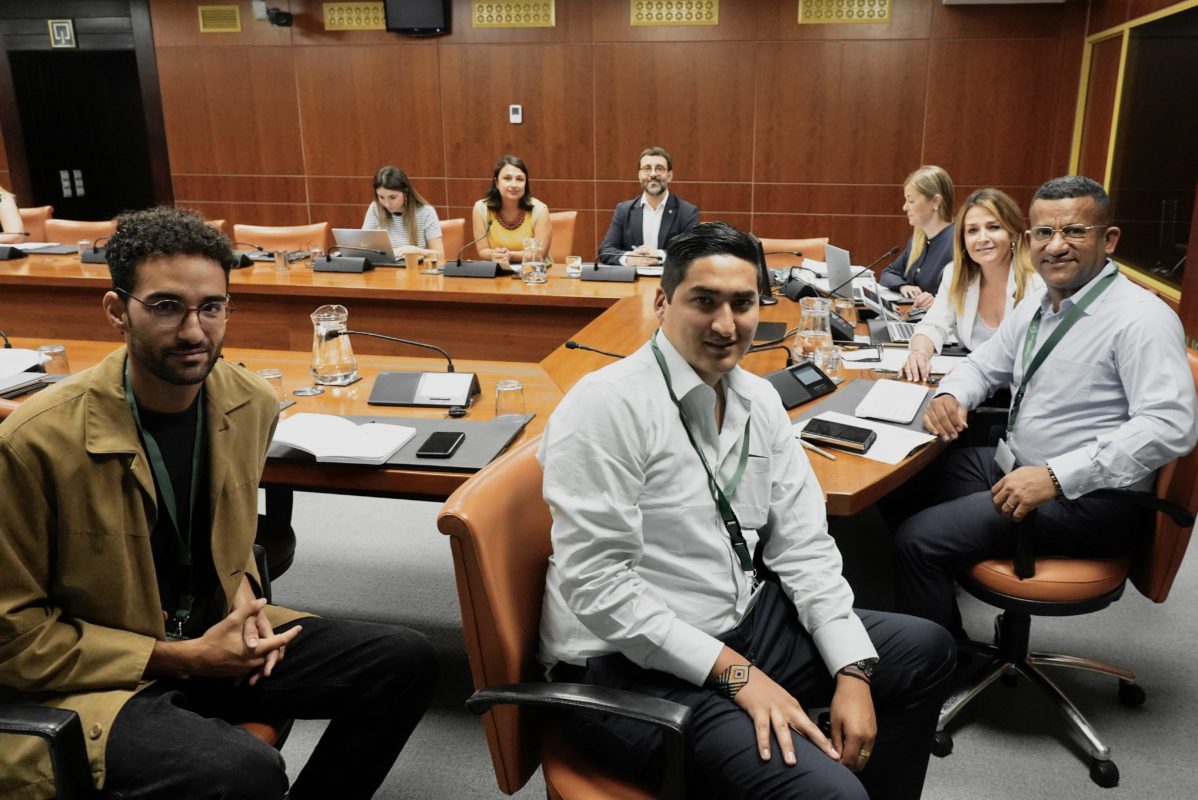
Este artículo también está disponible en inglés/This article is also available in English.
Durante décadas, Nariño ha sido uno de los territorios más violentos e inestables de Colombia. Su posición geoestratégica, fronteriza con Ecuador y con acceso directo al Pacífico, lo ha convertido en un corredor clave para el narcotráfico, la minería ilegal y otras economías ilícitas. El departamento cuenta actualmente con aproximadamente 65 000 hectáreas de coca, lo que supone alrededor del 26 % del total de cultivos del país.
Sin embargo, desde 2024, Nariño se ha convertido en uno de los pocos lugares donde la política de “Paz Total” de Colombia está dando resultados concretos. Dos grupos armados, Comuneros del Sur (antes ELN) y la Coordinadora Nacional Ejército Bolivariano (antes FARC), han entablado negociaciones con el Gobierno colombiano, han comenzado a entregar armas, han establecido zonas de ubicación temporal y han firmado acuerdos humanitarios que abarcan cuestiones como la sustitución de cultivos de coca, el reclutamiento de niños y el desminado. Como resultado, según datos de la Gobernación de Nariño, los homicidios disminuyeron un 84% entre 2023 y 2024, los casos de reclutamiento de niños y niñas se redujeron un 65% y los incidentes con minas terrestres disminuyeron un 99%.
Estos avances son el resultado de llevar los procesos de diálogo y negociación al ámbito territorial, lo que permite un enfoque más matizado y específico para cada contexto, combinado con el desarrollo de una estrategia de dividendos de paz por parte de la Gobernación de Nariño. Esta estrategia, centrada en iniciativas socioeconómicas y medioambientales, cuenta con el apoyo del Instituto Europeo para la Paz y permite tanto a los directamente involucrados en el proceso como a la población en general experimentar los beneficios tangibles de la paz. Los avances de Nariño tienen el potencial de remodelar la dinámica del conflicto en Colombia, especialmente en departamentos vecinos como el Cauca, y en toda América Latina a través de sus conexiones con Ecuador y el Pacífico, al desarticular las economías ilícitas y las redes criminales que operan mucho más allá de las fronteras administrativas y estatales.
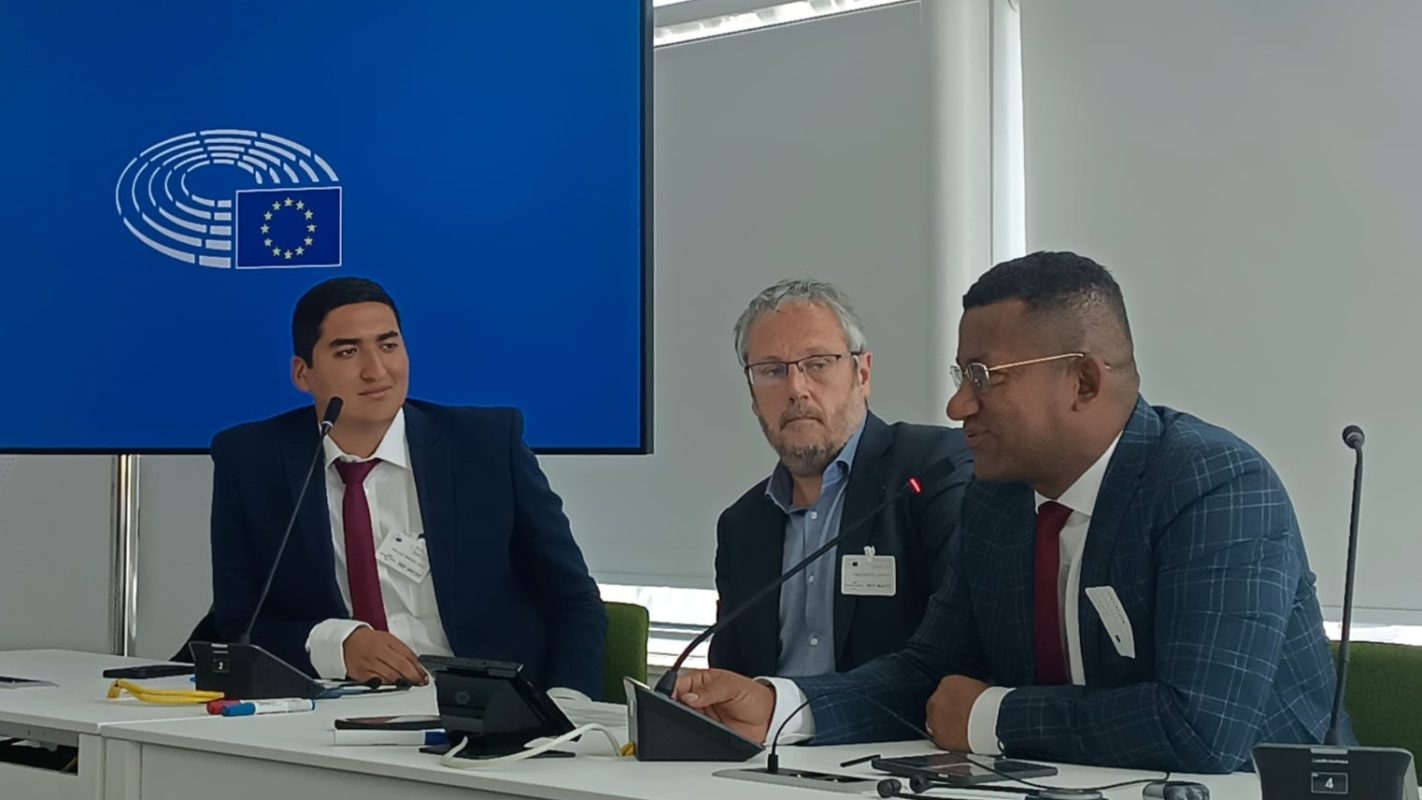
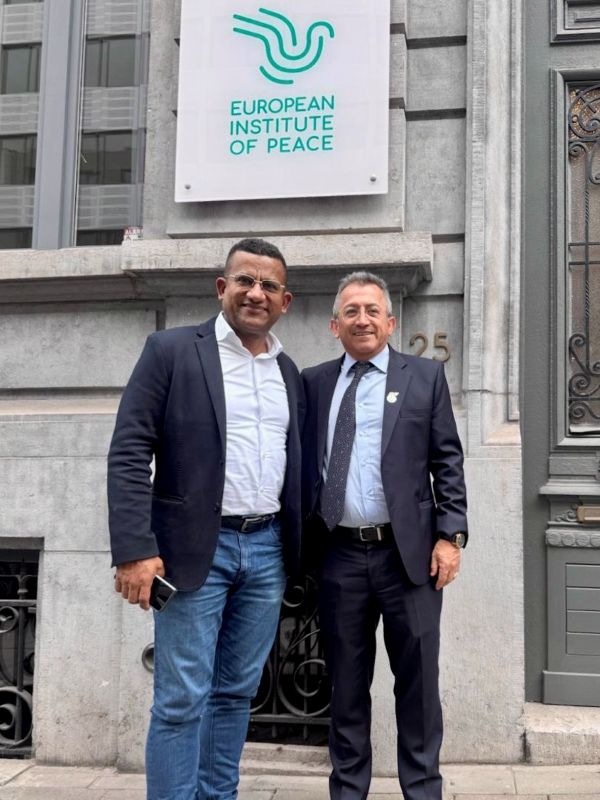
En junio de 2025, el gobernador del departamento colombiano de Nariño, Luis Alfonso Escobar Jaramillo, visitó Bilbao, Vitoria y Bruselas con el apoyo del Instituto. La visita tenía como objetivo dar a conocer los innovadores esfuerzos de paz de Nariño. También se buscaba movilizar el apoyo internacional para una región cuya estabilidad y desarrollo son fundamentales para los esfuerzos de paz de Colombia y tienen importantes implicaciones para la seguridad en toda América Latina. Se organizaron comparecencias en los Parlamentos Vasco y Europeo, y se celebraron reuniones con el Gobierno Vasco y altos funcionarios de la Unión Europea (UE), entre los que se encontraban representantes del Servicio Europeo de Acción Exterior, el Servicio de Instrumentos de Política Exterior, la Dirección General de Asociaciones Internacionales y la Dirección General de Migración y Asuntos Internos, entre otros. Asimismo, se coorganizó una sesión de trabajo con organizaciones de la sociedad civil con sede en Bruselas activas en Colombia junto con la Embajada de Colombia en Bélgica.
La visita del gobernador a Europa puso de relieve el papel fundamental de los socios internacionales, en particular de la UE. La diplomacia europea puede ayudar a dar visibilidad al modelo de paz de Nariño y apoyarlo como iniciativa piloto para otros territorios fronterizos afectados por el conflicto. La cooperación financiera y técnica —a través de la iniciativa Global Gateway de la UE, la cooperación bilateral, las empresas público-privadas y socios estratégicos como el Instituto— será esencial para consolidar los dividendos de la paz, la transición de las economías ilícitas y el fortalecimiento de la resiliencia de las comunidades.
Durante más de dos décadas, la UE ha sido uno de los socios más comprometidos con la paz en Colombia, con una inversión de más de 500 millones de euros en apoyo político y financiero, sin contar las contribuciones de sus estados miembros. Su respaldo fue fundamental para garantizar el histórico acuerdo de paz de 2016 y avanzar en su implementación. Colombia es uno de los éxitos más notables de la UE en términos de resolución de conflictos y apoyo a la construcción de la paz. Hoy, con la Cumbre CELAC-UE de noviembre en el horizonte, es fundamental reafirmar que no es momento de dar un paso atrás. Colombia y las iniciativas de paz territorial como las de Nariño demuestran que un apoyo internacional sostenido y flexible proporciona seguridad, desarrollo y estabilidad, lo que beneficia no solo a las comunidades locales, sino también a toda la región y a la comunidad internacional en su conjunto.
This article is also available in Spanish/Este artículo también está disponible en español.
For decades, Nariño has been one of Colombia’s most violent and unstable territories. Its geostrategic position, bordering Ecuador and with direct access to the Pacific, has made it a key corridor for drug trafficking, illegal mining and other illicit economies. The department currently accounts for approximately 65,000 hectares of coca, which is about 26% of the country’s total crops.
However, since 2024, Nariño has become one of the few places where Colombia’s ‘Total Peace’ policy is producing concrete results. Two armed groups, Comuneros del Sur (formerly ELN) and the Coordinadora Nacional Ejército Bolivariano (formerly FARC), have entered negotiations with the Colombian Government, begun handing over weapons, established temporary encampment zones, and signed humanitarian agreements covering issues such as coca crop substitution, child recruitment and demining. As a result, according to data from the Governorate of Nariño, homicides decreased by 84% between 2023 and 2024, child recruitment cases dropped by 65%, and landmine incidents declined by 99%.
These breakthroughs are the result of taking the engagement and negotiation processes to the territorial level, allowing for a more nuanced and context-specific approach, combined with the development of a peace dividends strategy by the Governorate of Nariño. This strategy, centred on socioeconomic and environmental initiatives, is supported by the European Institute of Peace and enables both those directly involved in the process and the broader population to experience the tangible benefits of peace. Nariño’s progress has the potential to reshape conflict dynamics within Colombia, particularly in neighbouring departments like Cauca, and across Latin America through its connections with Ecuador and the Pacific, by disrupting the illicit economies and criminal networks that operate far beyond administrative and state boundaries.
In June 2025, the Governor of Colombia’s Nariño department, Luis Alfonso Escobar Jaramillo, visited Bilbao, Vitoria and Brussels with the support of the Institute. The visit aimed to raise awareness of Nariño’s innovative peace efforts. It also sought to mobilise international support for a region whose stability and development are critical to Colombia’s peace efforts and hold significant implications for security across Latin America. Hearings were organised at both the Basque and European Parliaments, and meetings were held with the Basque Government and European Union (EU) Officials, including representatives from the European External Action Service, the Service for Foreign Policy Instruments, the DG for International Partnerships, and the DG for Migration and Home Affairs, among others. A working session with Brussels-based civil society organisations engaged in Colombia was co-hosted with the Colombian Ambassador in Belgium.
The Governor’s visit to Europe underscored the vital role of international partners, particularly the EU. European diplomacy can help raise the visibility of Nariño’s peace model and support it as a pilot initiative for conflict-affected border territories. Financial and technical cooperation – through the EU’s Global Gateway, bilateral partnerships, public-private ventures, and strategic partners like the Institute – will be essential to consolidate peace dividends, transition from illicit economies, and strengthen community resilience.
For over two decades, the EU has been one of Colombia’s most committed peace partners, investing over € 500 million in political and financial support, without considering the investments of its member states. Its backing was instrumental in securing the historic 2016 peace agreement and advancing its implementation. Colombia is one of the EU’s most notable successes in terms of conflict resolution and peacebuilding support. Today, with the CELAC-EU Summit in November on the horizon, it is vital to reaffirm that this is not the time to withdraw. Colombia, and territorial peace initiatives like those in Nariño, demonstrate that sustained, adaptable international support delivers security, development, and stability, benefiting not only local communities but also the wider region and the international community alike.
- عقد المعهد الأوروبي للسلام الجولة الرابعة للحوار بين العديد من المكونات السياسية في جنوب اليمن في العاصمة الأردنية عمان في الفترة من 5-7 يوليو 2025، ولقد شارك في الحوار ممثلين عن الجهات التالية: المجلس الأعلى للحراك الثوري لتحرير واستقلال الجنوب- حزب حركة النهضة للتغيير السلمي- الحراك الجنوبي المشارك في مؤتمر الحوار الوطني- جنوبيات من أجل السلام- الائتلاف الوطني الجنوبي- لجنة الاعتصام السلمي في محافظة المهرة- التحالف الموحد لأبناء شبوة- مجلس شبوة الوطني العام- مجلس حضرموت الوطني.
- استعرض المشاركون الأوضاع السياسية والاقتصادية والأمنية التي تمر بها المحافظات الجنوبية بشكل خاص واليمن بشكل عام وما تواجهه من تردي للأوضاع المعيشية والخدمات الأساسية وانفلات الأمن بالعاصمة عدن وباقي محافظات الجنوب.
- طالب المشاركون مجلس القيادة الرئاسي والحكومة والسلطات المحلية تحمل مسئولياتها تجاه المواطنين بشكل فوري ودون تأخير من خلال العمل على تجاوز هذه الأزمة التي تمس حياتهم ومعيشتهم وإصلاح السلطات المحلية التي كان لإدائها اثراً كبيراً في تدهور الأوضاع، محذرين من مخاطر استمرار هذا التدهور دون إيجاد الحلول الجذرية والشاملة لهذه الأزمة.
- أكد المشاركون رفض العنف واستخدام القوة المسلحة كوسيلة لتحقيق مكاسب سياسية او فرض واقع سياسي على أي منطقة أو محافظة، ورفض الاعتقالات والاخفاء القسري التي طالت العديد من الشخصيات السياسية والدينية والاجتماعية في العاصمة عدن، وفي هذا الإطار رفضوا رفضاً قاطعاً ما صدر من تهديدات في الأيام القليلة الماضية باستخدام القوة العسكرية لفرض واقع سياسي ضد أبناء حضرموت والذي يعتبر خرقاً جسيماً لقواعد العمل السياسي.
- عبر المشاركون عن تأييدهم الكامل لثورة نساء عدن وأبين ولحج المطالبة بتحقيق سبل العيش الكريم وتوفير الخدمات الأساسية بما في ذلك الكهرباء والمياه والصحة والتعليم والمرتبات وذلك خلال المظاهرات الأسبوعية التي خرجن فيها، وأدانوا عمليات القمع والاعتقالات التعسفية التي طالت عدد من النساء في عدن، ورفضوا رفضا قاطعاً عمليات الترهيب والتهديد والإيذاء الجسدي والنفسي التي تعرضت النساء لها، واهمية ضمان حماية النساء والناشطات من أي انتهاكات او مضايقات، واحترام حقوقهن بما في ذلك حقهن في حرية التعبير عن الراي والتظاهر السلمي، وطالبوا السلطات باتخاذ الإجراءات اللازمة لتلبية مطالبهن المشروعة، كما عبروا عن اسفهم من عدم إيلاء المجتمع الدولي الاهتمام اللازم بمساندة ثورة النساء.
- اتفق المشاركون من حيث المبدأ على انشاء منصة سياسية تضمهم جميعاً لتكثيف التشاور والتعاون فيما بينهم واتفقوا على متابعة هذا الموضوع خلال الفترة القادمة.
- ناقش المشاركون سبل مشاركة الجنوب في العملية السياسية وكيفية التعبير عن موقفهم للرأي العام اليمني وعلى المستويين الإقليمي والدولي، مع التأكيد على أهمية قيام دول المنطقة والمجتمع الدولي بدورٍ إيجابي في تحقيق السلام في اليمن.
- اتفق المشاركون على ضرورة قيامهم بإعداد رؤية للإصلاح السياسي والاقتصادي والأمني في ضوء التحديات التي تواجه المجلس الرئاسي والحكومة، والوضع المرتبك في العديد من المحافظات الجنوبية وتم تكوين فريق عمل لإعداد ورقة لمناقشتها بشكل عاجل خلال الفترة المقبلة، مع التركيز على أهمية تطوير النظام السياسي وتحقيق المصالحة الوطنية دون إغفال المحاسبة.
- أكد المشاركون ضرورة الإصلاح الاقتصادي على ان يتم بشكل تدريجي ومتوازن ويأخذ في الاعتبار المعاناة التي يمر بها الشعب اليمني، والتأكيد على ضرورة إيداع إيرادات الدولة بمختلف مصادرها في البنك المركزي، وكذلك أكدوا مخاطر تعويم الدولار الجمركي الذي سيمس مصالح المواطنين في محافظات الجنوب خاصة واليمن عامة في ضوء ان المزيد من تدهور الأوضاع قد يؤدي الى المزيد من التفكك، بل وربما الانهيار الكامل.
- أكد المشاركون أهمية توحيد التشكيلات العسكرية والأجهزة الأمنية تحت مؤسستي الدفاع والداخلية وفقاً لاتفاق الرياض ورفض أي تشكيلات مسلحة خارج إطار القانون.
- ثمن المشاركون اللقاء الهام الذي جمعهم مع عدد من سفراء وممثلي بعثات الدول الصديقة لدى اليمن بما في ذلك الاتحاد الأوروبي والولايات المتحدة والمملكة المتحدة وهولندا وكذلك مكتب المبعوث الخاص للأمم المتحدة في اليمن، لتبادل الآراء حول تطورات الأوضاع في اليمن بشكل عام والجنوب بشكل خاص.
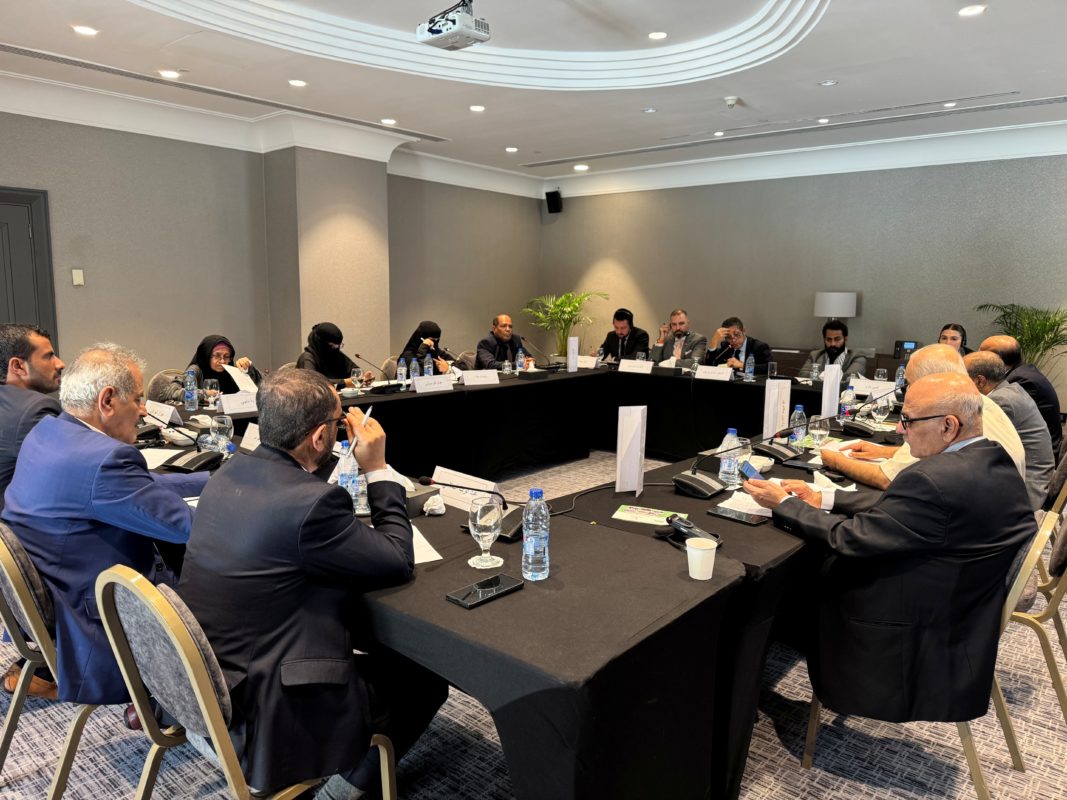
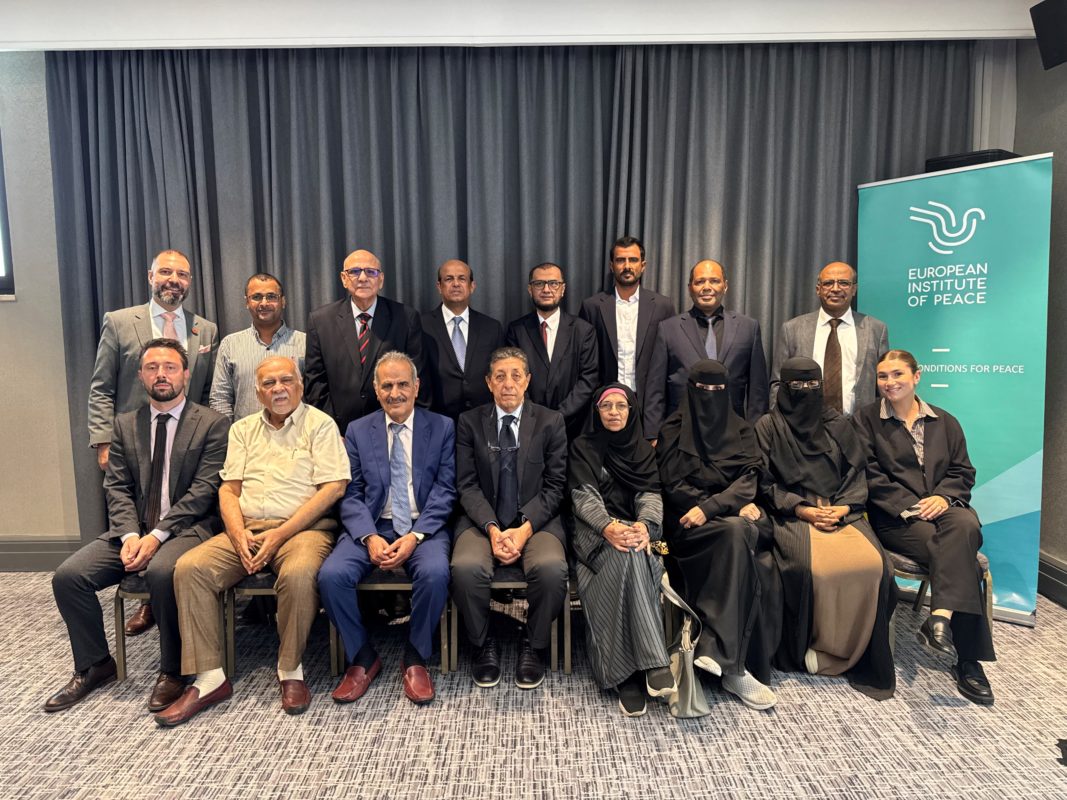
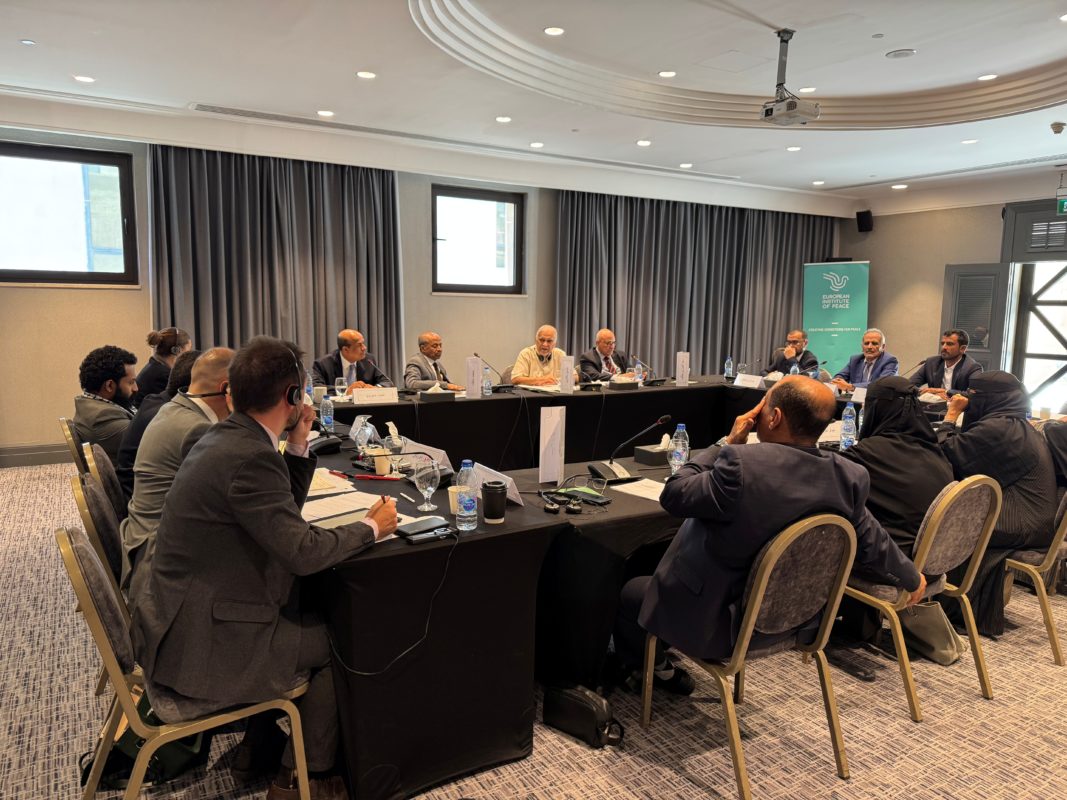
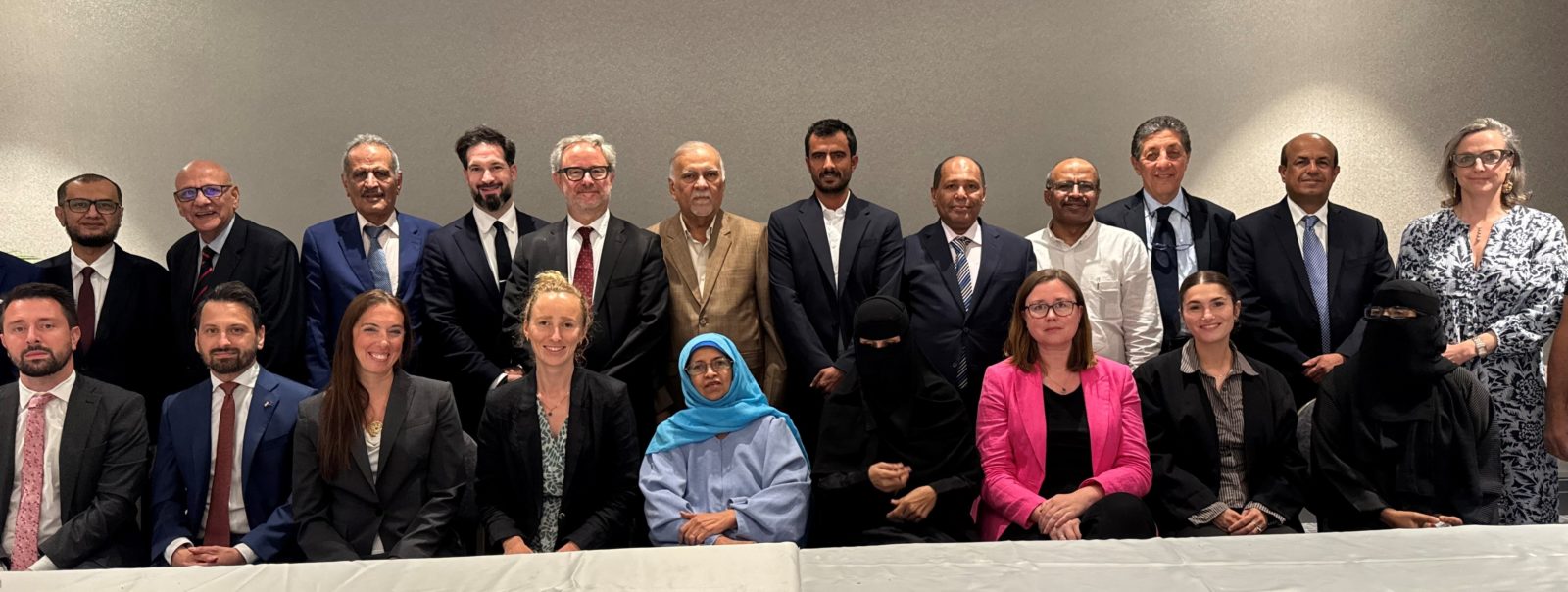
- The European Institute of Peace held the Fourth convening of the Southern Dialogue Process in Yemen in the period of 5–7 July 2025 in Amman, the Hashemite Kingdom of Jordan. The dialogue included representatives from the following entities: Supreme Council of Southern Revolutionary Movement (Hirak), Nahdha (Renaissance) Movement for Peaceful Change, Southern Movement (Hirak) Participating in the National Dialogue Conference, Southern National Coalition, Committee of the Peaceful Sit-In in al-Mahra Governorate, United Alliance of the People of Shabwa, Hadhramaut National Council, Shabwa National General Council, and Southern Women for Peace Group.
- Participants reviewed the political, economic, and security conditions in the southern governorates and Yemen as a whole, noting the deteriorating living conditions, lack of basic services, and insecurity in the capital city of Aden, and other areas in southern Yemen.
- Participants call on the Presidential Leadership Council, the government, and local authorities to take immediate action to address the crisis affecting citizens’ lives and livelihoods. They emphasize the need to reform local authorities, whose performance has contributed to the worsening situation, and warn of the dangers of continued deterioration without comprehensive solutions.
- Participants reject violence and the use of force to achieve political goals or impose a political reality on any region. They condemn the arrests and enforced disappearances of many political, religious, and social figures in Aden. They also reject recent threats to use military force to impose a political reality on the people of Hadhramaut, which violates the accepted rules of political action.
- Participants express their full support to the women’s revolution in Aden, Abyan, and Lahj, who have been demanding a decent living and basic services such as electricity, water, healthcare, education, and salaries during their weekly demonstrations. They condemn the repression and arbitrary arrests of women in Aden and reject intimidation, threats, and harm against them. They stress the need to protect women and activists from violations and harassment and to respect their rights, including freedom of expression and peaceful protest. They call on the authorities to take the necessary measures to meet the women’s legitimate demands and express regret over the international community’s lack of support for the women’s revolution.
- The participants have agreed in principle to establish a political platform to enhance consultations and cooperation among them and to follow up on this issue in the coming period.
- Participants discussed ways for the southern Yemenis to participate in the political process and how to express their position to the Yemeni public, regionally, and internationally. They emphasize the importance of regional countries and the international community in playing a positive role in achieving peace in Yemen.
- Participants agree on the need to develop a vision for political, economic, and security reform considering the challenges facing the country’s Presidential Leadership Council and government, as well as the turbulent political conditions in many southern Yemeni governorates. A working group has been formed among dialogue participants to prepare a paper for urgent discussion, focusing on developing the political system and achieving national reconciliation while ensuring accountability.
- Participants stress the need for gradual and balanced economic reform, considering the suffering of the Yemeni people. They emphasize that all state revenues should be deposited in the Central Bank of Yemen and warn against floating the customs exchange rate of the US dollar, which could harm citizens’ interests in the southern governorates and Yemen as a whole. They note that further economic deterioration could lead to more disintegration, or even complete collapse of state functions.
- Participants also highlight the importance of unifying military and security forces under the government’s Defence and Interior institutions, according to the Riyadh Agreement, and reject any armed groups that operate outside of the law.
- Participants commend the significant meeting they held with ambassadors and diplomats representing friendly countries, including the European Union, the United States, the United Kingdom, and the Netherlands, as well as the Office of the UN Special Envoy for Yemen, to discuss developments in Yemen, particularly in the southern governorates.

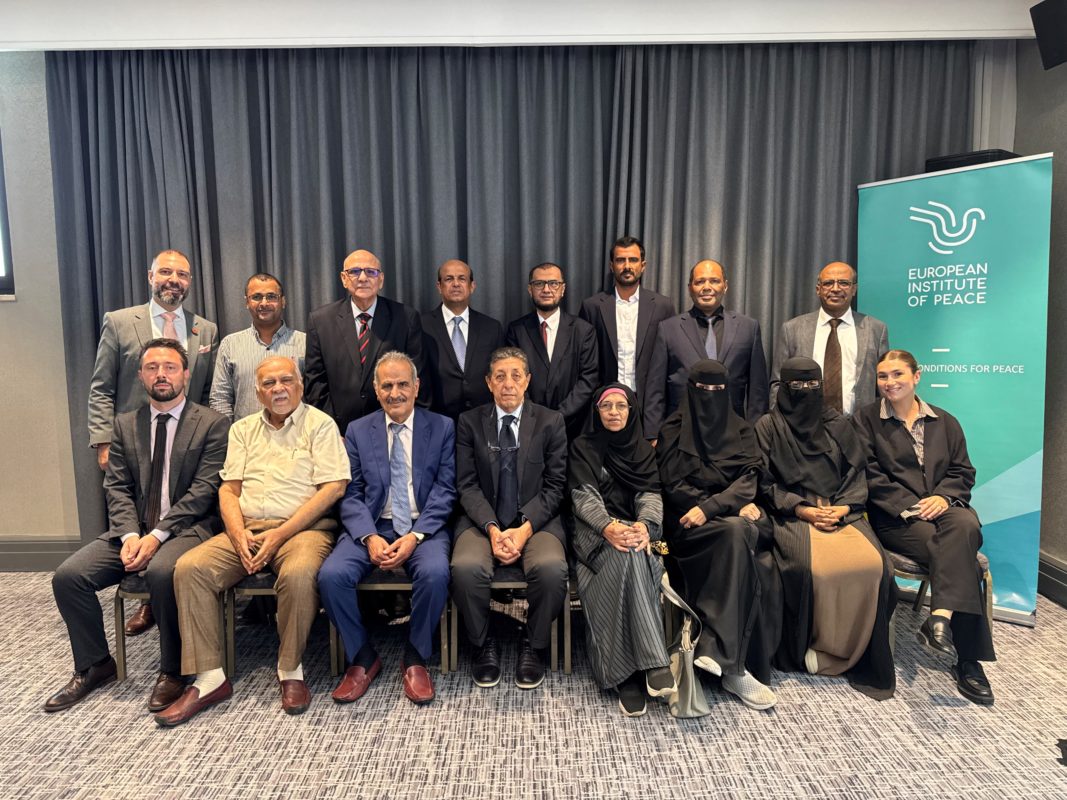
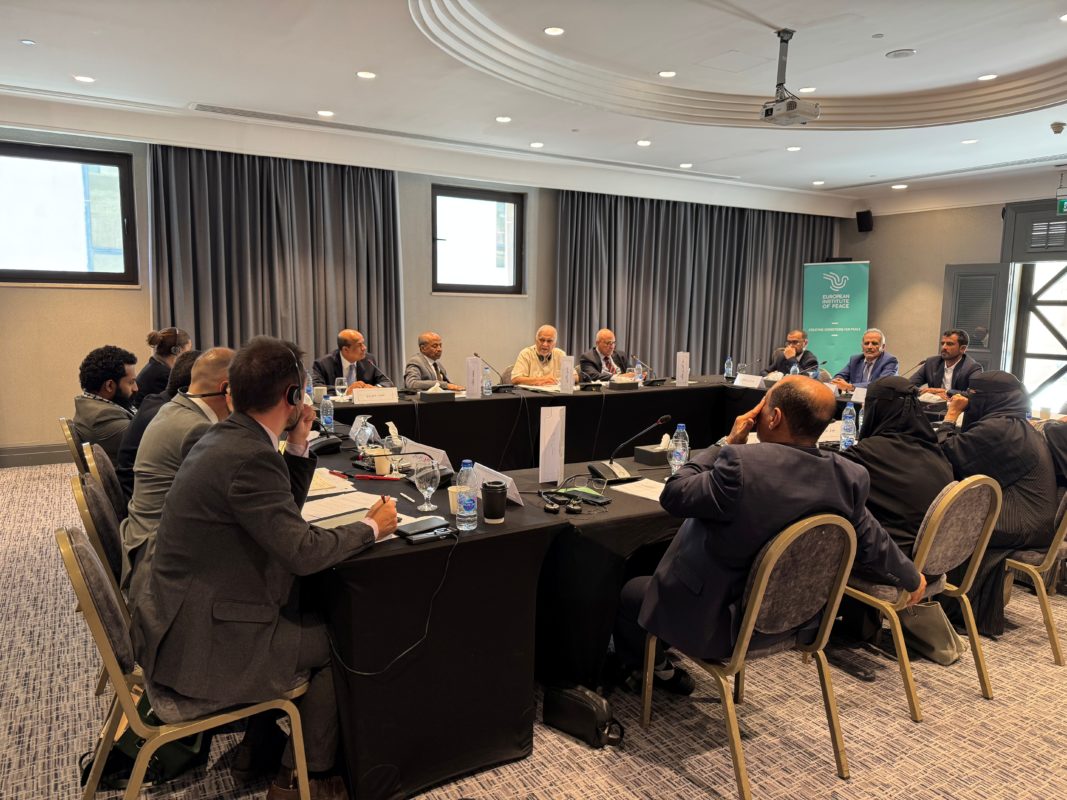
This document was produced as part of an ongoing dialogue project facilitated by the European Institute of Peace to foster trust and convergence between political components in southern Yemen and to support the efforts of the UN Special Envoy for Yemen. This document has been produced with the financial assistance of the European Union. Its contents are the sole responsibility of the European Institute of Peace and can under no circumstances be regarded as reflecting the position of the European Union.
On 26 June 2025, The Institute hosted the event ‘A European Conversation on Syria’ in Brussels, together with the Belgian Ministry of Foreign Affairs, Foreign Trade and Development Cooperation. Held under the Chatham House Rule at the Egmont Institute, this meeting brought together senior representatives from the European Union and from several European States to reflect on the current situation in Syria and explore how European actors can contribute to short and long-term stability and peace.
The discussion started with an assessment of the major challenges facing Syria six months into its political transition, including sectarian tensions; measures to aid economic recovery; the need to unify security forces; inclusivity in political processes; transitional justice, accountability, and reconciliation; and broader regional security dynamics. Europe’s engagement should be predicated on a partnership approach that respects Syria’s agency and in full awareness of the significant capacity constraints at national levels across multiple fronts.
Despite these challenges, this moment represents a key opportunity to articulate Europe’s long-term strategic interests, encompassing key areas such as security, migration, trade, and resource management. In particular, the following were identified as priority areas for Europe to provide added value in support of Syria’s stabilisation and political transition:
- Institutional capacity building, which Europe can support by offering technical assistance and expertise to strengthen the capacities of staff within ministries and public institutions, so that they can deliver services and implement policies effectively.
- Supporting political inclusivity and human rights including by enhancing support for civil society actors – both inside Syria and within the diaspora – to strengthen their role in the political transition.
- Developing a trade and energy partnership, to reintegrate Syria into the global market and its economy. This can be achieved, in part, by reviving or reimagining a cooperation framework similar to the EU–Syria Cooperation Agreement signed in 1977. It could also involve expanding Syria’s sources of revenue and potentially integrating Syria into the European Energy market through the Great Sea Interconnector (GSI) project.
- Support for economic recovery through different avenues, which could include facilitating platforms which coordinate diaspora-led investment in small businesses, offering EU export guarantees, and contributing to job creation, cash-for-work schemes, and microfinance initiatives.
- Support stabilisation of Northeast Syria and Qamishli-Damascus Relations, by investing in infrastructure rehabilitation, particularly in the energy and water sectors. A visible and balanced European presence could also help mediate external pressures and support internal cooperation.
- Addressing the camps and prisons housing ISIS-affiliated populations in Northeast Syria where Europe can play a vital role in responding to humanitarian imperatives and reducing future security risks. This includes supporting the repatriation, rehabilitation, and reintegration of third-country nationals by engaging both the countries whose nationals remain in the camps and the Syrian Democratic Forces (SDF). Europe can also coordinate a response to the issue of male detainees held in prisons in Northeast Syria on suspicion of ISIS affiliation, including several hundreds of European passport holders.
The European Institute of Peace is proud to announce the launch of the website for our Environmental Pathways for Reconciliation (EPfR) project, which contributes to building a sustainable peace in Yemen by using the environment as an entry point for dialogue, reconciliation and trust-building among different parties at both the community and the national level.
The website contains comprehensive information on our team’s research and analysis work on environmental security and governance in Yemen and on the project’s consultations with the local population and engagement with decision-makers, with over 3,600 individuals involved across 13 governorates so far. Through these dialogue spaces that convene local decision-makers, traditional leaders, civil society, and subject experts, Yemeni citizens can identify locally led peacemaking solutions to address environmental risks and enhance resilience.
This website aims to become a key resource not only for the EPfR project, but for environmental peacemaking at large, showcasing the lessons generated by the project that can contribute to guiding integrated programmes on climate, peace and security – in Yemen and internationally.
The project is implemented by the European Institute of Peace with support from the German Federal Foreign Office and is part of the Weathering Risk Peace Pillar led by adelphi.
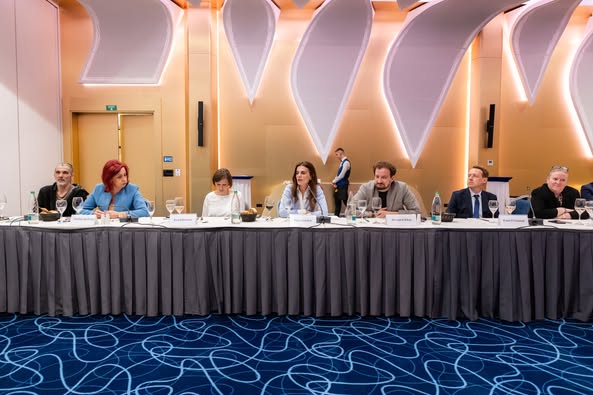
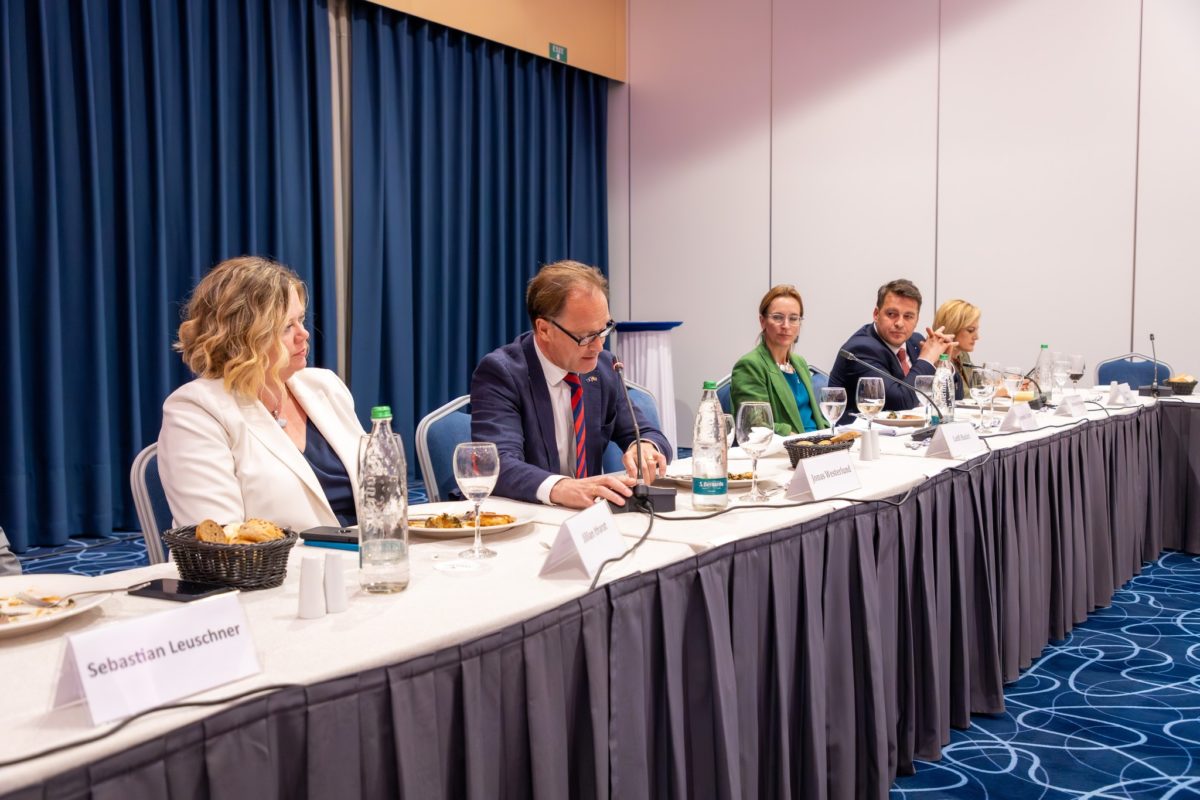
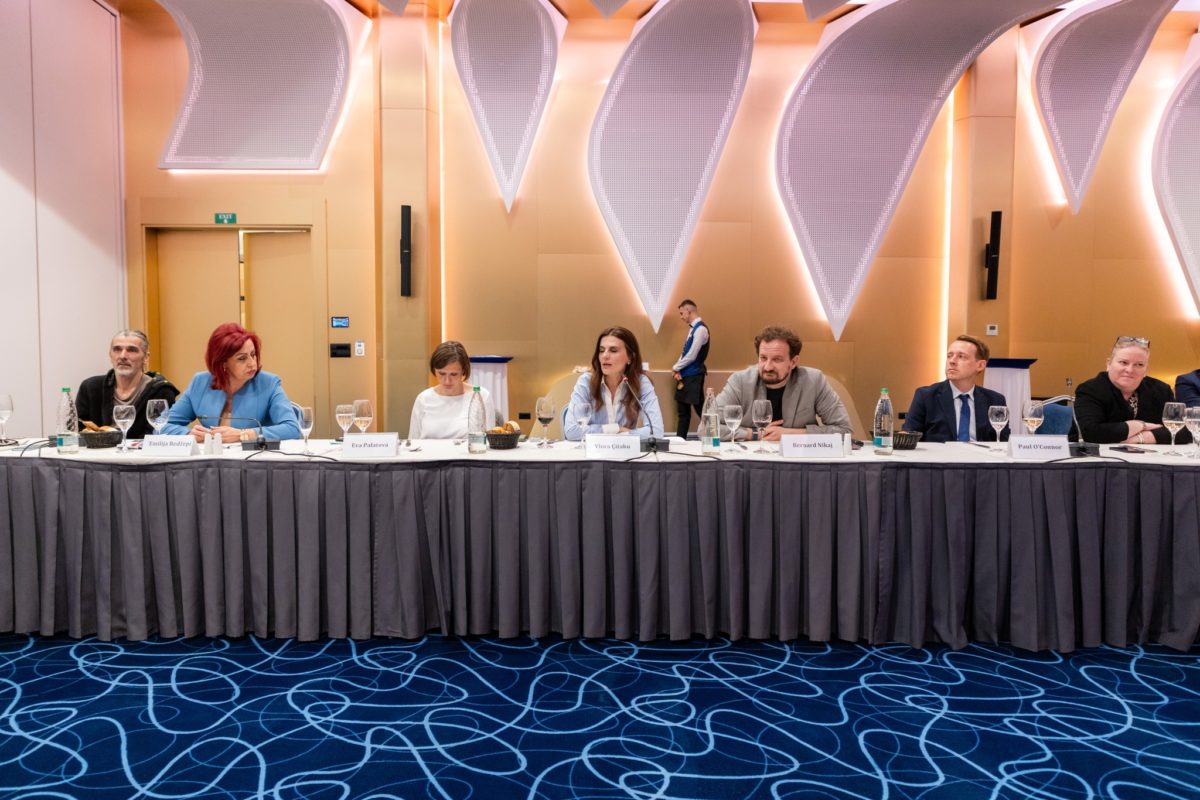
On 6 May, the European Institute of Peace and our partners from a pro-normalisation civil society coalition in Kosovo held a working meeting in Pristina with senior representatives of political parties, independent institutions, diplomats, and civil society. The event was held in the “Dinner Talks” format established by the coalition to promote dialogue on key challenges and opportunities.
The gathering explored prospects related to the normalization dialogue with Serbia, constitutional multi-ethnicity, international relations, and options for overcoming the current institutional deadlock. Civil society participants assessed that the absence of a political agreement among Kosovo’s leading actors undermines perspectives and the potential for progress on the local communities’ key priorities.
The central message that emerged was the need to look ahead, to pursue comprehensive normalisation and inclusive decision-making, grounded in the constitutional principles of a multiethnic Kosovo and the full participation of all societal actors.
The Institute and partners will continue to engage in stakeholders’ dialogue with the aim of overcoming stalemates and opening space for key processes to move forward.
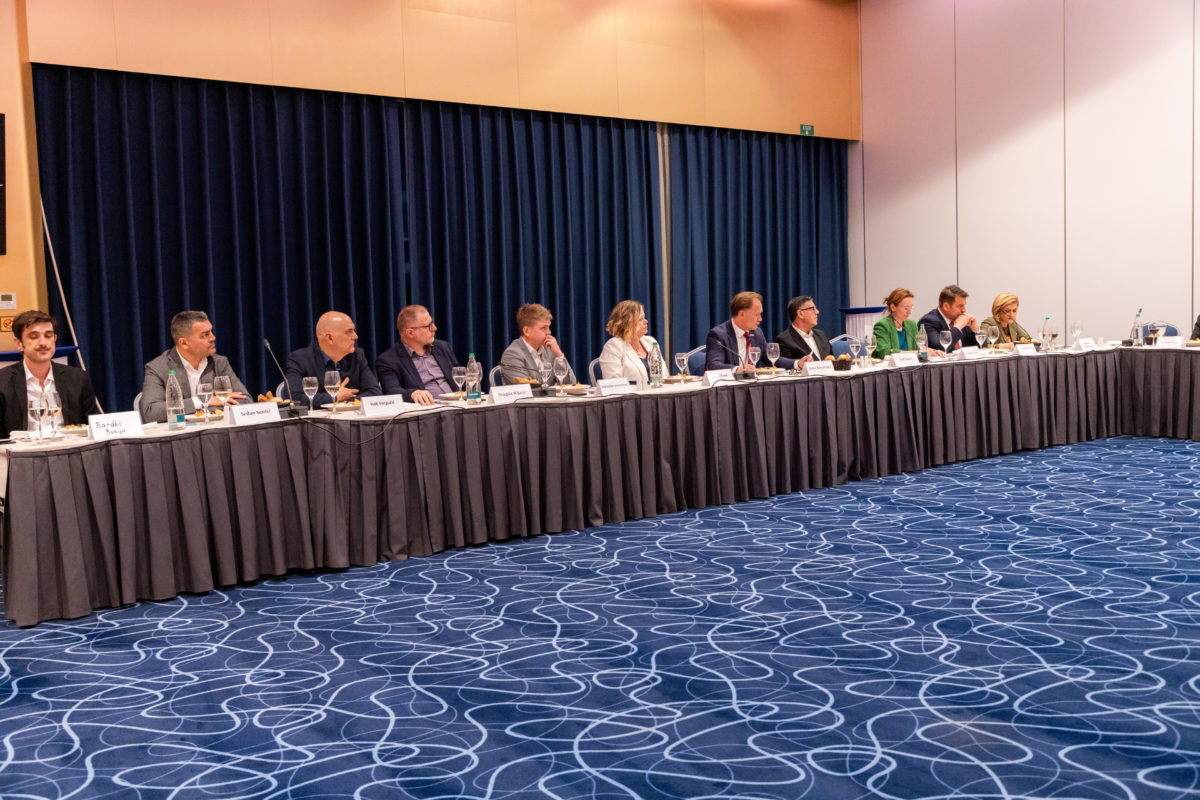
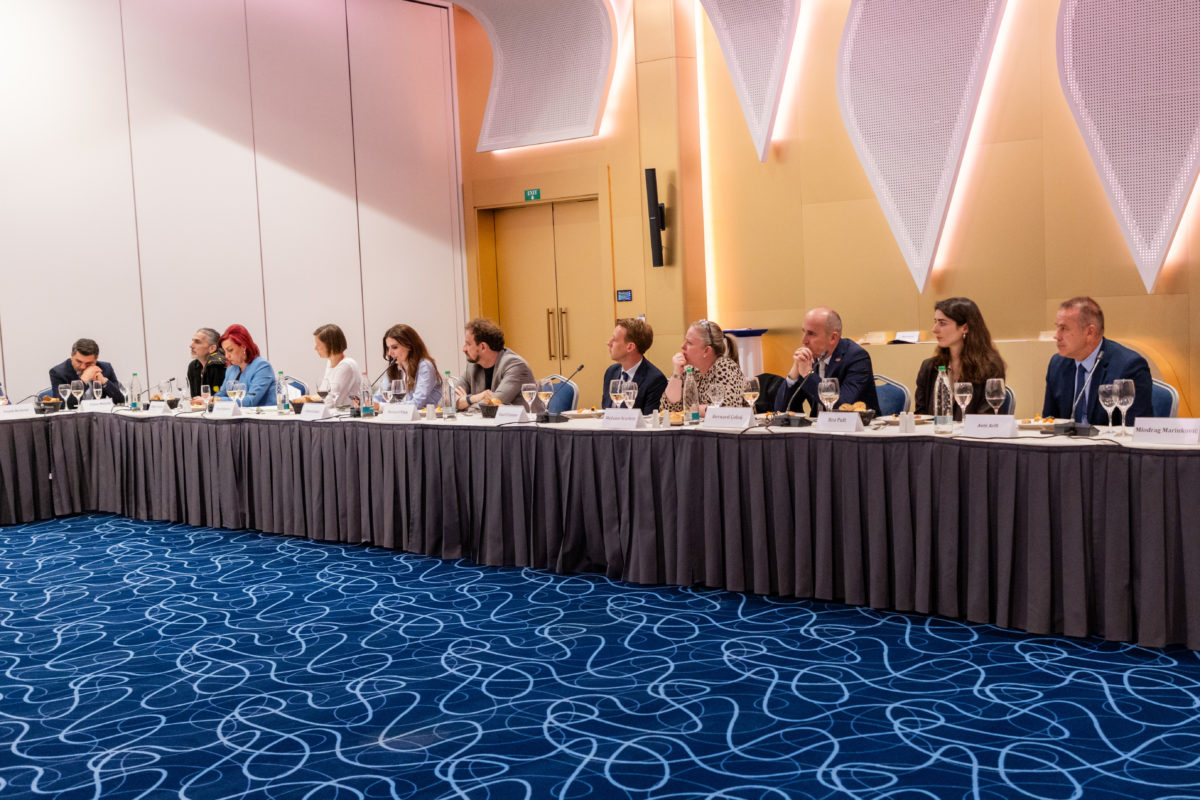
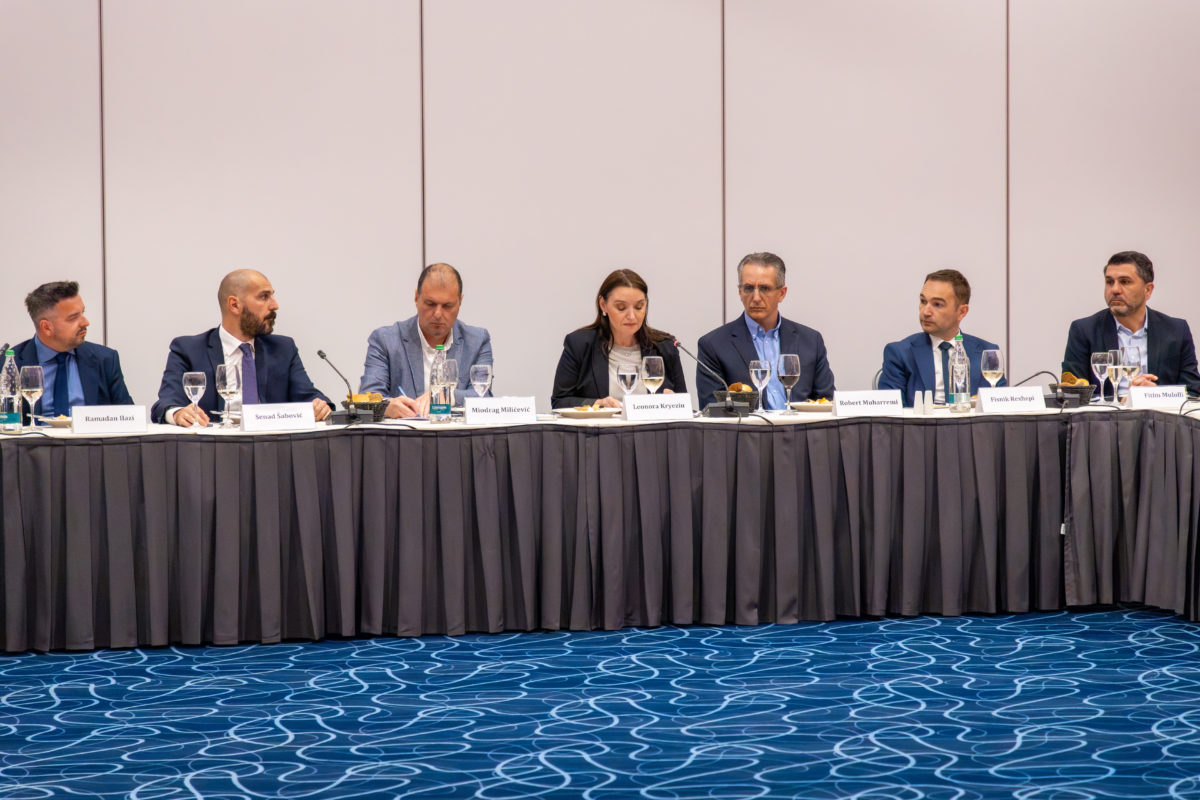
In 2024, on the occasion of the 10th Anniversary of the establishment of the European Institute of Peace, the Institute commissioned a series of articles about our work, interviewing staff members, senior advisors, and people who have worked with us in the past decade on conflict prevention and resolution in different areas of the world.
How best to communicate our work is not obvious. Discretion is often an essential ingredient to what we do, for example around dialogue and engagement with parties to conflict and their supporters. But we cannot afford not to communicate in an increasingly crowded media and public affairs environment, one in which political and public recognition is too low regarding the value and practical benefits of the work that we and our partners undertake. “What you are doing is great – why aren’t you telling more people about it?” is a typical reaction from partners that want to increase their support for us. Sharing these stories about the Institute’s work is of the ways in which we are responding to these requests.
When he’s not deployed on missions to the Horn of Africa, you can usually find Nuradin Dirie working at a quiet desk in one of the reading rooms upstairs in the British Library. It’s his ‘office away from the office’, as he likes to call it. It’s certainly a stark contrast to the arid plateaus and plains of Puntland in northern Somalia, where he’s most recently been active for the European Institute of Peace.
Nuradin has always had a keen interest in diplomacy, both in his native Somalia and in the UK, where he has lived for over thirty years. When the Indian Ocean tsunami hit the coasts of Somalia in 2004, he mobilised his network among the diaspora community in the UK to coordinate a response. Soon, he travelled to Somalia to play a role in the urgent humanitarian relief effort underway there. Working with the international disaster response in his native country, he saw the impact he could have working across cultures. After the disaster, he decided to continue working in Somalia, building a bridge between his country and the international community. Since then he has worked as a diplomat, humanitarian and a leader in local politics. Today, Nuradin Dirie is the European Institute of Peace’s Senior Advisor in the Horn of Africa, where his contacts and experience in the region are frequently called upon to help understand and mediate conflicts – many of which are deeply political in nature.
It’s a less partisan role than he has played in the past. Ideally, democracy blends new ideas with collective consensus, balancing individual choice with social harmony. However, disrupting traditional systems can be catastrophic, particularly following conflicts.
The Worst Form of Government, Except for all the Others
In Puntland in 2023, attempts to shift from a traditional, clan-based political system to direct elections threatened to spark civil war. Nuradin’s contributions, and the Institute’s role in navigating these tensions—drawing on local knowledge and international support—were crucial to ensuring peace in a moment of instability.
The Puntland region of Somalia is pastoral, and urban settlements are a relatively new development. Social systems that are sometimes thousands of years old had always been relatively stable, maintaining equitable power distribution among pastoral groups. Since Puntland’s establishment as an autonomous federal state in Somalia in 1998, elections had followed an “indirect” model based on those traditional systems: elders representing pastoral clans chose their own representatives in parliament, and these representatives had in turn chosen the President.
From an outside perspective, it could seem unfair that unelected, often dynastic clan elders should wield such political power. The system, deeply rooted in the specific community bonds and structures of nomadic herders, had evolved to foster stability, not individual choice.
In 2023, just months before the end of incumbent Puntland President’s Said Abdullahi Deni’s term, he presented new legislation to replace the traditional, clan-based system with direct elections — starting with that year’s vote. Outside observers saw Deni’s sudden push to establish universal suffrage as a move toward a better democracy.
Locals quickly understood it as a power grab. In Puntland, maintaining the balance of power between the many local clans and sub-clans is an extraordinarily delicate affair. Particular care is taken to ensure that the presidency is rotated among three main factions making up a dominant clan, called the Mohamoud. Under the unwritten agreement, which some analysts argue is the key to Puntland’s stability, President Deni, an Osman Mohamud from the Bari region, was supposed to be followed by a representative of a different sub clan, the Isse Mohamud. Under the proposed new suffrage scheme, the Isse Mohamud would have lost their traditional turn in office. Resistance to Deni’s attempts to bring in universal suffrage was strongest in a northern region of Puntland called Nugaal. The Isse hail mostly from a region called Nugaal.
To be sure, many residents of Puntland had grown tired of the traditional model, criticizing clan governance as corrupt and inefficient. But changing the existing system, and balance of power. required consultation and careful handling, in a society that has been governed along clan lines for thousands of years. Instead, the sudden attempt to push through a shift to direct elections, particularly by a President facing the end of his term, was not viewed as an effort to make Puntland more democratic. When voices that understood the local context criticized it as a calculated attempt to hold onto power, the proposal instead just stoked long-standing tensions.
In June, 2023, deadly clashes occurred between an opposition militia and government forces in the state capital Garowe. The fighting threatened to erupt into widescale violence. Though Puntland had escaped the worst of the Somalia civil war in the 1990s, inter-clan tensions were high. Insurgent groups and other militant non-state actors were also present in the region, and though they had no direct connection to the Presidential politics, they could exploit any instability for their own purposes, particularly if electoral tensions escalated.
To de-escalate the complex, fast-deepening crisis would require experience, local knowledge, and connections to civil society and the international community. Led by Nuradin, the Institute became active in Puntland, as part of the effort to prevent the conflict from spinning out of control.
Applying Pressure from Above
In addition to establishing a direct vote for representatives, Said Abdullahi Deni’s proposal for a direct vote would have shifted Puntland’s government from a longstanding parliamentary system toward a presidential one. Opponents said the change would place too much power in the executive. Dani’s government fired back that the opposition were trying to stall democratic progress.
As the situation escalated and the threat of widespread violence seemed ever more real, Nuradin and the European Institute of Peace conducted shuttle diplomacy between local communities, traditional authorities, political power brokers, armed groups, civil society organisations and the international organizations. The work took a multi-pronged approach: bottom-up through local networks, and top-down through high-level, to diffuse tensions, rebuild broken relationships, and persuade President Deni to retract his flawed reform plan.
Technical expertise was important to Nuradin’s efforts. But his intimate knowledge of how local politics worked in Puntland was even more critical. In 2009, he himself had been a presidential candidate in the state.
“I knew the motivation of the local politicians, I knew what they were playing at, because I had played the game myself. And now I played that same game not for politics, this time, but for peace.”
He also had reliable access to decision-makers in the international community.
“The kind of authority it gives you, it’s really valuable,” he says, “because local power holders see I’m representing the European Institute of Peace, they see that I’m regularly briefing the diplomatic community, that I’m able to generate pressure from the UN Special Representative, or from one of the Ambassadors – people make these associations, and they carry weight.”
Nuradin and the Institute were often vital links for the international community, briefing EU member states, plus the UK and US ambassadors on the evolving situation on the ground, and providing recommendations for how they could best target their interventions and support. Much of the investment in Puntland and support to the security sector comes from international donors, a source of significant influence over the government’s decision-making. The Institute was able to leverage its access at the right moment, a testimony to the importance of maintaining strong relationships and access to actors at the highest level.
Applying Pressure from Below
Diplomatic engagement was a critical component of the efforts to avert a crisis, but ultimately it was outreach to those in Puntland’s wider civil society which likely carried greater weight in the resolution of the situation. Were election tensions to transform into violence, it would be Somalis, not the international community who would be on the frontlines of that conflict.
Drawing on extensive local knowledge and networks, the Institute partnered with the Puntland Non-State Actors Association (PUNSAA) and the Puntland Development and Research Center (PDRC) to engage with a broad diversity of actors on the ground. Abdinasir Yusuf, the deputy director of the PDRC, knows himself what it means to live through violent conflict, having been forced to flee Mogadishu at just 12 years old. He worked with the European Institute of Peace and the PUNSAA tirelessly, day in, day out for nearly three months, to try and avert an outbreak of civil war in Puntland.
Abdirahman Abdirazak is the chairman of PUNSA and has been working with civil society in Puntland for twenty years. The platform comprises 120 groups including women, youth, traditional elders, national NGOs and the business community. Abdirahman says that without the push together with Nuradin and the Institute to reach out to civil society and calm tensions, he can’t imagine what would have happened.
“We tried all kinds of different approaches. Even when the president refused to meet with certain groups, we engaged in shuttle diplomacy and ran around between actors to try and build bridges. We met with armed groups, we listened to their grievances, then we would communicate these to the government. We relied heavily on the network of the EIP and Nuradin, it was really crucial for us.”
Through a vast network of contacts on the ground and a wealth of local experience, as well as access to international institutions, the Institute was able to work with local partners and avoid disaster. A month before the January elections, under considerable diplomatic and local pressure, President Said Abdullahi Deni agreed to maintain the clan-based indirect model, abandoning the shift to direct elections that had brought Puntland to the brink of civil war.
We will never know how things might have turned out had the plan gone ahead. A crisis averted rarely makes the headlines. But Nuradin and the Institute’s partners on the ground believe their work helped avoid bloodshed. He said:
“Without that kind of collective work, the partners providing the community side, us providing the political engagement and the diplomatic angle, I don’t think we would have had peaceful elections.”
It even worked out well for President Deni, who lost his reform plan, but managed to win re-elections, a first in Puntland’s recent political history, due in part to the inability of opposition groups to organise during the unrest. The question remains as to whether the President, and Puntland society at large, will now take this opportunity to reflect and re-organise to implement reform in a more sustainable way without reigniting tensions before 2029.
Being the Bridge
The European Institute of Peace’s work in Puntland shows just how critical it is for conflict resolution mediators to sensitively combine local knowledge with outside technical experience, cultural traditions with international norms. In Puntland, flexible, adaptive, locally grounded and internationally connected peacemaking organisations like the Institute complemented existing institutions, bridging not just factions and competing interests, but cultures and generations, and began the process of successfully navigating change together.
Modern culture has a tendency to think of ‘traditional’ systems as outdated, a quaint cultural heritage. But sometimes the solutions to our problems don’t just lie in the future. There is wisdom in tradition that the modern world often ignores. Somalis living in Puntland remember a thousand years of pastoral tradition. As Nuradin puts it,
“Before we learn our first word of the Qur’an, we learn about who we are, and that means who our ancestors were. Who we are is who we were.”
Their experience of ‘modernity’, by way of colonialism, is only about a hundred years, Nuradin notes.
“You can understand the reluctance of people to accept the modern system, because it’s like 10% of their being. And you want to ignore 90% of who they are.”
For Nuradin, any sustainable peace has to be rooted in the sustainable culture of communities.
“We are where we are, we’ve been living with this nomadic, pastoral system of governance for the past thousand years, we can’t change it like that, so what elements of it do we want to include, and what elements do we want to include from modernity to make sure everyone’s included?”
In 2024, on the occasion of the 10th Anniversary of the establishment of the European Institute of Peace, the Institute commissioned a series of articles about our work, interviewing staff members, senior advisors, and people who have worked with us in the past decade on conflict prevention and resolution in different areas of the world.
How best to communicate our work is not obvious. Discretion is often an essential ingredient to what we do, for example around dialogue and engagement with parties to conflict and their supporters. But we cannot afford not to communicate in an increasingly crowded media and public affairs environment, one in which political and public recognition is too low regarding the value and practical benefits of the work that we and our partners undertake. “What you are doing is great – why aren’t you telling more people about it?” is a typical reaction from partners that want to increase their support for us. Sharing these stories about the Institute’s work is of the ways in which we are responding to these requests.
As the last of the evening light fades over Pristina, Kosovo, the European Institute of Peace’s Senior Advisor in the country, Senad Šabović, enters his local tavern, Taverna Erolli, to watch a football match. Inside, the owner is trying to pirate the match on the bar’s TV: last year, Kosovo stopped the broadcast rights of Telekom Srbija’s Arena Sport, after it televised messages of support for an attack on Kosovo Police in the Serb-majority village of Banjska by Serb gunmen in September. The loss of broadcast rights for sports became the next everyday frustration springing from the stalled ‘normalisation dialogue’ that’s been ongoing between Kosovo and Serbia following Kosovo’s declaration of independence — a declaration still not recognised by Serbia. The political effect of those daily frustrations is something that Senad understands with a local’s nuance, and brings to bear in his work for the European Institute of Peace’s efforts to bring stability to Kosovo.
Though Kosovo’s war may have ended over a quarter of a century ago, ongoing tensions between Kosovo and Serbia still affect so many aspects of people’s daily lives here. From the lack of recognition for educational and professional certifications, to cumbersome and expensive barriers on trade, exchange rates, postal services and communications infrastructure, much remains still unresolved. The simmering tensions occasionally offer the rest of Europe opportunities to understand the local frustration. In 2018, digital clocks across Europe suddenly fell behind by six minutes, causing disruption and confusion across the continent. When technicians finished their investigation, it turned out that a row between Kosovo and Serbia over outstanding electrical bills had caused a hiccup in the entire European energy grid. For Senad, the situation is exasperating.
We’re 25 years since the war and it’s almost an insult to the average person’s intelligence that we still have this level of tension as we speak today.
Daily frustration masks more serious possibilities. The Banjska attack was just the latest in a worrying string of violent incidents in the western Balkans. In May 2023 more than 90 NATO peacekeepers were injured in clashes with residents of Serb-majority municipalities in the north, after Serb residents boycotted elections and the local government forcibly installed rival Albanian mayors. Serbia responded by manoeuvring troops closer to its border with Kosovo, while NATO reinforced its presence with an additional 700 troops. Many in Kosovo say the international community has abandoned them after the military intervention in 1999, and simply doesn’t understand the risk of renewed fighting that remains today. Populist politicians on both sides increasingly resort to revisionist rhetoric about national identity to win support.
The Need to Belong
The profound social and cultural shifts that have accompanied globalisation have today left many disoriented, feeling a loss of identity as the certainties of the past rapidly dissolve.
Although a growing recognition of our identity as ‘global citizens’ is no doubt healthy, finding peace is not just about recognising our common interests, needs and humanity. It’s also about respecting and accommodating our differences. We don’t want to be everybody, everywhere, because that’s the same as being nobody nowhere. We also want to feel that we are embodied as someone, rooted somewhere – something that was denied to so many in Kosovo for so long. With little else to offer voters in terms of real material benefits, it’s a sentiment that so-called ‘populist’ politicians not just here, but everywhere from Budapest to Brandenburg have been playing on to win support.
The question is how to strike the balance between local communities and global society, and the western Balkans lies at the cutting edge of that challenge. How can we build institutions capable of respecting difference, while also addressing common needs for security, reliable services, and stable livelihoods?
Particularly when in the tavern, where a picture of Senad hangs on the wall alongside other regulars, they still can’t even get that evening’s match on.
Normalising Normalisation
The breakaway of Kosovo, previously a majority ethnic Albanian province in southern Serbia, was the last of the big Balkan conflicts of the 20th century. Forces led by Slobodan Milošević killed some 10,000 Albanian Kosovar civilians in retaliation for their community’s mobilisation, before in 1999 NATO eventually intervened with a three-month bombing campaign, forcing the withdrawal of Serb troops. After spending the next decade as effectively a UN protectorate, Kosovo declared independence in 2008. Recognised by a majority of Western countries, the declaration is still not universally accepted, and deep scars from the war remain. A legacy of ethnic divisions is part of a long list of grievances and issues that remain unresolved.
In 2011 an EU-mediated normalisation dialogue was initiated between Kosovo and Serbia with the aim of relieving political, social and economic tensions.
In the early years, the Brussels Agreements sought to resolve issues including freedom of movement, recognition of educational diplomas, regional representation and trade and international customs. Finally formalised in 2013, the landmark negotiations went further, when both sides agreed not to block or hinder the other’s integration into the EU.
But the most contentious issue of all did not get resolved: the status of the Serb-majority municipalities in Kosovo. The vast majority of Kosovo’s population is ethnically Albanian, and after Kosovo’s independence in 2008, significant communities of ethnic Serbs now found themselves a minority in the new nation. The idea proposed in the 2013 Brussels Agreement was to integrate these municipalities into Kosovo’s legal framework, but grant Serbian-majority municipalities a degree of self-organisation.
The process had enough backers, but implementation proved tricky. Many in Kosovo, spurred on by opportunistic political rhetoric, feared that the new Municipal Association would essentially become an extension of Serbia. At the same time, many Serbs in the north of Kosovo, echoing rhetoric rising in Belgrade, were afraid that the deal would cut them off from support from Serbia, and abandon them to an Albanian government in Pristina.
A State of Disassociation
Central to these fears was the rise of populist and revisionist narratives in Kosovo’s national politics. And this rise in populism, just as it has been almost everywhere, was both a cause, and a result of the increasing rift between civil society, the government, and international institutions. In Kosovo, populist politicians – perhaps out of belief that the more technical governance agendas will not rally up voters – have for years worked hard to portray themselves as defenders of the nation, and to convince their constituents not only that Serbia fully intended to reclaim sovereignty over its erstwhile territory, but also that the EU was forcing Kosovo’s hand into capitulating to Serbia’s demands at the negotiating table.
Visar Ymeri, himself a former member of the now ruling party turned prominent civil society activist knows the game intimately. He says that in private, politicians like Kosovo prime minister Albin Kurti would accept the terms of the Association of Serb Majority Municipalities, but to do it publicly would be political suicide.
With little improvement in economic development, health or education, during his tenure, Visar says that Kurti only really has his persona as an uncompromising defender against Serbia and pushy bureaucrats from Brussels. But of course, in order for this persona to mean anything, he has to paint both Serbia and the EU in a particularly threatening light, which only serves to pour fuel on the already smouldering flames. And Belgrade’s aggressive rhetoric towards Kosovo, as well as its active attempts to block Kosovo’s pathway to Europe despite former agreements not to is certainly doing an excellent job of fanning the flames on the other side of the border.
Popularism creates polarisation not just across different groups within societies, it also polarises power vertically, isolating the state from other states and the wider international community. And it also isolates the state from civil society, whose greater diversity of voices would threaten the one-dimensional nationalist rhetoric of the ruling party.
Jovana Radosavljevic is the executive director of New Social Initiative, a North Mitrovica-based civil society organisation working on the topics related to the Kosovo-Serbia dialogue and non-majority community rights. As she sees it, a diversity of civil society inputs can help add nuance to the debate, and break the monopoly of single, simplistic narratives. But it’s often difficult for them to find a space at the table. According to her,
what we have now in Kosovo is a very negative trend unfortunately, where the space is shrinking in regard to the openness of the government to accept any sort of input or criticism coming in from different actors. I think it’s really important to ensure that civil society has the manoeuvring space to reflect the community needs and concerns as well.
But for Visar, the core of the issue is the story that’s being told about the Municipal Association, rather than the Association itself.
To be quite honest, this is not an issue with the citizens of Kosovo. I mean, the association is not going to be visible. Nobody from Prishtina ever travels to Leposavić. Have you ever met somebody that just went to Leposavić to have a coffee? Never. It was made as a big fuss by Vetevendosje [Kurti’s political party] mostly but also by a part of the media and civil society – in 2013 and 2015 there was a lot of misinformation about the Association.”
Rhetoric born out of political positioning as much as from ideology is doing nothing to help the region turn over a new page.
No wonder Senad and others are frustrated. The more civil society becomes fragmented, the more fear takes over, and the more susceptible people are to populist and nationalist rhetoric. And the more the Kosovar state becomes isolated from the international community which historically supported and protected it, the more it feels that it has to adopt a defensive posture against Serbia. What is needed, is a gradual reconnect of the various layers, for people to regain a sense of confidence in their wellbeing as a citizen of a democratic society.
A Pragmatic Approach
With the help of Senad’s local expertise and the Institute’s vast network of contacts at both the track II and track I level, the Institute was able to design an intervention which quickly went to the heart of the political impasse. As with so many other European Institute of Peace programs, a pragmatic approach with an early focus on the issue of the Association of Serb-majority Municipalities was key. In turn that engagement could serve as the point of entry to eventually tackle the political blockage.
Despite almost a decade of rhetoric at all levels about moving forward with the Association, there was still no practical proposal on the table which would allow the government and the international community to make progress. The first task the European Institute of Peace gave itself was to engage with experts and community groups in civil society and understand what exactly was needed to transform the Association into a workable reality.
Throughout 2022, the Institute worked in partnership with the Friedrich Ebert Stiftung (FES) to develop an actual draft statute for the establishment of the Association, which was then submitted to the highest levels of decision-makers at the national and international level. Senad and other team members consulted with track II and other key actors and platforms, to draft a tangible proposal that would satisfy all parties.
The goal was to demonstrate how an association could work in full compliance with Kosovo law, and at the same time, make a substantial offer to the encompassed Kosovo Serb-majority municipalities. One of the key issues was the widespread doubt and confusion about whether the creation of such a municipal association would be constitutional according to Kosovo law. Understanding this concern, the EIP worked intimately with a constitutional lawyer to ensure that all potential conflicts were addressed and mitigated, so that they would leave no chance for the government or other actors to find pretexts as to why it could not be implemented.
The EU had consistently pushed Kosovo to resolve the issue of the Serb-majority Association. But without a concrete draft statute, the process could not move forward, plagued by doubts about its constitutional legality. While only one factor in a series of diplomatic steps still underway, the consolidated draft arrived at the right time to dispel the central Association myths. And it coincided with Brussels pushing a Franco-German, comprehensive proposal that prominently included provisions demanding the establishment of the Association. The subsequent EU proposal for the Association, submitted to the parties in October 2023 under an initiative largely led by France and Germany, drew substantially on the European Institute of Peace/FES document.
The next task was to consult with local stakeholders, including civil society, to pre-empt political fearmongering, and here again the Institute’s connections not only to track I actors, but also to civil society, were of crucial importance. Though falling short of the full adoption that was hoped for, Kosovo Prime Minister Albin Kurti for the first time publicly expressed a willingness to seriously re-open the issue, following the submission of the draft statute. Later, in the context of Kosovo’s application for the Council of Europe in spring 2024, the Kurti government expressed its appreciation of the proposed statute. There are no quick wins in the work of conflict resolution, but this was certainly a big step forward after almost a decade of political deadlock.
The ball is now in the government’s court. As of April 2024, the Parliamentary Assembly of the Council of Europe recommended that Kosovo be invited to become a member. The final decision now rests with the Committee of Ministers, who have said that membership would be contingent upon Kosovo fulfilling its commitment to initiate the Association process. It’s certainly not the end of the story by any means, and what happens next will largely depend on whether Kosovo and Serbia are able to stand by their commitments. But if they genuinely want to pursue the path to greater peace and prosperity, they can now draw on credible and pre-vetted proposals to put words into action.
United in Diversity
For some elites in Brussels or Washington, events in Kosovo may perhaps seem marginal. Conflicts in Gaza and Ukraine understandably receive far more attention. But the disputes seen here are not just about Kosovo and Serbia. They’re illustrative of so many of the conflicts we are facing today and will increasingly face in the future. The municipal association is at the cutting edge of the question as to how to blend local autonomy with national, regional and global political, social and economic modes of life.
Each layer of collective organisation is only as strong as its constitutive parts. The EU is strong only to the extent that its member states are strong. Kosovo and Serbia are strong only to the extent that their municipalities and communities are strong. And communities are strong only to the extent that the individuals within them are strong. Devolution of power, greater independence and individualism are wonderful things that can spur great creative change, but social groups must remain connected if they are to thrive in today’s world. The EU’s ‘United in Diversity’ motto is a nice ideal.
If you ask Senad, Jovana or Visar and they will tell you just how much local knowledge, sensitivity, and work it takes to put that motto into practice.
In 2024, on the occasion of the 10th Anniversary of the establishment of the European Institute of Peace, the Institute commissioned a series of articles about our work, interviewing staff members, senior advisors, and people who have worked with us in the past decade on conflict prevention and resolution in different areas of the world.
How best to communicate our work is not obvious. Discretion is often an essential ingredient to what we do, for example around dialogue and engagement with parties to conflict and their supporters. But we cannot afford not to communicate in an increasingly crowded media and public affairs environment, one in which political and public recognition is too low regarding the value and practical benefits of the work that we and our partners undertake. “What you are doing is great – why aren’t you telling more people about it?” is a typical reaction from partners that want to increase their support for us. Sharing these stories about the Institute’s work is of the ways in which we are responding to these requests.
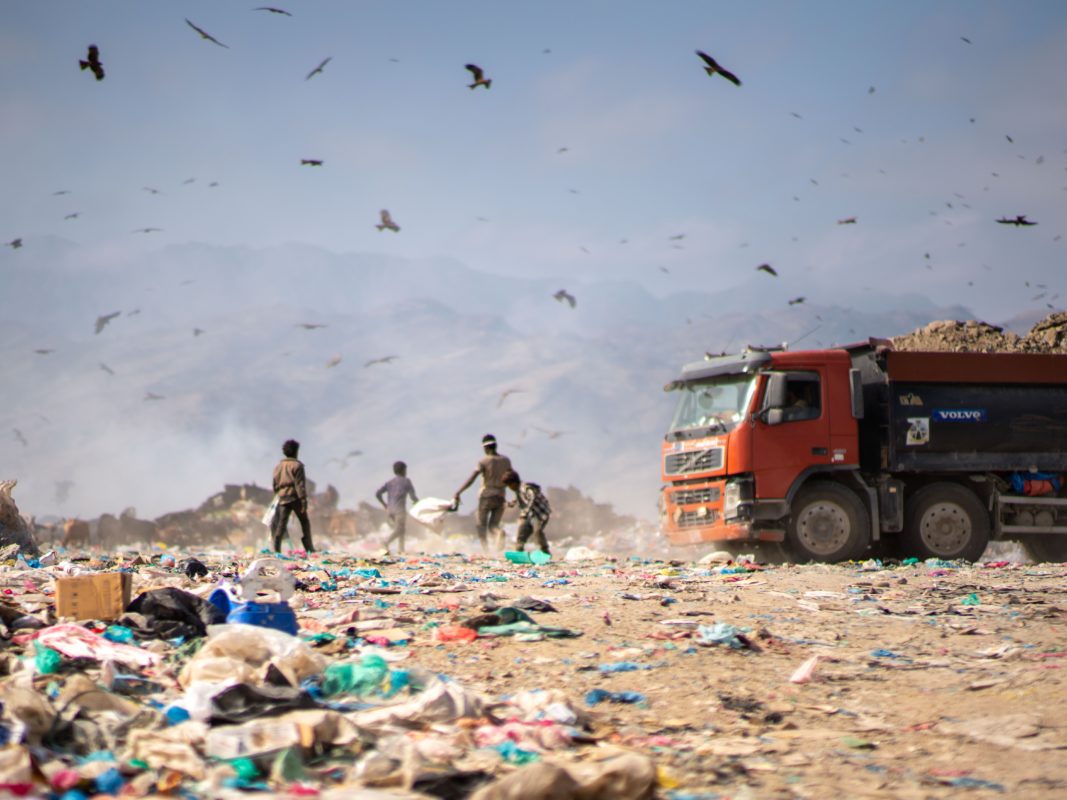
According to the International Committee of the Red Cross, of the 20 countries most affected by climate change, the majority are at war. Not only is climate change a driver of instability and conflict, but armed conflict is often a cause of environmental degradation. During the first two years of the conflict in Ukraine, carbon dioxide emissions directly related to the war stood at 175 million tonnes – more than the yearly output of the Netherlands. In Gaza, the UN Environment Programme estimates that over 100,000 cubic metres of sewage and wastewater are currently being dumped daily onto land or into the Mediterranean Sea as a result of infrastructure damage. In 2019, Europe’s military carbon footprint alone was estimated at around 24.8 million tCO2e, equivalent to the CO2 emissions of about 14 million average cars. War is waste.
Recognising both the relationship between armed conflict and climate change, in early 2019, the European Institute of Peace established a dedicated unit, the Climate and Environmental Peacemaking Programme. The Programme responds to the security and conflict risks posed by environmental challenges by engaging parties to conflict, opening new avenues for dialogue, building trust and relationships, and providing policy advice on climate and environment. It creates a space for greater civil society input by also being the bridge between populations and decision-makers, and shifting the consciousness of those in power.
The Institute has implemented bespoke projects which engage directly with the environmental aspects of conflict in the Liptako-Gourma region of West Africa, in Yemen, and Somalia. This has enabled the Institute to connect mediators to technical expertise on climate science, identifying and socialising peace dividends related to climate action, such as stability, economic growth and development. It advocates for the necessity of putting climate front and centre when it comes to peacemaking. Seeking out other partners who are equally passionate about tackling the nexus between climate and security is also a priority.
Since 2022 the European Institute of Peace has been a core member of the ‘Weathering Risk Peace Pillar’, which seeks to address climate security risks through peacemaking and peacebuilding. Together, these initiatives argue for a response to climate change that goes beyond the work of scientists, to involve others with direct experience studying and responding to climate’s relationship to conflict.
Engaging Climate Experts in Peacemaking
One of those initiatives was a complex survey that produced surprising results. The Institute’s Pathways for Reconciliation project asked nearly 16,000 Yemenis to voice their needs and priorities. This is the largest exercise of its kind ever undertaken in Yemen. The poll found that the environment ranked among the top three concerns in eight out of nine of Yemen’s governates. In four governates it was the number one concern, ranking even higher than the cessation of fighting.
In hindsight, this was not surprising. Yemen currently ranks 171 out of 182 for climate vulnerability. Over 70% of the country’s population rely directly or indirectly on agriculture. In recent years, Yemen has suffered drought, flooding, disease outbreaks, locust infestations and rising sea levels. In 2023, natural disasters forced close to 320,000 people from their homes. An estimated 19.5 million people depend on some form of humanitarian assistance at present, and many are having to resort to unsustainable well-drilling, cash crops and uncontrolled tree felling for fuel to secure their basic needs.
Capitalising on the insights gained from the Pathways for Reconciliation programme, the Institute launched a follow up initiative – the Environmental Pathways for Reconciliation.
Crowd-Sourcing Solutions to Climate and Conflict
Yemeni journalist Suaad Abdullah supported a series of local consultations and dialogues on the interrelations between environmental challenges and the conflict. “When I joined the Environmental Peacemaking Programme I was afraid – how would I manage to gather all the stakeholders and different parties in one room?” she said. Travelling to sites across the country, Suaad Abdullah and her team engaged over 2,400 people across the nine governorates of Aden, Taiz, Marib, Al-Mahra, Al-Hodeidah, Shabwah, Sana’a, Al-Dhale’e, and Hajjah in a mixture of surveys, focus groups, key informant interviews, and community dialogues. The goal of Environmental Pathways for Reconciliation was to better understand and contextualise local perceptions of the challenges surrounding climate and conflict — and to identify opportunities and potential solutions.
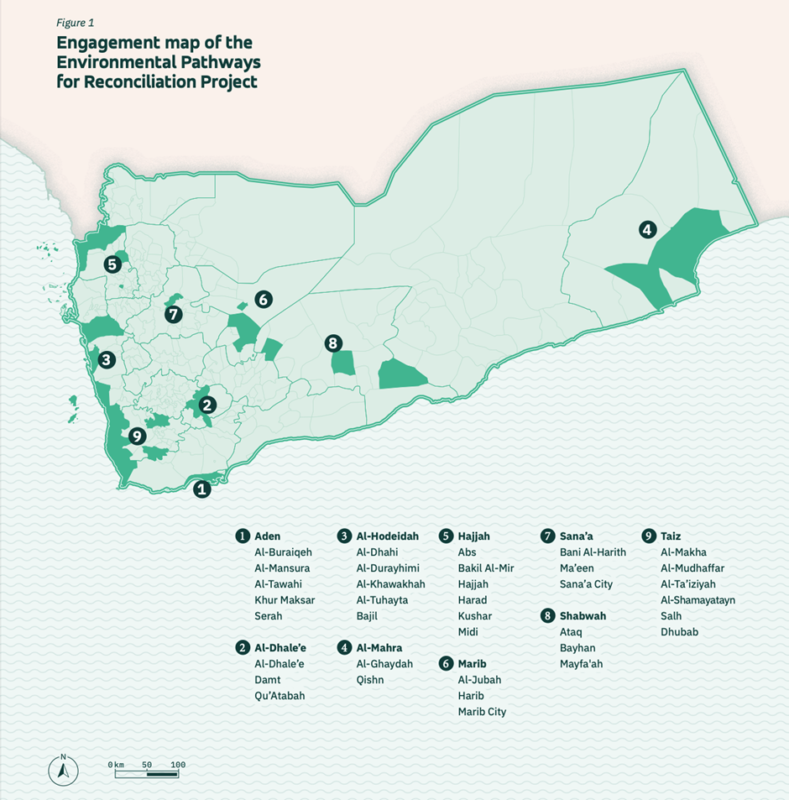
The results of the consultation confirmed how central environmental concerns were to any potential resolution of the war. 92% of respondents perceived a reduction in the availability of and access to natural resources in the past years. Critically, more than half said that they had experienced tensions or conflicts in their areas relating to environmental issues. 85% of those consulted considered it essential to address climate change in the short-term, with 60% insisting that environmental considerations be integrated into any conflict resolution in Yemen. Issues raised ranged from poor sanitation and access to clean water in IDP camps and informal settlements, desertification, flooding and droughts, and the decimation of local fishing.
While the initiative focused on Yemen’s general population, it was critical to not exclude decision-makers and local power holders in the dialogues. Suaad Abdullah says that it wasn’t always easy to convince local leaders to participate, but that the results when they did were often surprising and encouraging. She adds that even if local populations were acutely aware of how climate change was driving the conflict, in some cases it wasn’t always easy to get local elites to make the connection. But often she didn’t need to – communities themselves were ready and able to get the message across to local government and take advantage of rare opportunities for frank and open exchange with decision-makers. She recalls one instance in a community dialogue in Ma’rib –
“We had a real mix in the group, local sheikhs, academics, farmers. Some were confused and started arguing, asking what the connection was between climate and conflict. I wanted to reply to them, but before I could, a local farmer stood up and addressed the group. “If you don’t know about the link between the environment and peace,” he said, “it is a disaster, and you are driving conflict in this governorate.” The farmer went on to explain that years ago he was a rich man, earning 100,000 USD from his land cultivating and selling fruits and vegetables. With desertification in recent years his earnings were reduced to 20,000 USD. “What of someone who was already poor, what will they do, to whom will they turn?” he asked. At that moment I saw that the group understood, and even started to give their own similar examples – local conflicts over access to wells, all sorts of things. I understood then the power of these meetings.”
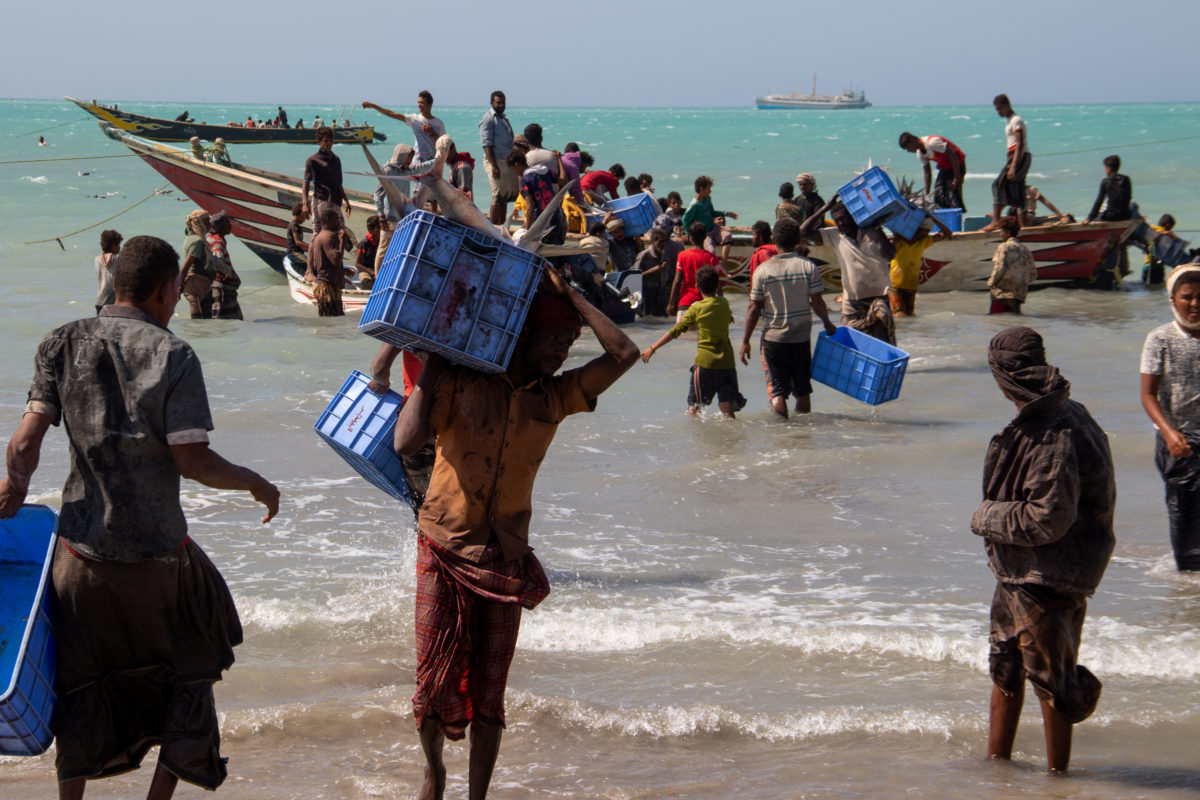
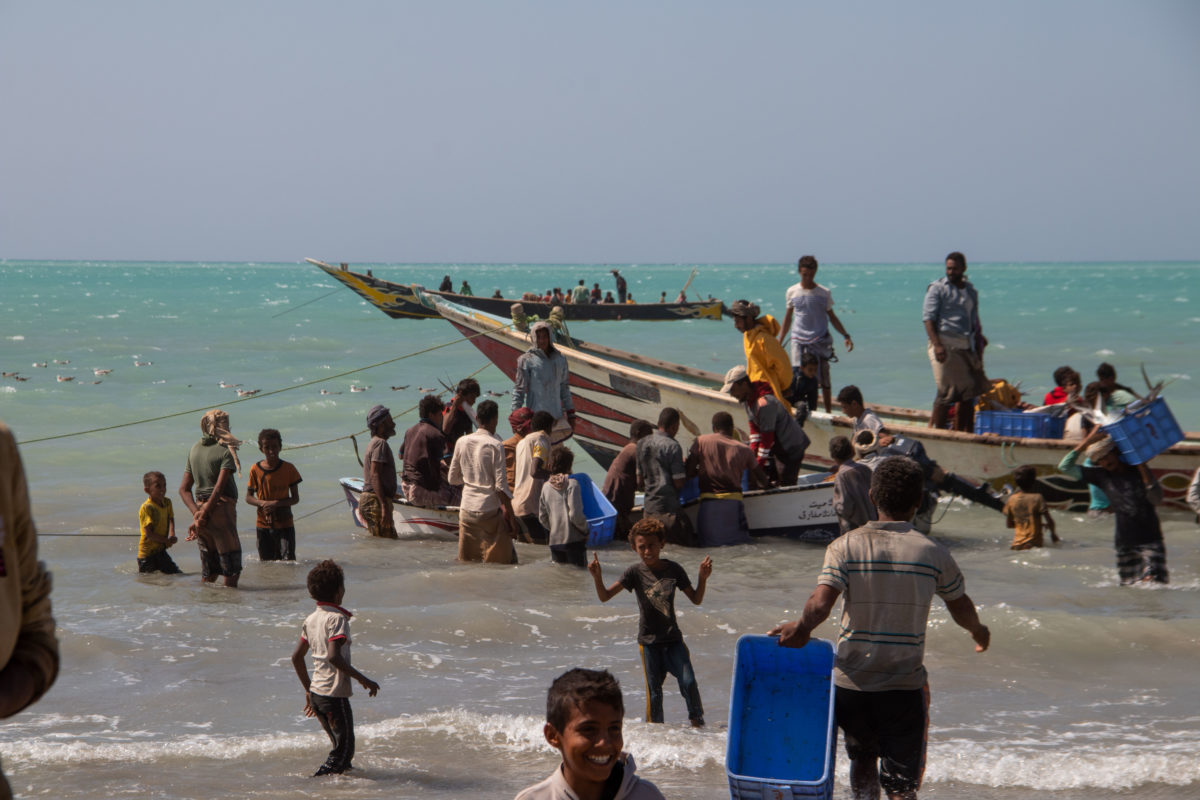
Local NGOs, tribal mediators, traditional elders and minorities were all able to take advantage of the shared space to connect and share resources, knowledge and contacts to help stimulate efforts to find solutions to shared environmental problems.
In Yemen, societal fragmentation and state collapse mean that environmental governance is virtually non-existent. “When it comes to preparations and capacity to manage the environment at the local and national level, for sure we are at zero,” Suaad says. In that context, instead of demanding for improved environmental governance as a precursor to sustainable peace, Environmental Pathways for Reconciliation works from the ground up, engaging the people most directly affected by the conflict and the environmental crises. After consultations across the country to understand the issues from a local perspective, the project continues its engagements at the governance level, to map solutions, connect these ideas to funding, and implement them on the ground.
It’s still early in the process, and there’s much work to be done, but already ideas are starting to surface: the use of clean fuel for cooking, green belts to fight desertification, local committees to mediate climate-related disputes, early warning systems, and the use of solar energy as an alternative to diesel and gas. The energy and passion is there, the challenge is only to direct and coordinate the huge potential of the collective intelligence of the Yemeni people. When organisations like the Institute are able to hold the space for local actors to come together and dialogue in a structured way, the possibilities are endless.
“In Al Mahrah, our commitment to protecting the environment, our people, and the sea knows no bounds. We stand ready to make sacrifices and take decisive action to safeguard our precious natural resources. But we recognize that we cannot do it alone. United as men and women committed to the betterment and safeguarding of our region, we stand ready to face the challenges ahead and forge a brighter future for Al Mahrah and its inhabitants.”
Radhwan Mohammed Saeed, a local fisherman from Al-Mahrah and participant in the Environmental Pathways for Reconciliation community dialogues.
Credits: Nazeh Mohammed, EIP 2023
Crossing the Gulf: Getting the Message to Power
The consultation in Yemen showed that while local communities may be experts on issues in their own regions, they don’t always possess the bigger picture at the broader level. Pushing for climate analysis when it comes to conflict resolution also means engaging institutions and governments.
Across the Gulf of Aden from Yemen, in Somalia, the Institute has been able to achieve notable progress in bringing climate change to the centre of the debate around peacemaking.
As in Yemen, Somalia grapples with the devastating impact of drought, flooding, desertification, biodiversity loss, sea level rises and extreme temperatures. These issues have wreaked havoc on Somali society and added further layers of complexity to local conflicts, giving rise to resource scarcity and competition, displacement and migration, livelihood disruption and humanitarian crises. In many cases these issues have made communities increasingly susceptible to recruitment by armed groups such as Al-Shabaab, clan militias, Ahlu Sunna Wa Al-Jama’a, and others.
Before the Institute began directly engaging with officials in Mogadishu, local government did not treat environmental issues as important conflict drivers. Three years ago, the programme responsible for climate issues was limited to a small desk in the prime minister’s office. Lack of coordination and at times competition between Somalia’s federal states meant that comprehensive approaches to climate were often complicated and stalled.
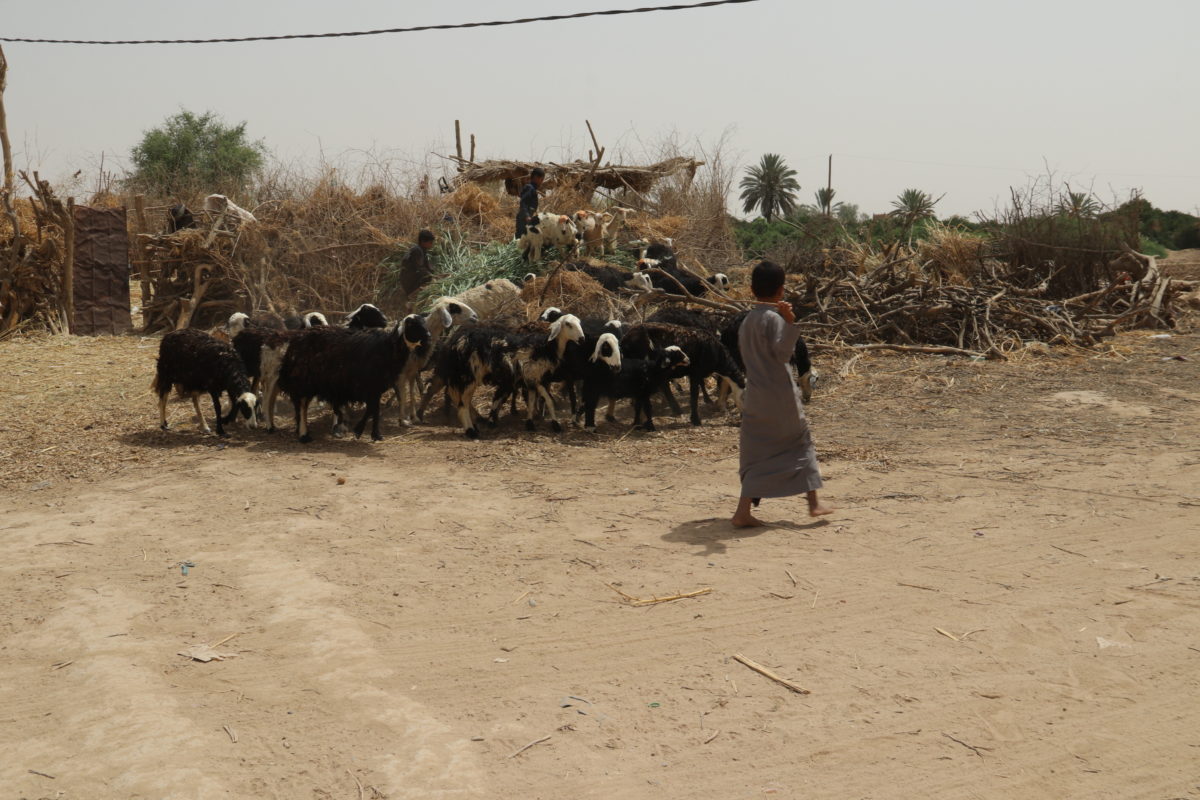
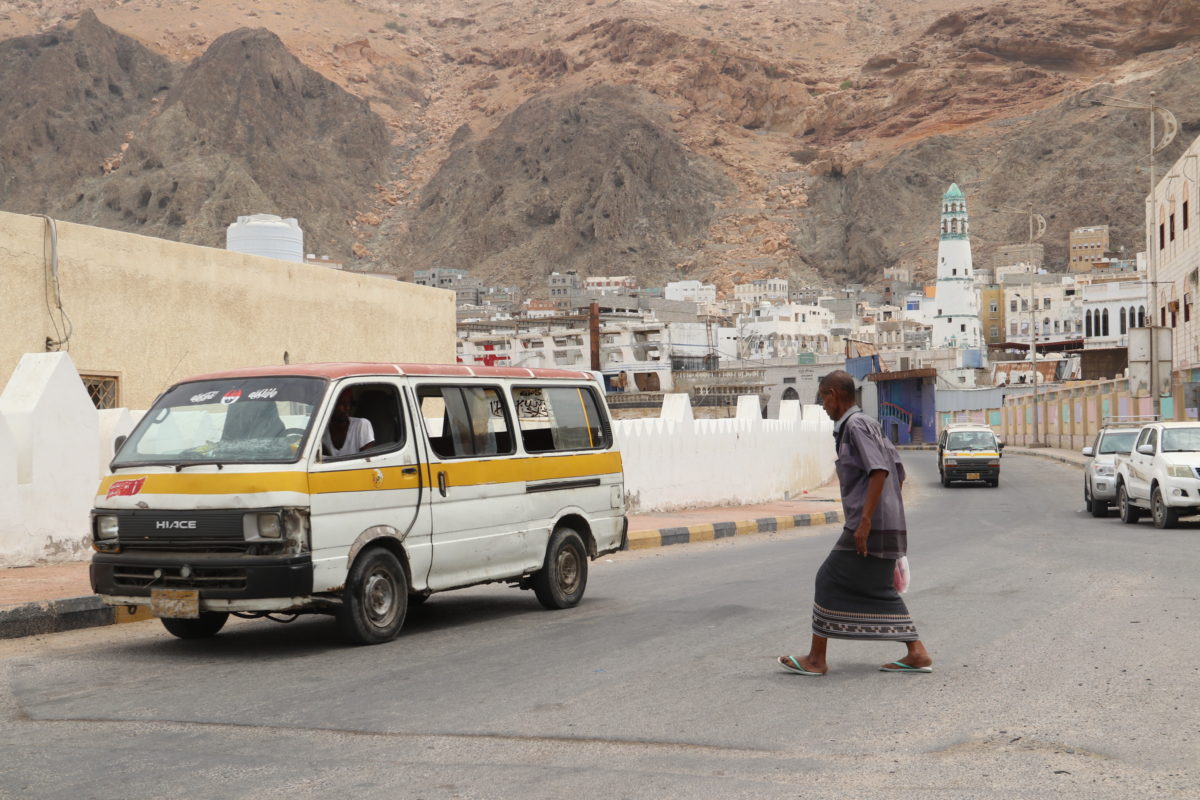
Engaging with governments on environmental matters
The process took time. Sensitising ministers about how to better engage on climate and conflict isn’t just about dealing with a lack of will or capacity. We are all collectively learning how to understand and tackle climate concerns today, and in many cases governments are also learning to adapt and require inputs not only from civil society, but also knowledge from other governments and international bodies.
With the support of the Federal Ministry of Environment and Climate Change of Somalia, the Institute facilitated three Cross-Ministerial Workshops. The workshops demonstrated the value of convening multiple governmental actors to discuss technical environmental matters, such as climate finance and climate security, as an entry point for dialogue and trust-building that can lead to greater cooperation in a context of political and institutional disagreement.
The direct engagement, coordination, and policy support that the Institute provided to federal and state-level actors, coupled with their active involvement in environmental peacemaking activities, have significantly shaped their understanding, capacity, and attitude towards addressing environmental and climate security risks. New policies implemented by different parts of the government now recognise the importance addressing these risks in collaboration with other actors who share similar mandates, notably the reviewed Nationally Determined Contributions to the Paris Climate Agreement.
Stepping up to the Challenge
Ensuring climate change is at the heart of peacemaking also requires financial support. Climate finance to help fragile and conflict-affected states mitigate the threat is still lagging far behind what it needs to be. In the cases of Somalia and Yemen, two of the most vulnerable countries, climate finance averaged only 2 USD per capita over the period 2014-2021.The situation is improving slowly, with global climate financing estimated at 1.3 trillion USD in 2023 – double that of 2019. But that’s still only 1% of GDP dedicated to a challenge that threatens humanity with civilisational collapse.
By 2031 it’s estimated that we’ll need to be putting at least 10 trillion USD into climate adaptation if we are to get anywhere close to staving off the worst impacts of ecological collapse. Conflict is often the driver of change, and the solutions arising from the frontlines of Yemen, Somalia and other countries facing the double crisis of climate change and armed conflict may yet lead the way for us all. But we need to be there to support them.
Somalia has for years been plagued by tensions and competition between Mogadishu and the regional government of Puntland to the North. Despite bitter conflict in the Galkayo Mudug region between the autonomous state of Puntland and neighbouring Galmudug state, (part of federal Somalia), severe drought in 2016 presented a rare opportunity for the two parties to cooperate. In response to the drought, authorities allowed herders from Galmudug state to bring livestock to graze deep inside Puntland territory.
Opportunities like that are rare. In this case, one was seized. It’s become a useful example of how efforts to confront climate change will now form part of any effort at peace building.
In 2024, on the occasion of the 10th Anniversary of the establishment of the European Institute of Peace, the Institute commissioned a series of articles about our work, interviewing staff members, senior advisors, and people who have worked with us in the past decade on conflict prevention and resolution in different areas of the world.
How best to communicate our work is not obvious. Discretion is often an essential ingredient to what we do, for example around dialogue and engagement with parties to conflict and their supporters. But we cannot afford not to communicate in an increasingly crowded media and public affairs environment, one in which political and public recognition is too low regarding the value and practical benefits of the work that we and our partners undertake. “What you are doing is great – why aren’t you telling more people about it?” is a typical reaction from partners that want to increase their support for us. Sharing these stories about the Institute’s work is of the ways in which we are responding to these requests.


You could be forgiven for missing the offices of the European Institute of Peace, tucked beside the Basque mission, on a quiet side street in the European district of Brussels. Only a stone’s throw from the enormous headquarters of the European Commission’s Directorate-General for International Partnerships, the organization’s modest 19th century stone building lacks the usual rows of flags and cold glass of the Commission’s office just down the hill. It cuts quite a different image. In fact, it’s not even part of the European Union. And that is sort of the point.
Officially, the European Institute of Peace is a ‘foundation’ under Belgian law. It maintains strong connections to grassroots actors on the ground, like an NGO. But it also has access to high level government circles, like an international organization. Uniquely, the Institute moves between worlds, operating in a space that includes both diplomats and social movements, armed rebels and humanitarians, scientists and artists, economists and activists.
An Idea Whose Time Had Come
In 2009 the late Martti Ahtisaari, former Finnish president and Nobel Peace Prize winner, called for the establishment of a ‘European Institute of Peace’. Foreign Ministers Alexander Stubb of Finland and Carl Bildt of Sweden took the idea a step further in 2010, submitting an informal discussion paper to Catherine Ashton, at the time High Representative of the European Union for Foreign Affairs and Security Policy. The paper captured a sentiment that traditional diplomacy, while by no means obsolete, was becoming increasingly limited in its capacity to mediate conflicts and seek out sustainable peace in today’s world. The fall of the Berlin wall may have brought the world closer together, but the globalisation of neoliberal norms which went with it also had a profound – and often disruptive – impact on how power would soon be distributed, both between and within states.
What Europe needed was a body closely connected to the EU and European states, but independent, and not bound by the bureaucratic and political constraints of Brussels. This new kind of organization would be able to engage with a broader range of state and non-state actors, both European and otherwise, through a greater variety of formal and informal means. It would bridge the gap between high-level politics and newer, less centralized and more complex ways that power moved in the world of conflict prevention and resolution.
After four years of consultations, studies and workshops — and with support from European diplomats, international organisations and conflict experts growing — on 12 May 2014 the vision finally became a reality and the European Institute of Peace was officially launched by the foreign ministers of its nine founding board members: Belgium, Finland, Hungary, Italy, Luxembourg, Poland, Spain, Sweden and Switzerland. The Institute was to be a centre of excellence in the understanding and praxis of conflict prevention and resolution, designing and engaging actively in peace dialogues, training mediators, and providing support to peacemaking efforts around the world. Not only would it assist conflicting parties outside Europe to find common ground, it would also serve as a bridge between Europe and the world, to share experiences, listen and learn.
It wouldn’t be easy. Around the time of the European Institute of Peace’s inauguration, Boko Haram kidnapped 100 schoolgirls in Nigeria, deadly clashes with ISIS rocked in Iraq, and pro-Russian separatists declared the independence of Donetsk and Luhansk in eastern Ukraine.
Different Vibes for Different Tribes
In a way, the somewhat austere, neoclassical stone exterior of the Institute offices is an apt metaphor for the way the organisation presents itself to official Brussels. It’s formal when necessary and versed in the diplomatic etiquette needed to ensure messages from the ground are heard at the top. That’s what the media might imagine conflict mediators do most of the time. But the Institute does much more than that: one of its unique strengths is the ability to interact with all kinds of actors on the ground, from marginalised communities to armed groups, from citizens’ movements to heads of government.
With the average age of staff a youthful 32, the European Institute of Peace’s office feels more like a technology start-up than a diplomatic organization. An entrepreneurial spirit has been part of the culture since the beginning. Staff were encouraged to experiment, be imaginative, and take risks in the pursuit of peace. Growing from a handful of Brussels-based staff, the Institute now has a permanent team of approximately 50 full-time personnel. They in turn support a global network of over 100 experts, advisors and local partners working in more than 20 conflict-affected regions over the past ten years.
Geopolitics headed in a worrisome direction during that first decade. The writing may have been already on the wall in 2014: that we were entering a period of significant upheaval, more challenging than we could have imagined.
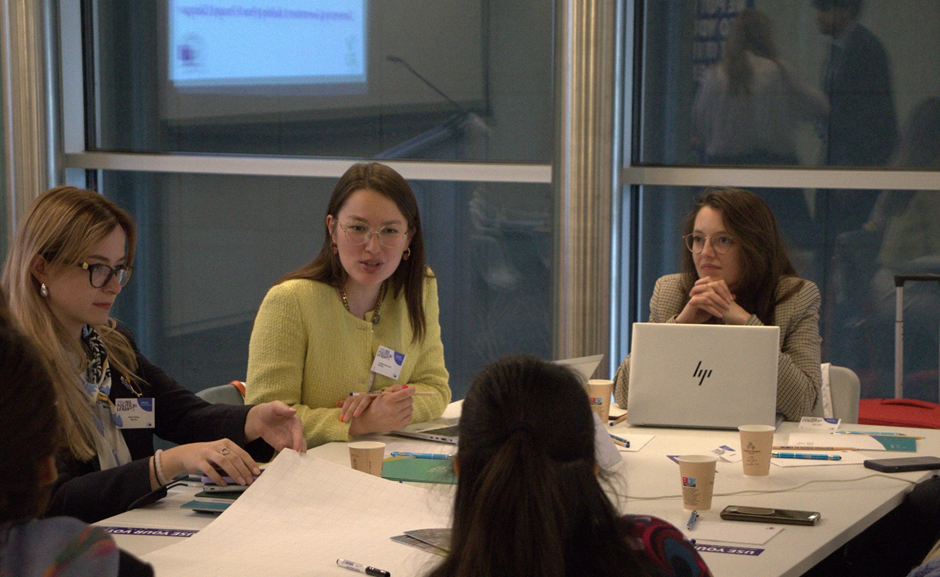
Brave New World
Standing at his desk trying to somehow make sense of the mosaic of coloured blocks that is his weekly meeting agenda, Michael Keating lets out a heavy sigh. It’s not just his dismay at his unending list of meetings with donors, diplomats, researchers, journalists, and civil society groups trying to navigate conflicts everywhere from Kyiv to Kinshasa. That’s nothing new for a man whose professional trajectory has included everything from finance to documentary film production to UN deployments: Afghanistan, Malawi, Israel, Palestine, New York, Geneva, Pakistan and Somalia, where he was Special Representative of the Secretary-General. He joined the Institute as Executive Director in late 2018.
Rather, his frustration is more at what he perceives to be uncertain political will to invest in peace and the shrinking space for organisations like the European Institute of Peace to operate. He can struggle to contain his exasperation when he looks out at what he sees as a world turning its back on dialogue and comprehensive approaches to conflict resolution in favour of hard security, defence, physical borders, inadequate humanitarian interventions, zero-sum politics and quick wins.
Active conflicts are at their highest levels in decades, and after a slow decline in the last 20 years, conflict-related deaths are dramatically increasing, not least as a result of the wars in Ukraine, the Middle East and Sudan. At the same time, the authority of the intergovernmental institutions set up to prevent and resolve wars has significantly diminished.
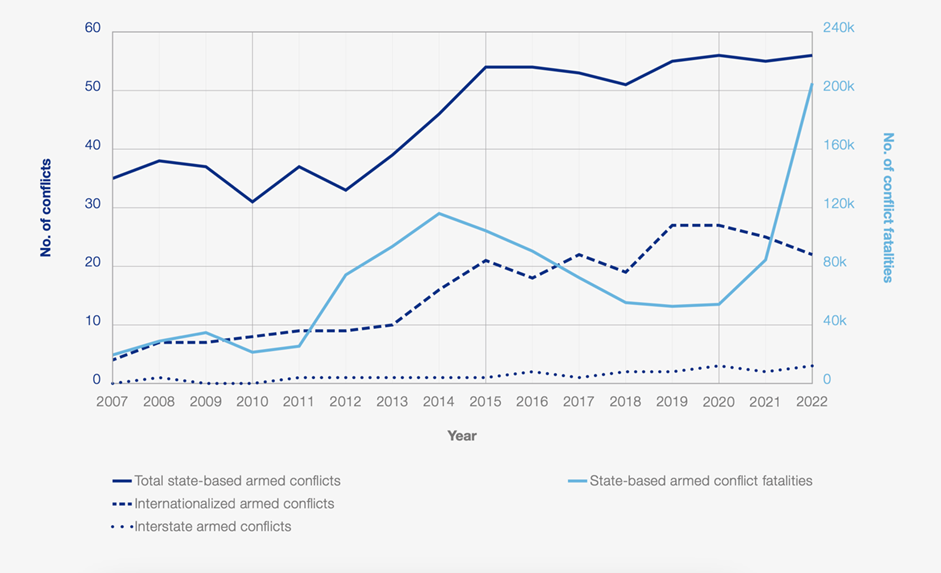
We might even look back with envy at the world when populism, social-media fuelled polarisation, AI, cyber-attacks, misinformation, disinformation and deep-fakes were not the pervasive problems they are today. A world less fragmented by armed, non-state groups, and where a full-scale land invasion of Europe’s eastern borders was still relatively unthinkable. Where there was respect for rules-based norms of international relations. Observers now speak of a ‘geopolitical recession’, where the “playbook for international relations, diplomacy and political good manners is being re-written”. For Europe, these challenges have increasingly played out at home.
Investing in Peace in Times of Conflict
As the world shuns multifaceted dialogue in favour of realpolitik and defence spending, the political will to invest in sustainable peace, and to support organisations like the European Institute of Peace, diminishes. Governments pour billions into defence spending but are disinclined to invest a fraction of that money for far less risky business of authentic dialogue and mediation. The reasons vary but often come down to “it’s not a priority” and “it’s just not realistic”. And when they do fund such work, they often want to see tangible or even immediate results, and conflict resolution can be a very slow process. How can you establish trust and build real relationships with partners on the ground when you may need to pull the plug on dialogue processes before they reach a sustainable conclusion?
The Institute’s level of unrestricted funding has gone from 46% of its total in 2015 to just 15% today. This reflects success in crafting and projects but limits its scope to take initiative, respond to crises and catalyse larger efforts to prevent and resolve violent conflict. Constantly running programmes on a short-term, hand to mouth, project by project basis is simply not sustainable, for either the Institute and its peer organisations, for conflict affected populations, and for donors that demand sustainable results.
The temptation is to market activities not on the grounds of resolving grievances, but rather because they could serve a particular political end, such as controlling immigration, counter terrorism, accessing resources or securing international shipping lanes. These objectives are politically compelling but when they displace the goal of advancing and securing sustainable peace as an end in itself, the result is an approach that is ineffective at achieving its intended political aims – and that is morally questionable in the way it instrumentalises human relations. There is a need to make the case for reversing this relationship, that politics can serve peacemaking, not the other way around.
The European Institute of Peace is uniquely placed to step in and provide practical support to a variety of actors to prevent and resolve violent conflict – and in particular to support the European Union to fulfil its core mission to promote the rule of law and lasting peace in an increasingly geopolitical and contested environment. To do so, it needs predictable and long-term support to do what it was designed to do and to fulfill the founding vision.
In conflict resolution, the odds are rarely in your favour. But sometimes it’s when the odds are stacked against you that pushing for peace is most important. The risks of doing nothing are simply too great, and relationships built and maintained at the darkest moments repeatedly prove their value when circumstances create the possibility, gradually or suddenly, of political progress. What is unrealistic is not so much investing adequately and consistently in the painstaking business of peacemaking. Rather, it is to expect political breakthroughs or peaceful and secure outcomes if we are not prepared to make that investment.
The role of precious resources in shaping conflict prevention and resolution has been thrust centre stage by the new US Administration’s approach to ending wars. “The Ukraine minerals deal is a perfect metaphor for Trump’s foreign policy” as one headline puts it.
The importance of the political economy and ‘following the money’ has long been recognised by those in the business of conflict resolution. This is often related to the role natural resources can play in conflict dynamics, whether gold in Sudan, diverse minerals in the Great Lakes, or oil and gas in other politically fragile or violent settings.
But the role of the private sector in dialogue, let alone negotiations and implementable plans to end conflict is poorly defined. In an era where transactional deals seem to take on an increasingly important role in peace making, agreeing on some parameters for engagement seems more important than ever.
This was evident at an event entitled “Forgotten No More: Addressing the Crisis in the Democratic Republic of the Congo” at last week’s Munich Security Conference, a conversation between Michael Keating, Executive Director of the European Institute of Peace, and Felix Tshisekedi, President of the Democratic Republic of Congo.

The eastern city of Bukavu was falling to the March 23 Movement with Rwanda Defence Forces support as he talked, heralding an even greater humanitarian crisis than already exists. In a discussion about the current situation, the President spoke about military developments on the ground, diplomatic efforts to end the fighting and dwelt at length on the role of resources. He put recent events firmly in a larger context: decades of abusive exploitation of the DRC’s natural wealth.
“People are suffering because they happen to live in an area rich in resources” he said, mentioning tungsten, cobalt, tin, copper, nickel, titanium and “blood coltan”. States and corporations are turning a blind eye to if not incentivising illicit supply chains.
“Remaining silent risks complicity” said the President, adding “We took Apple to court not because we want to punish it but to draw attention to the problem”. His point was that if there was political will, this could be addressed, if not stopped, in the process sharpening accountability for the ongoing violence, whether of states, companies and consumers.
He pointed to technology that allows identification of the exact origin and movement of minerals and the need for transparent controls on companies. Revenues should be generated to create jobs and invest in economic development, not just in armed forces.
The footprint of the private sector was discussed at another event, “Peace in Pieces, Whatever Happened to Smart Approaches to Peace and Security?” co-hosted by the Institute with APCO . This is likely to expand as competition for resources relating to the green transition, food security and economic growth intensifies.
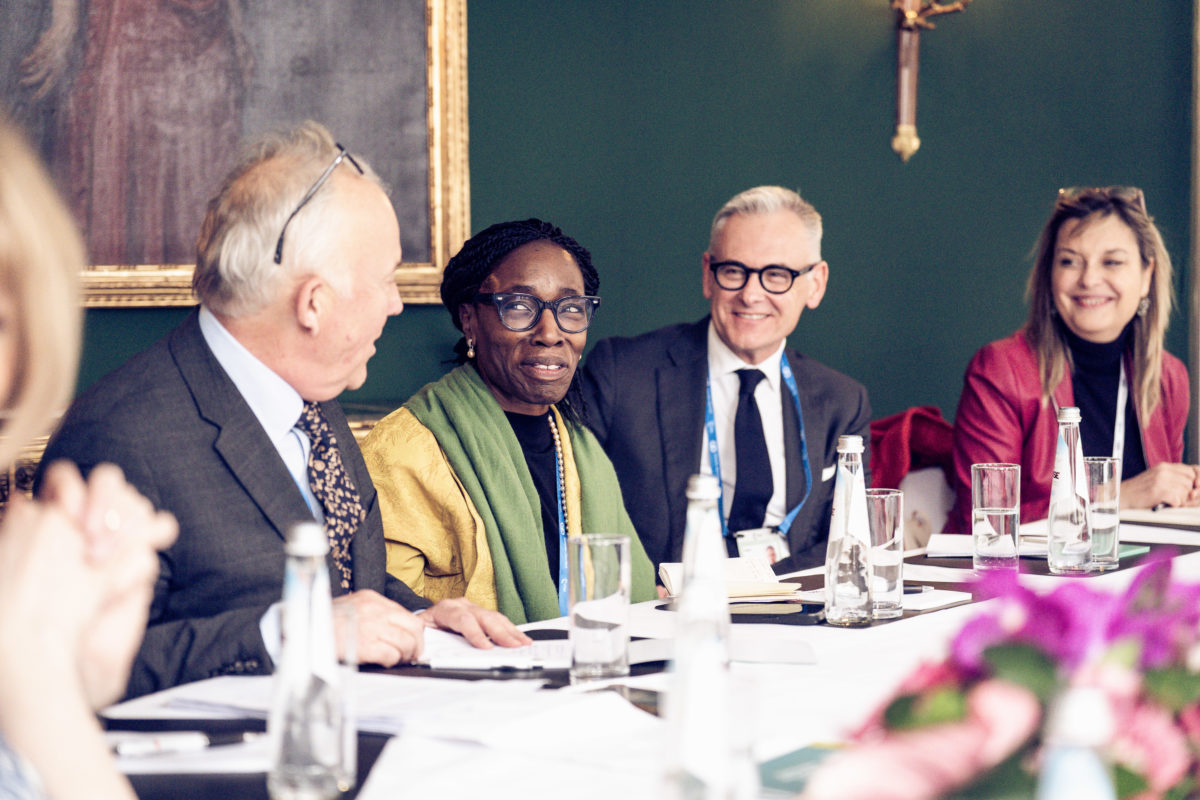
With the number of conflicts and people being killed and displaced around the world rising rapidly, the issue is whether responsible corporations are willing to play a role not just in peacebuilding and post conflict reconstruction – where there are already many positive examples – but in prevention and resolution of violent conflict. And if so, what?
Could corporate risk assessment and early warning capacities be brought into play? Can business catalyse or support dialogue, or be more involved in the definition of agreements to encourage peace dividends? Is there scope for more deliberate polylateral fora that include business, governments and civil society to address specific crises? Should commitment to a set of principles and to ‘doing no harm’ be the prerequisite for corporate engagement in conflict resolution?
For western companies, these issues are becoming more pressing. The US Administration’s foreign policy now focuses on transactional interventions to secure economic interests and generate profits – even at the expense of long-standing alliances, shared values and the rule of law. This applies to space, critical waterways, the Arctic and other resource and mineral rich areas, whether Ukraine, the Middle East and no doubt Sudan and the DRC.
In this strange new era, with so many assumptions being challenged, new centres of power emerging and the rules-based order under assault, creativity and principled realism are needed including from the private sector to arrest and reverse levels of violence and to promote stability, peace and human dignity. Watch this space.
In December 2024, the European Institute of Peace concluded a series of unilateral meetings to discuss the status of environmental governance in Yemen and explore potential pathways for environmental dialogue and cooperation with technical and political representatives of the Ministry of Water and Environment (MOWE) and the Southern Transitional Council (STC). The “Technical Meetings on Climate and Environmental Peacemaking in Yemen” served to discuss approaches to addressing environmental issues in a way that contributes to conflict resolution and prevention. Together with the Institute, the delegations identified critical issues and geographic areas of priority to enhance environmental governance and cooperation within the Internationally Recognized Government of Yemen (IRGY).
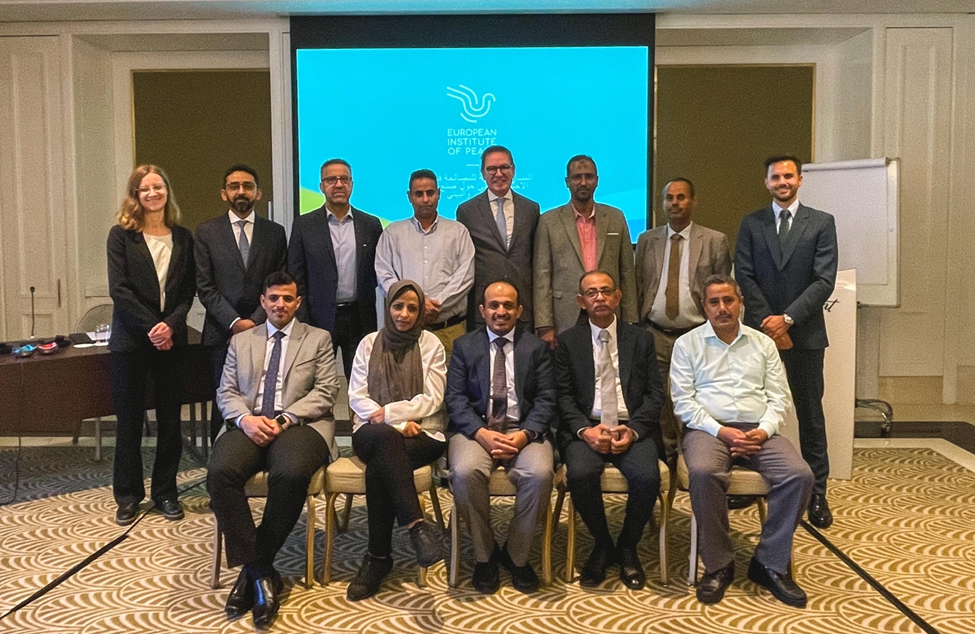
Delegates representing the Internationally Recognized Government of Yemen through the Ministry of Water and Environment at the First Technical Meeting on Climate and Environmental Peacemaking in Yemen, Amman, August 2024
Environmental impact of the conflict
Over the last decade, political crises in Yemen have escalated into full-scale, internationalized war. The conflict has become increasingly complex and intractable. It has had profound humanitarian, economic, and societal impacts, which also have harmed the country’s natural environment. Military activity has caused direct environmental damage, while other pressures such as the over-extraction of groundwater, challenges in public environmental management, and the escalating effects of climate change, have further intensified environmental issues. Coupled with a rapid population growth, these factors have led to large-scale environmental degradation, including the depletion of water resources, desertification of agricultural land, deforestation, and land and water pollution.
While the environmental consequences of the conflict are often overlooked in high-level discussions about peace and security, they leave a crucial imprint on the country’s social fabric. As natural resources become increasingly scarce, competition over water, land, fuel, and other essential resources intensifies. This affects individual livelihoods and community resilience to conflict and climate, undermining efforts to achieve sustainable peace and reconciliation. In an extensive consultation conducted by the Institute across nine governorates in 2023, more than half of respondents reported tensions and disputes linked to environmental issues in their area.

Delegates representing the Southern Transitional Council at the First Technical Meeting on Climate and Environmental Peacemaking in Yemen, Amman, August 2024
Environment and peace
Addressing environmental risks as part of conflict resolution and prevention efforts is not only key to reducing resource-related or degradation-driven tensions but can also serve as an entry point for enhanced collaboration, improved governance, and trust-building. Responding to these environmental risks through technical collaboration, data sharing, institutional capacity-building, and joint policy development can provide opportunities to foster dialogue and mutual understanding. The Institute’s engagement at the national level seeks to leverage shared environmental concerns as a new avenue for peace, framing discussions around common interests.
The first two rounds of unilateral meetings evolved from broad exchanges on environmental concerns and priorities into in-depth discussions on the technical, political, and administrative dimensions of environmental governance in Yemen. The delegates explored prevailing grievances and challenges related to natural resources management, risks arising from climatic change and demographic shifts, as well as structural, political, and financial constraints that obstruct effective responses. The discussions concluded with reflections on strengthening governmental cooperation, improving environmental governance, and fostering trust through collaborative environmental initiatives.
About the project
The Environmental Pathways for Reconciliation (EPfR) project aims to contribute to sustainable peace in Yemen by engaging different strata of the Yemeni society in environmental dialogue and cooperation. Through its bottom-up and inclusive approach, the project amplifies Yemeni voices in political and peace discussions, using environmental issues as entry points and elements for peace. By conducting consultations and facilitating dialogues at the community, governorate, and national levels, the project supports Yemenis to identify solutions to environmental and climate security risks with a peacemaking approach. The EPfR project is implemented by the Institute with support from the German Federal Foreign Office and is part of the Weathering Risk Peace Pillar led by adelphi.